
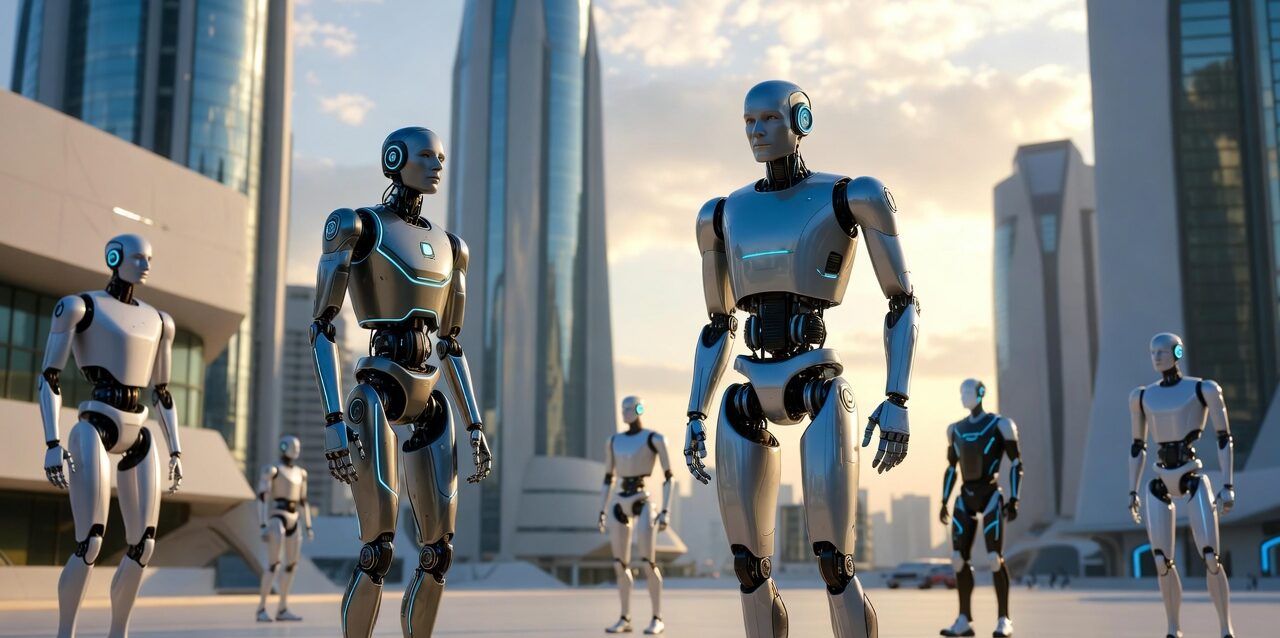
Robots Reimagined: AI-Powered Humanoids and the End of Labor Shortages
From Industrial Arms to Humanoid Companions and Ubiquitous Helpers
As of February 2026, the global robotics market exceeds $50–60 billion annually, dominated by industrial arms in manufacturing and logistics. Humanoid prototypes (e.g., Tesla Optimus, Figure 01/02, Boston Dynamics Atlas) demonstrate rapid progress in dexterity, AI integration, and mobility, while service robots grow in healthcare, retail, and homes. Market forecasts project explosive growth: humanoid robots alone could reach $18–20 billion by 2030 (CAGR ~40%), with broader robotics markets scaling significantly.
This case study synthesizes credible forecasts from Morgan Stanley, MarketsandMarkets, ABI Research, Deloitte, IEEE surveys, and expert predictions (e.g., Elon Musk, Figure AI) to outline trajectories for robotics over the next 15 years — driven by AI convergence, cost declines, and labor shortages.
1. Near-Term (2026–2030): Pilot to Early Commercial Scale — AI-Enhanced & Collaborative Robots
- Humanoid Deployment Accelerates
Early commercial pilots expand in factories (e.g., BMW with Figure, automotive assembly with Tesla Optimus). Humanoids handle repetitive, unsafe, or precision tasks: picking, packing, assembly. Shipments ramp to ~100,000–200,000 units annually by 2030, with prices dropping to $50,000–$150,000 range. Cobots (collaborative robots) integrate deeper with humans via advanced AI for safe interaction. - Service & Healthcare Growth
Robots enter hospitals, elderly care, and hospitality: monitoring, medication delivery, mobility assistance, and basic companionship. Soft robotics and AI enable gentler handling. Home service bots (cleaning, cooking aids) become more capable and affordable. - AI as Core Enabler
Large language models + computer vision give robots contextual intelligence, natural interaction, and adaptability. Edge computing reduces latency; 5G/6G supports remote operation and swarms.
2. Medium-Term (2030–2035): Widespread Integration — Humanoids in Workplaces & Homes
- Humanoids Become Commonplace
Millions of units deploy: 8–10 million working humanoids in the U.S. alone by mid-2030s (Morgan Stanley). They shift from novelty to normal co-workers in manufacturing, logistics, retail, and construction. Prices fall further ($20,000–$50,000 range); AI enables complex tasks (e.g., cooking, caregiving, repairs). - Sector-Specific Breakthroughs
Healthcare: robots assist with lifting, bathing, and companionship for aging populations. Logistics & agriculture: autonomous systems address labor shortages. Defense: robotic soldiers and reconnaissance units proliferate. Swarm robotics and soft bots enable new applications (disaster response, inspection). - Societal & Regulatory Shifts
Human-robot collaboration norms emerge; regulations address safety, ethics, and job displacement. Retraining programs expand as automation impacts wages and occupations.
3. Long-Term (2035–2040): Ubiquity & Symbiosis — Billions of Robots & General-Purpose Helpers
- Mass Adoption & Billion-Scale Projections
Optimistic forecasts (Elon Musk, Brett Adcock) suggest hundreds of millions to billions of humanoids globally by 2040 — potentially 1–10 billion in extreme scenarios. They perform mundane, risky, or repetitive tasks at scale, making labor “optional” in many domains. General-purpose humanoids handle vast arrays of household and professional work. - Advanced Capabilities
Full AI symbiosis: robots with near-human cognition, emotional responsiveness, and adaptability. BCI integration or advanced interfaces enable seamless control. Bio-inspired designs, self-repair, and energy efficiency mature. Robots in space exploration, elder care, and personal assistance become normalized. - Economic & Social Transformation
Robotics reshapes economies: addressing demographic declines, boosting productivity, but risking inequality. New industries (repair, maintenance, programming) emerge; universal basic income or policy responses address displacement.
Key Robotics Types by 2040 (Illustrative Examples)
- Industrial Humanoids — Factory assembly, heavy lifting, precision tasks (e.g., Optimus successors).
- Service & Care Robots — Elderly assistance, healthcare support, hospitality (gentle, empathetic designs).
- Home Companions — Household chores, companionship, child/elder monitoring.
- Specialized Bots — Swarms for search/rescue, defense units, agricultural workers.
Risks & Societal Shifts
- Job Displacement & Inequality — Millions of roles automated; wage impacts could reach hundreds of billions annually.
- Ethics & Safety — Weaponized robots, privacy from constant monitoring, over-reliance on machines.
- Regulation & Access — Premium tech favors wealthy; global standards needed for safety and equity.
- Human Identity — Blurring lines between human and machine work; potential loss of purpose.
Bottom Line
By 2040, robotics evolves from specialized tools to ubiquitous, AI-powered, general-purpose companions — with humanoids potentially numbering in the hundreds of millions to billions. The dominant paradigm becomes human-robot symbiosis — amplifying human capabilities, addressing labor shortages, and transforming industries from manufacturing to caregiving. Robotics won’t replace humanity; it will redefine labor, companionship, and daily life in an era of abundance and adaptation. The future isn’t robots taking over — it’s robots enabling us to do more, live longer, and focus on what truly matters, provided society navigates the ethical and economic challenges wisely.