
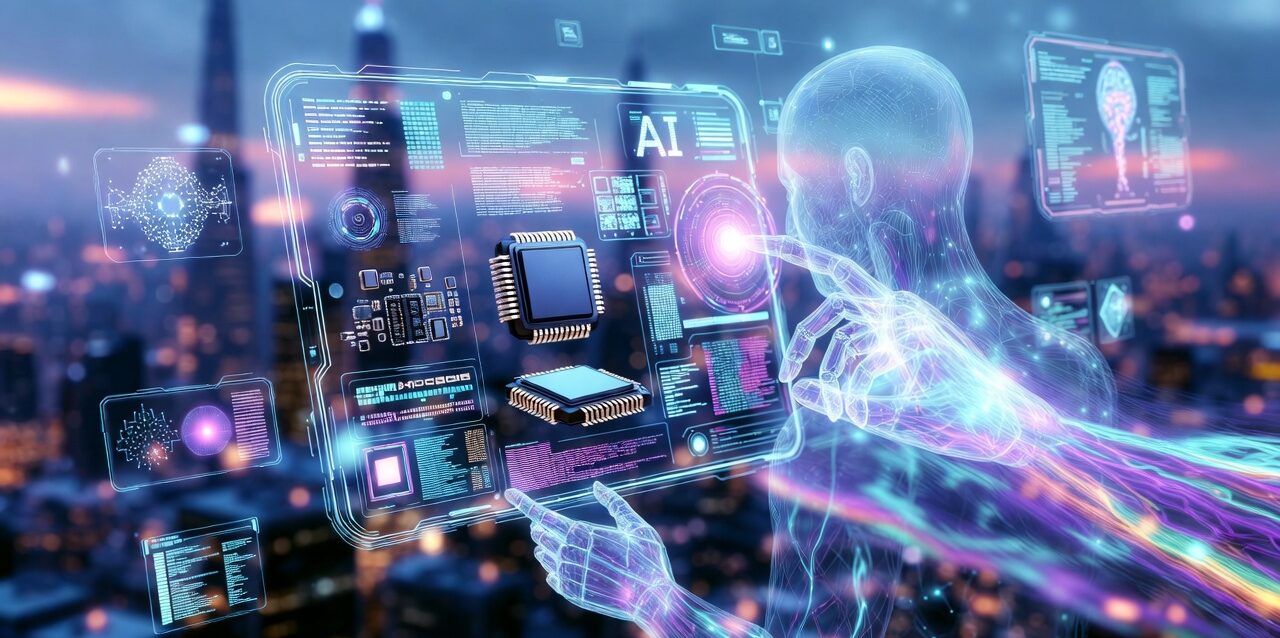
The Computer Future: When Silicon Fades and Intelligence Becomes Ambient
From Silicon Limits to Quantum, Neuromorphic, Optical, and Ambient Intelligence
As of February 2026, classical computers — dominated by silicon-based CPUs/GPUs — continue to follow Moore’s Law slowdowns, with transistor scaling nearing physical limits. The global computing market (hardware, cloud, AI accelerators) exceeds $1 trillion annually, driven by AI training, data centers, and edge devices. Personal computers remain laptops/desktops, but mobile, wearables, and cloud shift the focus.
By 2040, computers transform dramatically: quantum systems deliver exponential speedups for specific problems, neuromorphic chips mimic brain efficiency for AI, optical/photonic computing breaks energy barriers, and ambient/ubiquitous computing makes devices invisible and always-on. Classical silicon persists for everyday tasks, but hybrid architectures dominate.
1. Near-Term (2026–2030): Classical Peak + Quantum/Neuromorphic Pilots
- Classical Computing
Silicon chips reach ~2–3 nm nodes; 3D stacking, chiplets, and specialized accelerators (e.g., AI TPUs, NPUs) drive performance. Personal computers become thinner, more efficient, with AI everywhere (Copilot-style assistants, local inference). Edge AI grows; laptops/desktops handle complex tasks offline. - Quantum Emergence
Noisy Intermediate-Scale Quantum (NISQ) systems (1,000–10,000 qubits) achieve limited advantage in simulation, optimization, and chemistry. Commercial use in pharmaceuticals, finance, and materials begins ~2030–2035. Fault-tolerant quantum likely post-2030. - Neuromorphic & Efficient AI
Brain-inspired chips (e.g., Intel Loihi successors, IBM TrueNorth evolutions) gain traction for low-power AI at edge/IoT. Early adoption in robotics, autonomous systems, and always-on sensors.
2. Medium-Term (2030–2035): Hybrid Architectures & Broad Advantage
- Quantum Advantage
Broad quantum advantage (2030–2040): fault-tolerant systems (hundreds–thousands logical qubits) solve real problems faster/cheaper than classical supercomputers (e.g., drug discovery, cryptography, optimization). Hybrid quantum-classical systems become standard in cloud. - Neuromorphic Maturity
Neuromorphic processors achieve brain-like efficiency (orders of magnitude lower power for AI tasks). Used in edge AI, robotics, autonomous vehicles, and low-power IoT. Market grows rapidly for always-on, adaptive intelligence. - Optical & Photonic Advances
Optical computing prototypes scale for AI acceleration (light-based matrix multiplications). Co-packaged optics (CPO) become standard in data centers for ultra-fast, low-energy interconnects. - Personal Devices
PCs evolve into lightweight, modular, AI-centric devices (foldables, AR glasses, ambient screens). Cloud + edge hybrid dominates; “personal computer” concept blurs.
3. Long-Term (2035–2040): Ambient, Symbiotic, & Post-Silicon Computing
- Ubiquitous & Ambient Intelligence
Computing becomes invisible: embedded in environments, wearables, implants, and brain-computer interfaces (early non-invasive BCI). Devices anticipate needs; “personal computer” is a persistent digital presence (cloud + local agents). - Post-Moore Paradigms
Quantum scales to fault-tolerant, full-scale systems (post-2040 dominance in certain domains). Neuromorphic/optical hybrids power efficient AI. Potential for DNA storage, molecular computing, or spintronics emerge. - Societal Impact
Exponential compute enables breakthroughs (personalized medicine, fusion, climate modeling). Economic value from quantum alone could reach $450–850 billion by 2040. Personal computing shifts to thought-controlled, seamless interfaces.
Key Computer Types by 2040 (Illustrative Examples)
- Classical Hybrid — Everyday devices (laptops, phones) with massive AI acceleration.
- Quantum Cloud — Solves intractable problems (chemistry, optimization, cryptography).
- Neuromorphic Edge — Ultra-low-power AI in wearables, robots, sensors.
- Optical Accelerators — Data centers for energy-efficient, high-speed AI training.
- Ambient Interface — No “device” — computing is everywhere, context-aware.
Risks & Societal Shifts
- Inequality — Quantum/neuromorphic access favors institutions/wealthy nations.
- Security — Quantum breaks current encryption; post-quantum crypto essential.
- Energy & Environment — Data centers strain power grids; neuromorphic/optical promise efficiency.
- Privacy & Control — Ambient computing risks surveillance; ethical AI governance critical.
Bottom Line
By 2040, computers evolve from silicon boxes to hybrid, ubiquitous, and exponentially powerful systems. The dominant paradigm becomes converged classical-quantum-neuromorphic-optical computing — classical for general use, quantum for hard problems, neuromorphic for efficiency, and optical for speed/energy. Personal computing becomes ambient and seamless; devices fade as intelligence integrates into life. The future isn’t faster laptops — it’s a world where computation solves impossible problems, powers abundance, and redefines human capability, provided we manage power, equity, and ethics wisely.