The Vertical Future: Sustainable Supertalls and Living Towers by 2040
From Supertall Icons to Sustainable, Smart, and Vertical Urban Ecosystems
As of February 2026, the world has over 200 buildings taller than 300 meters (supertall) and a handful exceeding 500–600 meters (megatall), with Burj Khalifa (828 m) still the tallest. Skyscrapers symbolize economic power, urban density, and architectural ambition, but face criticism for energy use, wind loads, material carbon footprints, and social isolation at height. Global construction of tall buildings continues, especially in Asia (China, India, Southeast Asia), the Middle East (Saudi Arabia, UAE), and emerging U.S. markets (Miami, Austin, New York).
By 2040, skyscrapers evolve beyond height records toward sustainable, smart, mixed-use vertical cities — integrating green tech, regenerative design, AI/IoT intelligence, and self-sufficient systems to address climate, population, and resource pressures.
1. Near-Term (2026–2030): Sustainable Supertalls & Smart Integration
- Height Growth & Regional Leaders
Several supertall projects complete or advance: Jeddah Tower (1,000 m, Saudi Arabia) potentially resumes, Burj Azizi (Dubai, 725 m), and others in China/India. North America sees growth in Miami, Austin, Toronto, and New York (Hudson Yards, Spiral, etc.). Asia dominates with hundreds of 150 m+ towers added. - Sustainability as Standard
Net-zero and carbon-neutral designs become mandatory in many markets: high-performance façades, dynamic shading, double-skin envelopes, building-integrated photovoltaics (BIPV), and mass timber hybrids reduce embodied carbon. Tall timber grows for mid-high rises; engineered wood lowers emissions. - Smart & Connected Buildings
IoT, AI, and sensors enable real-time energy management, predictive maintenance, occupant comfort, and adaptive lighting/HVAC. Mixed-use (residential, office, retail, hotels) dominates to maximize land efficiency and vitality.
2. Medium-Term (2030–2035): Regenerative & Vertical Urbanism
- Regenerative Design
Buildings generate more energy than they consume (net-positive): solar, wind, geothermal, and kinetic systems. Vertical farming, green walls/roofs, rainwater harvesting, and greywater recycling integrate for self-sufficiency. Nature-based solutions combat urban heat islands. - Mixed-Use & Vertical Cities
Skyscrapers function as “vertical neighborhoods” — offices, homes, schools, parks, clinics, and retail in one structure. Proto-arcologies appear: self-contained ecosystems with internal circulation, reduced external dependency, and community focus. - Materials & Construction Innovation
3D printing, modular/prefab, and advanced composites (graphene, aerogels, ultra-high-strength concrete/steel) enable faster, lighter, greener builds. Prefabrication cuts waste and time.
3. Long-Term (2035–2040): Mega-Structures & Adaptive Vertical Ecosystems
- Megatall & Arcology Concepts
1 km+ towers become feasible (Jeddah Tower successors, Neom proposals). Visionary arcologies (self-sustaining mega-buildings) move closer to reality in dense regions — housing thousands, with internal ecosystems (farms, energy, waste recycling). - Adaptive & Resilient Design
Buildings respond to climate: adaptive façades, flood-resistant bases, seismic damping, and modular retrofits. AI/IoT enables dynamic reconfiguration (space use, energy allocation). - Global Distribution
Asia leads in sheer numbers (China, India, Southeast Asia); Middle East pushes height/innovation; North America focuses on retrofits and sustainable upgrades; Europe emphasizes green retrofits.
Key Skyscraper Trends by 2040 (Illustrative Examples)
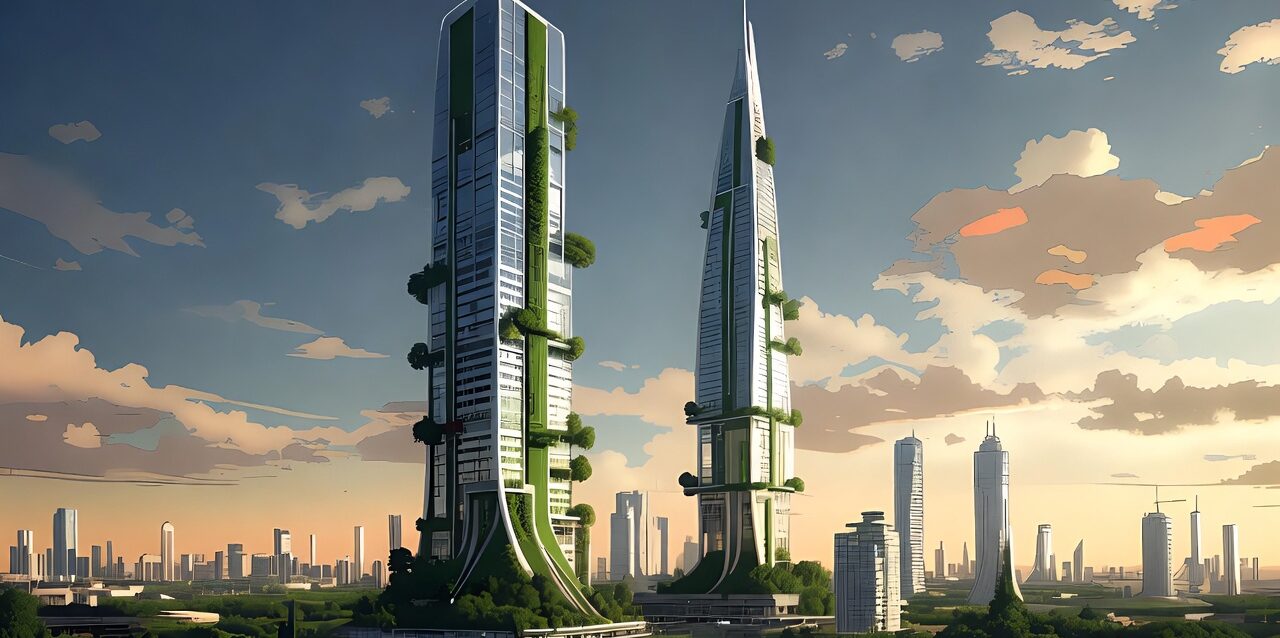
- Sustainable Supertall — Net-positive energy, vertical farms, green atria, smart skin.
- Mixed-Use Vertical City — Offices, homes, schools, parks in one tower; reduced commuting.
- Adaptive Megastructure — Modular, reconfigurable floors; climate-resilient base.
- Regenerative Tower — Generates energy, recycles water/waste, sequesters carbon.
Risks & Societal Shifts
- Inequality — Ultra-tall luxury towers widen divides; vertical slums possible without policy.
- Environmental Trade-Offs — Construction emissions remain high; embodied carbon must drop.
- Wind & Structural Challenges — Supertall sway, damping, and material limits.
- Cultural & Social — Isolation at height; need for community design.
Bottom Line
By 2040, skyscrapers evolve from height-driven icons to sustainable, smart, and regenerative vertical ecosystems. The dominant paradigm becomes mixed-use, net-positive, and adaptive tall buildings — integrating green tech, vertical farming, AI intelligence, and self-sufficiency to address urbanization, climate, and resource limits. Skyscrapers won’t just pierce the sky; they’ll sustain life within it — becoming efficient, resilient urban cells in denser, greener cities. The future is not taller for tallness — it’s smarter, kinder, and more integrated with people and planet.