
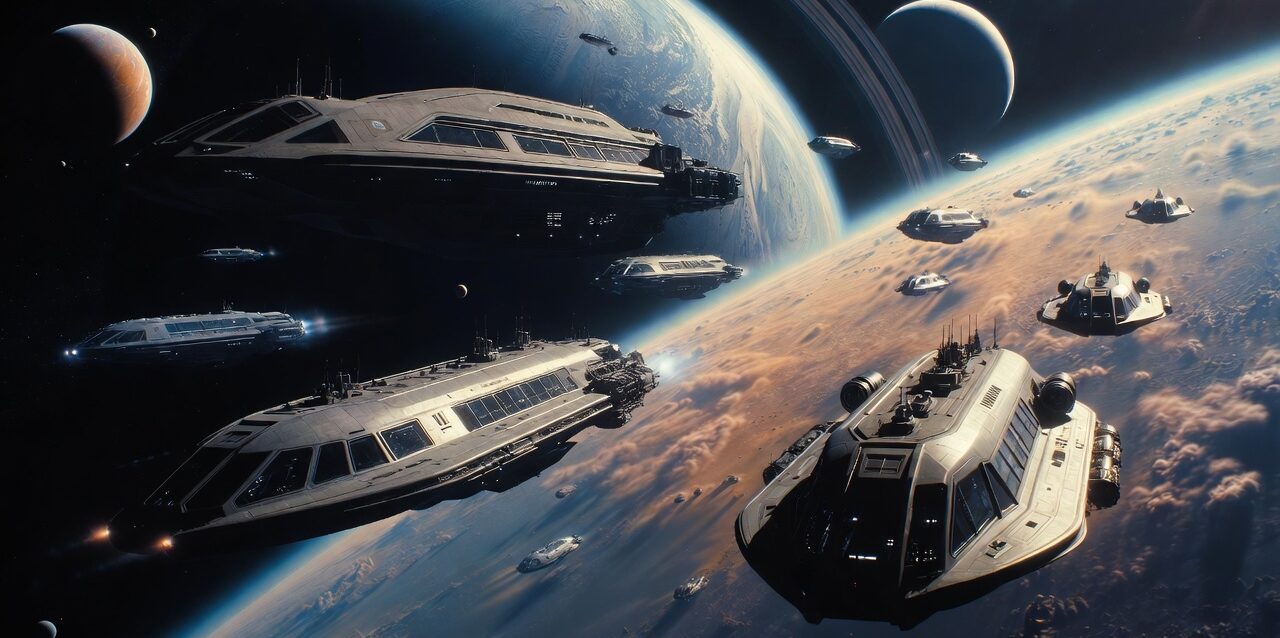
From Falcon to Starship: The Transformation of Human Spaceships by 2040
From Reusable Rockets to Crewed Deep-Space Vessels and Multi-Planetary Fleet
As of February 2026, human-built spaceships are in a transitional era. Reusable launch vehicles like SpaceX’s Falcon 9 and Blue Origin’s New Glenn (first orbital flight in 2025) dominate low-Earth orbit access. Crewed spacecraft remain limited: NASA’s Orion (Artemis program), SpaceX’s Crew Dragon, Russia’s Soyuz, China’s Shenzhou, and emerging designs like Boeing Starliner. The focus is on returning to the Moon (Artemis), developing heavy-lift capabilities (Starship, New Glenn), and laying foundations for Mars.
By 2040, human-built spaceships evolve dramatically — from reusable launchers to fully reusable deep-space vessels, crewed landers, and interplanetary transports. Reusability, in-situ resource utilization (ISRU), and massive scale become standard, enabling sustained lunar presence, Mars landings, and the first steps toward multi-planetary civilization.
1. Near-Term (2026–2030): Reusable Launch & Lunar Return
- Reusable Heavy-Lift Dominance
SpaceX Starship achieves routine orbital flights and rapid reuse (dozens of launches/year). Blue Origin New Glenn matures, flying regularly for NASA, commercial payloads, and lunar cargo. Falcon 9/Heavy continue for crew/cargo to ISS until retirement (~2030–2035). - Crewed Lunar Missions
NASA’s Artemis program ramps up: - Artemis II (2026): crewed lunar flyby (Orion on SLS).
- Artemis III (late 2020s): first crewed lunar landing (SpaceX Starship HLS).
- Artemis IV–VI (late 2020s–early 2030s): Gateway station assembly, surface stays, ISRU demos.
- Spaceship Design
Orion (deep-space capsule) proves reliable. Starship demonstrates orbital refueling, cargo delivery, and uncrewed lunar landings. Early crewed Starship flights possible by late 2020s.
2. Medium-Term (2030–2035): Deep-Space Capability & Mars Precursors
- Lunar Infrastructure & Sustained Presence
Permanent lunar outposts (Artemis Base Camp) emerge with habitats, rovers, and ISRU. Starship evolves into crewed lunar lander and cargo hauler. International partners (ESA, JAXA, CSA) contribute modules. - Mars Mission Preparation
SpaceX targets uncrewed Mars landings (~2028–2030s) to test ISRU (methane/oxygen production), entry/descent/landing. NASA/ESA plan Mars orbit missions (~2033) and surface precursors. - Advanced Crewed Spaceships
Starship matures into interplanetary vehicle (crew/cargo to Moon/Mars). Hybrid designs (e.g., Deep Space Transport concepts) emerge for long-duration transit. Radiation shielding, closed-loop life support, and artificial gravity studies advance.
3. Long-Term (2035–2040): Multi-Planetary Fleet & Routine Deep-Space Travel
- Mars Crewed Landings
First human Mars missions likely occur late 2030s–early 2040s (SpaceX/NASA). Initial stays last months to years, focusing on ISRU, habitats, and science. Starship fleets enable cargo and crew rotations. - Fleet Evolution
Starship becomes the workhorse for Moon/Mars (fully reusable, high payload, refuelable in orbit). Variants include crewed landers, cargo ships, and tankers. New designs (e.g., Blue Origin, China) emerge for specialized roles. - Living & Operations
Ships feature closed-loop systems (air/water recycling), hydroponics, radiation protection, and AI assistance. Long-duration transit (6–9 months to Mars) tests psychological and physiological effects.
Key Human-Built Spaceships by 2040 (Illustrative Examples)
- Starship (SpaceX) — Fully reusable, massive payload, orbital refueling; Moon/Mars crew/cargo.
- Orion (NASA/Lockheed) — Deep-space capsule; lunar/Mars transit and return.
- Blue Moon (Blue Origin) — Lunar lander; cargo/crew support.
- Next-Gen Crew Vehicles — Hybrid or modular designs for Mars transit, with artificial gravity concepts.
Risks & Societal Shifts
- Technical — Radiation, microgravity health, life support reliability.
- Cost & Access — Multi-trillion-dollar effort; initially government/private elite.
- Ethics & Governance — Planetary protection, resource rights, multi-national cooperation.
- Timeline Uncertainty — Delays common; 2040 Mars landing ambitious but plausible in optimistic paths.
Bottom Line
By 2040, human-built spaceships transition from Earth-orbit taxis to multi-planetary enablers — reusable, refuelable, and capable of sustained Moon/Mars operations. The dominant paradigm becomes fully reusable, ISRU-supported deep-space fleets — Starship and successors dominate, enabling lunar bases, Mars outposts, and the first permanent human presence off Earth. The future isn’t sci-fi fantasy — it’s incremental, high-risk progress: lunar footholds by 2030s, Mars landings by late 2030s–early 2040s. Humanity won’t colonize planets en masse yet — but we will prove we can live beyond Earth, setting the stage for a truly multi-planetary future. The stars are closer than ever — if we keep building.