
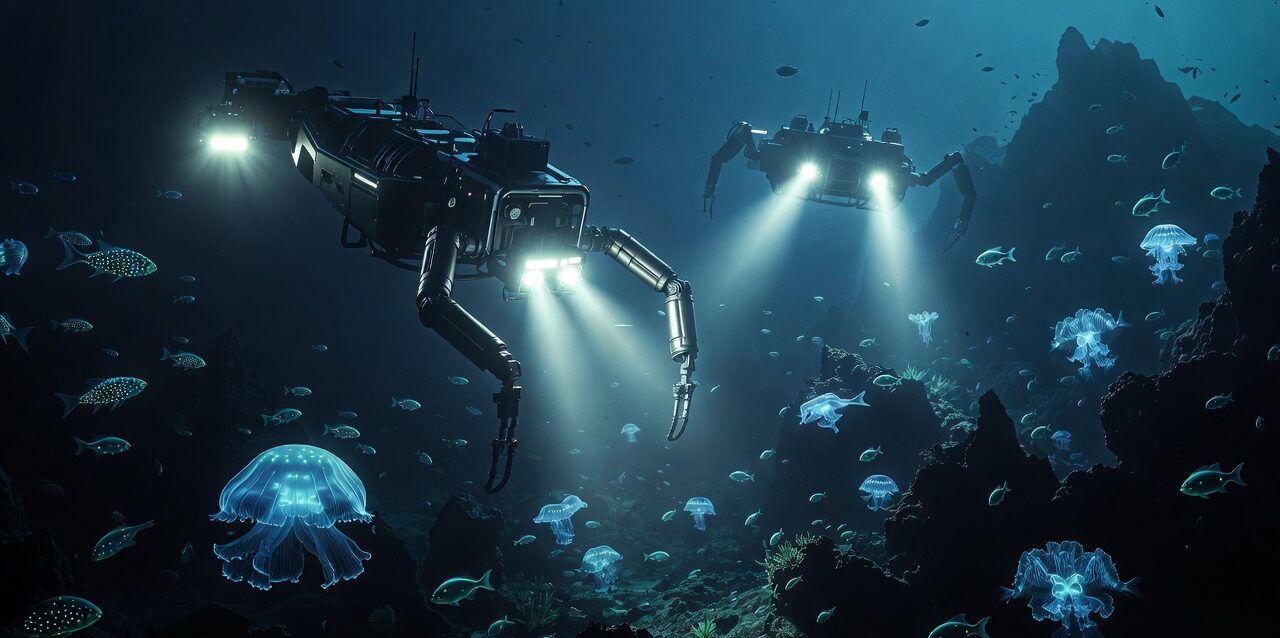
Deep Sea Exploration 2040: From 27% Mapped to Robotic Frontiers
From Limited Access to Comprehensive Mapping, Robotic Dominance, and Emerging Deep-Sea Economy
As of February 2026, only about 27% of the global seafloor has been mapped at high resolution (Seabed 2030 project update), with even less actually explored in detail — less than 0.001% of the deep ocean has been visually observed. The deep sea (below 200 m) remains one of the least known environments on Earth, yet it holds immense scientific, economic, and strategic value: biodiversity hotspots, critical mineral resources (polymetallic nodules, sulfides, cobalt crusts), carbon sequestration potential, and climate regulation functions.
By 2040, deep-sea exploration is expected to undergo a transformation driven by technological leaps (autonomous vehicles, AI, advanced sensors), international initiatives (Seabed 2030, UN Ocean Decade), and growing economic pressures (critical minerals for energy transition). Progress will be uneven — mapping and basic observation will advance significantly, but full understanding and sustainable use of the deep sea will remain ongoing challenges.
1. Near-Term (2026–2030): Mapping Acceleration & Robotic Expansion
- Seabed 2030 & National Strategies
The Seabed 2030 project (Nippon Foundation-GEBCO) aims to map 100% of the global seafloor by 2030. Current progress is ~27% (high-resolution multibeam data); by 2030, 50–70%+ coverage is plausible with increased use of uncrewed systems. The U.S. National Strategy targets complete mapping of deep U.S. EEZ waters by 2030 and nearshore by 2040. - Uncrewed Systems Surge
Autonomous underwater vehicles (AUVs), remotely operated vehicles (ROVs), and uncrewed surface vessels (USVs) like Saildrone become primary tools. They map vast areas cost-effectively, collect high-resolution bathymetry, and sample water/seafloor. AUV swarms and hybrid ROV/AUV systems enable longer missions and real-time data relay. - Key Focus Areas
Deep-sea mining exploration intensifies in international waters (Clarion-Clipperton Zone) and national EEZs. Scientific missions target biodiversity, seamounts, hydrothermal vents, and abyssal plains. NOAA and partners continue Okeanos Explorer-style expeditions, expanding to new regions.
2. Medium-Term (2030–2035): Deep-Sea Economy & Advanced Observation
- Deep-Sea Mining Commercialization
If regulations are finalized (ISA process ongoing), commercial nodule mining could begin in the early 2030s in select areas. Polymetallic nodules, sulfides, and cobalt-rich crusts become strategic resources for batteries, clean energy, and tech. Environmental baselines and monitoring tech (AI, eDNA) advance to assess impacts. - Autonomous & Persistent Exploration
Long-endurance AUVs and underwater gliders operate for months/years, mapping and sampling autonomously. AI processes massive datasets in real time, identifying features and anomalies. Swarms of mini-AUVs cover large areas simultaneously. - Biodiversity & Climate Insights
Deep-sea observatories (cabled and wireless) expand — continuous monitoring of vents, seamounts, and abyssal plains. Discoveries of new species accelerate; links to climate (carbon sequestration, ocean currents) become clearer.
3. Long-Term (2035–2040): Integrated Deep-Sea Understanding & Use
- Near-Complete Mapping
Seabed 2030 likely achieves 90%+ high-resolution coverage by 2040. Detailed maps enable targeted exploration and resource assessment. - Deep-Sea Economy
Mining scales in some regions (nodules, crusts); critical minerals support energy transition. Scientific/commercial balance debated — moratoriums or strict regulations in some areas. Tourism (submersible visits to wrecks/vents) grows for ultra-wealthy. - Technological Maturity
AI-driven exploration fleets (swarms, persistent platforms) dominate. Advanced sensors (eDNA, hyperspectral imaging) map biodiversity and geochemistry at scale. Human presence remains limited — ROVs and AUVs do most work.
Key Deep-Sea Exploration Milestones by 2040 (Illustrative)
- Mapping — 90%+ global seafloor at high resolution; detailed views of seamounts, vents, abyssal plains.
- Mining — Commercial nodule extraction in select areas; environmental monitoring tech standard.
- Science — Thousands of new species described; deep-sea role in climate/carbon cycle better understood.
- Access — Autonomous fleets and swarms enable routine, low-cost deep-sea missions.
Risks & Societal Shifts
- Environmental Impact — Mining could disrupt fragile ecosystems; long-term effects unknown.
- Geopolitics — Competition for resources (China, U.S., others) in international waters.
- Inequality — Benefits (minerals, knowledge) may concentrate in wealthy nations.
- Ethics — Need for precautionary approach; deep sea as “common heritage” vs. economic use.
Bottom Line
By 2040, deep-sea exploration shifts from sparse, ship-based efforts to systematic, robotic, and AI-driven discovery. The dominant paradigm becomes persistent, autonomous, and data-rich observation — mapping nears completion, mining begins in regulated areas, and scientific understanding of the deep ocean accelerates dramatically. The deep sea won’t be fully “known” — but it will be far less mysterious. Exploration won’t be about occasional dives — it will be continuous, scalable, and essential to climate solutions, resource security, and biodiversity knowledge. The future deep sea is not empty darkness — it is a frontier of opportunity and responsibility, unlocked by technology and guided by caution.