
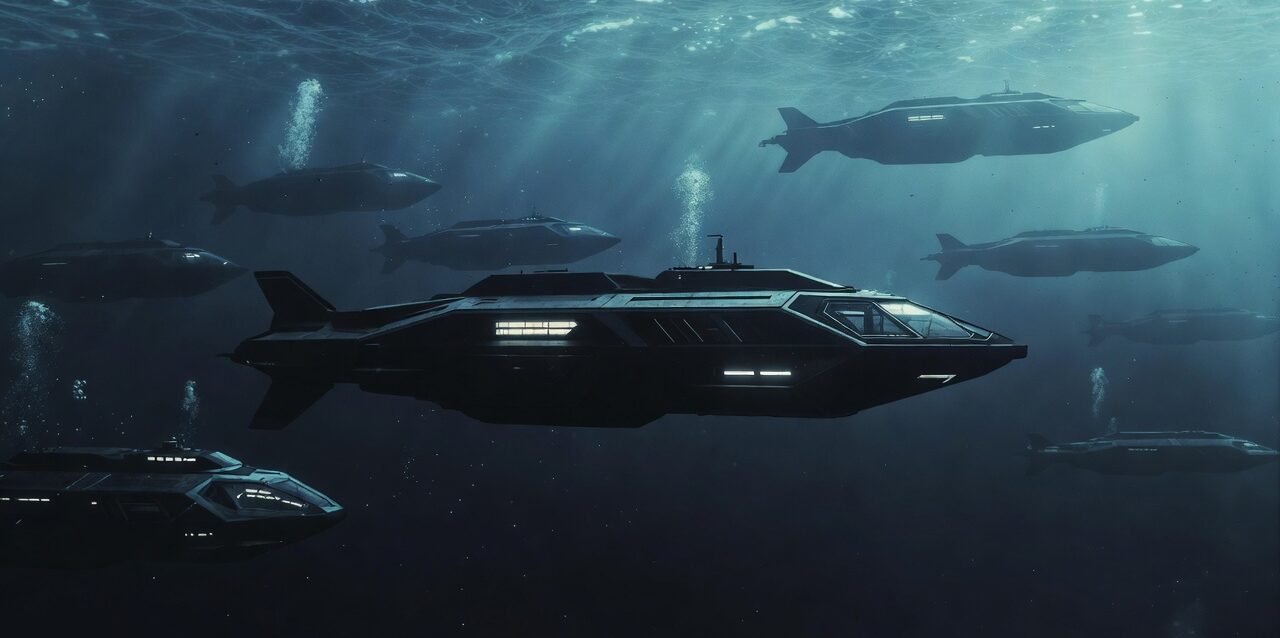
Submarines 2040: Surviving the Transparent Ocean with AI and Swarms
From Legacy Fleets to Stealthier, Smarter, and Multi-Domain Platforms
As of February 2026, submarines remain the most stealthy and survivable naval platforms, central to strategic deterrence, sea denial, intelligence, and power projection. Global fleets include ~70–80 nuclear-powered attack submarines (SSNs) and ~130–150 conventional (diesel-electric) boats, with major operators being the US (Virginia-class), Russia (Yasen, Borei), China (Type 093/095, Type 039), UK (Astute), France (Barracuda), and others. The US Navy’s Virginia-class is the current benchmark for SSNs, while AIP (air-independent propulsion) and lithium-ion batteries extend endurance for conventional subs.
By 2040, submarines evolve into more autonomous, networked, and multi-domain platforms — incorporating unmanned integration, advanced stealth, AI, and hybrid propulsion — while facing new threats from undersea drones, sensors, and distributed lethality.
1. Near-Term (2026–2030): Upgrades & Next-Generation Foundations
- Virginia-class Block V & Beyond
Block V submarines (with Virginia Payload Module) continue delivery, enhancing strike capacity (up to 28 Tomahawks). Block VI/VII designs add further improvements (better sensors, quieting, lithium-ion batteries in some variants). - AUKUS SSN-AUKUS
The AUKUS pact drives development of a new SSN class (SSN-AUKUS) for Australia/UK/US, blending Virginia and Astute technologies. First boats expected in the 2030s–2040s. Australia plans to acquire Virginia-class boats in the early 2030s as a bridge. - Conventional Sub Advances
Lithium-ion batteries (Japan, South Korea) and AIP (fuel cells, Stirling engines) extend submerged endurance. Unmanned underwater vehicles (UUVs) launch from subs for ISR and strike.
2. Medium-Term (2030–2035): SSN(X) & Next-Gen Designs
- US SSN(X) Program
The next-generation SSN(X) (successor to Virginia-class) enters design and early construction. Focus: enhanced stealth, speed, payload, sensors, and unmanned integration. Procurement delayed to ~2040 in some plans, with first boats in the early 2040s. - Global Modernization
China accelerates Type 095/096 SSNs. Russia evolves Yasen-class. Europe (France Barracuda, Germany/Spain Type 212/214 successors) emphasizes AIP and lithium-ion for conventional subs. Unmanned systems (Orca, Manta Ray) become standard. - Threats & Countermeasures
Proliferation of UUVs, seabed sensors, and anti-submarine warfare (ASW) drones challenge stealth. Submarines counter with better acoustic quieting, decoys, and networked sensors.
3. Long-Term (2035–2040): Multi-Domain & Autonomous Submarines
- Fully Networked & Unmanned Integration
Submarines operate as nodes in distributed maritime operations — commanding UUV swarms for ISR, strike, and ASW. Manned-unmanned teaming (MUM-T) becomes core. - Propulsion & Stealth Advances
Advanced lithium-ion or solid-state batteries, fuel cells, and hybrid systems extend endurance. Acoustic and non-acoustic stealth (thermal, magnetic, wake reduction) improves. Larger payloads (VPM-like modules) increase versatility. - Strategic Role
SSBNs (Columbia-class, Dreadnought, Type 096) maintain nuclear deterrence. SSNs focus on sea control, power projection, and countering peer adversaries in contested areas.
Key Submarine Characteristics by 2040 (Illustrative)
- Stealth — Advanced acoustic quieting, non-acoustic reduction, adaptive materials.
- Propulsion — Hybrid-electric, AIP/fuel cells, lithium-ion/solid-state batteries.
- Payload — Larger VLS, UUV launch/recovery, hypersonic weapons.
- Sensors — Distributed arrays, AI fusion, quantum sensors (emerging).
- Crew — Reduced (automation); unmanned variants common.
- Role — Networked, multi-domain, persistent presence.
Risks & Societal Shifts
- Proliferation — More nations field advanced subs, increasing ASW challenges.
- Cost & Industrial Base — SSN(X) delays highlight shipbuilding constraints.
- Autonomy Ethics — Lethal autonomous weapons debates intensify.
- Geopolitics — Submarines remain central to great-power competition.
Bottom Line
By 2040, submarines evolve from standalone stealth platforms to highly networked, autonomous-capable, and multi-domain assets. The dominant paradigm becomes hybrid propulsion, unmanned integration, and distributed lethality — SSNs maintain undersea superiority, while conventional subs with AIP/batteries excel in regional denial. Submarines won’t become obsolete — they will become smarter, more versatile, and more essential in contested oceans. The future is not bigger or louder submarines — it’s quieter, more connected, and more lethal ones that operate as part of a broader undersea network. The silent service stays silent — but it becomes omnipresent.