2040 Work Without Walls: AI Agents, Spatial Offices, and Total Freedom
From Human-Only Workforces to Human–AI Symbiosis and Agent-Driven Organizations
As of February 2026, AI is already deeply embedded in work:
- ~35–45% of knowledge-work tasks are at least partially automated or assisted by generative AI
- Companies report 20–50% productivity gains in roles that use AI tools intensively
- The majority of large organizations have adopted AI copilots (GitHub Copilot, Microsoft 365 Copilot, Claude for Work, etc.)
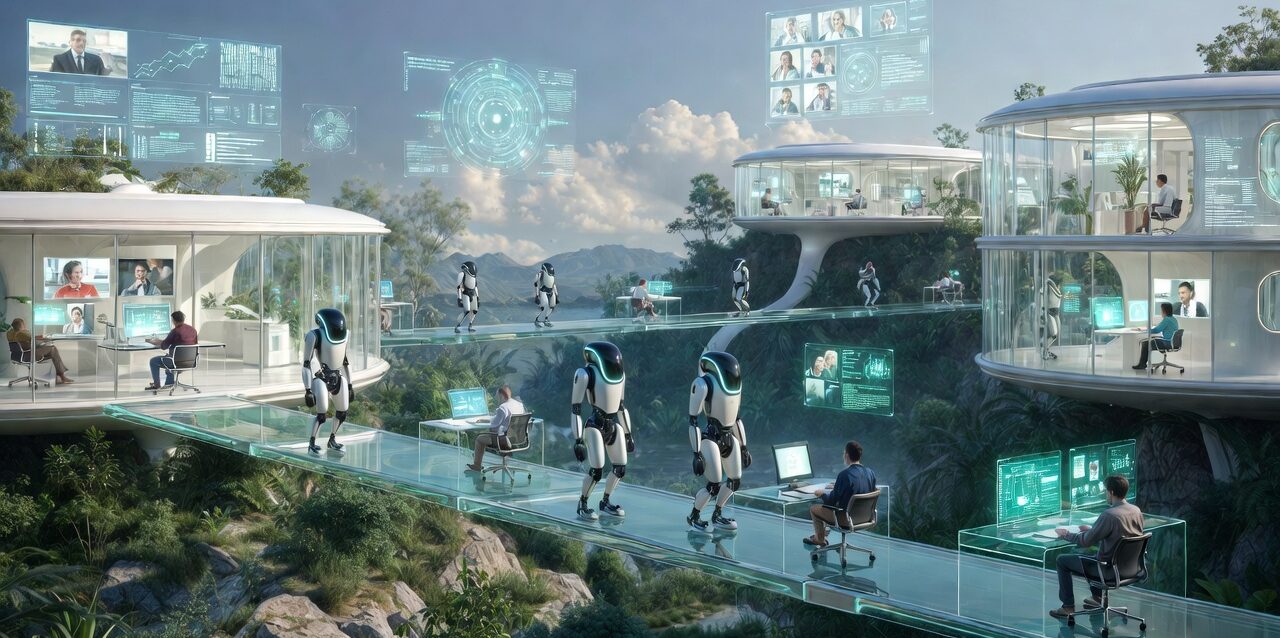
By 2040, “AI work” is no longer a separate category — it is simply work. AI agents become autonomous colleagues, teams are hybrid (human + software agents), and many organizations operate as networks of humans directing constellations of specialized agents. The boundary between human and AI contribution blurs dramatically.
1. Near-term (2026–2030): Agent Explosion & Human-in-the-Loop Dominance
- AI agents go mainstream
Single-purpose → multi-step agents become standard tools.
Examples: sales development agents, customer support agents, research agents, code-review agents, marketing agents, compliance agents.
Most white-collar workers have 3–10 personal/professional agents by 2030. - Agent platforms & marketplaces
Companies build internal agent stores or subscribe to external ones (OpenAI’s GPT Store successors, Anthropic Work, Adept, Replit Agent, etc.).
“Agent builders” emerge as a major job category — people who assemble and fine-tune agent teams for specific business functions. - Human role
Humans remain the orchestrators, reviewers, and ethical decision-makers.
Job titles shift: “AI orchestrator”, “agent supervisor”, “human-in-the-loop specialist”.
2. Medium-term (2030–2035): Autonomous Teams & Organizational Redesign
- Agent teams running entire functions
A marketing department might consist of: - 1 human strategist
- 12–20 specialized agents (content, SEO, social, ads, analytics, A/B testing, brand voice)
- 1 meta-agent coordinating the team Similar pattern in finance, legal, customer success, product development, HR.
- Autonomous business units
Small to medium companies begin running with 1–5 humans + dozens/hundreds of agents.
“One-person billion-dollar companies” become realistic (human founder + agent swarm). - New organizational forms
- Agent-first companies — built around agent capabilities from day one
- DAO-like structures — humans set high-level goals, agents execute and govern day-to-day
- Human oversight layers — dedicated “AI boardrooms” where humans review agent decisions
3. Long-term (2035–2040): Symbiotic Work & Post-Job Economy Elements
- Near-complete agent autonomy in many domains
Large parts of knowledge work run with minimal human intervention.
Humans focus on: - vision & strategy
- ethical judgment
- creativity that requires deep human context
- relationship-building & trust
- handling truly novel situations
- Agent economies & agent-to-agent commerce
Agents buy/sell services from each other (e.g. research agent pays data agent for premium datasets).
Internal agent marketplaces become profit centers in large organizations. - Redefinition of “employment”
- Many people become “agent portfolio managers” rather than traditional employees
- Rise of “agent dividends” — individuals own and lease out specialized agent teams
- Universal basic compute / agent credits discussed as policy response to displacement
Illustrative Workday in 2040
- 08:15 — Your personal AI wakes you with prioritized brief (news, overnight agent results, calendar)
- 09:00 — Strategy sync: you give high-level direction to 8 domain-specific agents
- 10:30 — Review loop: agents present 3 options each → you select + give feedback
- 13:00 — Deep creative work: you ideate while agents handle execution and research
- 15:30 — Agent-to-agent negotiation: your marketing agent buys data from external agent
- 17:00 — Reflection & learning: you train your agents on new context / preferences
- Evening — agents continue working while you disconnect
Key Numbers & Trends by 2040
- 60–85% of current knowledge-work tasks fully or mostly automated
- Average knowledge worker manages 10–50 agents
- Agent-to-agent transactions become measurable economic activity
- “Agent portfolio” value becomes a personal asset class
Bottom Line
By 2040, AI work is no longer a subcategory — it is the dominant form of knowledge work.
The future organization is a symbiotic network of humans setting direction and agents executing at scale and speed.
The most valuable skill is no longer doing tasks — it is directing, evaluating, and improving agent teams.
The winning companies are not the ones with the most employees, but the ones that orchestrate the most capable agent constellations.
Work doesn’t disappear — it changes shape: less execution, more orchestration, more creativity, more meaning.
The future isn’t humans vs. AI — it’s humans + AI, and the organizations that master that partnership will define the next era.