
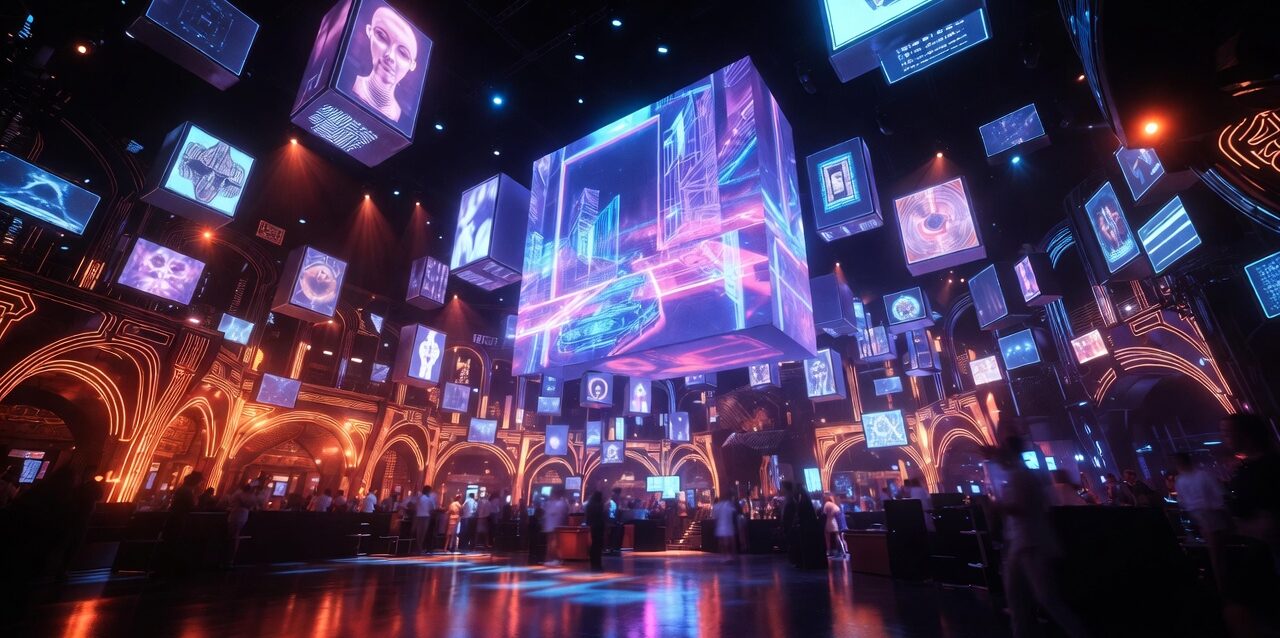
From Passive Screens to Fully Immersive, Personalized & Co-Created Realities
As of 2026 entertainment is still mostly passive and screen-bound:
- Streaming (Netflix, YouTube, Disney+, TikTok, etc.) accounts for ~70–80% of viewing time
- Gaming is the largest entertainment category by revenue (~$220–250B)
- Live events (concerts, sports) are recovering but still below pre-pandemic peaks
- Social media short-form video dominates attention (TikTok, Reels, Shorts)
By 2040 the dominant form of entertainment is active, immersive, personalized, and co-created — most people spend more time inside synthetic realities than passively watching pre-made content.
1. Near-Term (2026–2030): Spatial & AI-Personalized Entertainment Takes Over
- AR/VR headsets become everyday devices
Weight drops below 250 g, FOV >130°, resolution ≥60 PPD, all-day battery or light tethering.
Vision Pro / Quest successors make spatial computing comfortable for hours. - AI-generated & hyper-personalized content explodes
Generative AI creates entire movies, TV episodes, music albums, game levels tailored to individual taste/mood in seconds.
“Watch next” becomes “generate next” — AI continues stories exactly how you like them. - Live events go hybrid & immersive
Major concerts and sports are simultaneously physical + high-fidelity VR streams.
You can be in the front row virtually, feel crowd energy, change camera angles, interact with performers.
2. Medium-Term (2030–2035): Persistent Worlds & Co-Creation Dominate
- Persistent shared universes replace linear media
Entertainment shifts from “watching a show” to living inside ongoing worlds — like Fortnite meets Westworld meets The Sims on steroids.
Popular IPs become persistent, player-driven realities with AI NPCs, evolving stories, and user-generated content. - Co-creation replaces consumption
Anyone can direct episodes, write new storylines, design characters, compose soundtracks — AI handles execution.
Top creators are no longer just performers; they are world-builders and AI-prompt engineers. - Full-sensory & neuro-enhanced experiences
Haptic suits, scent emitters, temperature control, and early non-invasive brain stimulation create convincing immersion.
“Neuro-cinema” lets viewers feel emotions, adrenaline, or even light synesthetic effects.
3. Long-Term (2035–2040): Reality Blurring & Full-Dive Entertainment
- Base reality vs. synthetic realities
Many people spend 6–14+ hours/day inside high-fidelity virtual worlds.
Physical reality is increasingly used for: - nature & physical sports
- intimate relationships
- food & sensory experiences that VR can’t yet perfectly replicate
- Full-dive / high-fidelity VR
Lightweight headsets or direct neural interfaces deliver near-photoreal visuals, full-body haptics, vestibular stimulation, and convincing proprioception.
Distinguishing “real” from “virtual” becomes difficult without deliberate tests. - Entertainment as identity & economy
Virtual worlds become primary places for dating, friendship, status, creativity, and income.
Digital goods, land, avatars, and experiences are the main luxury/status items.
“Living in the metaverse” is no longer a joke — it’s a common lifestyle.
Illustrative Entertainment Day in 2040
- Morning: Wake up in persistent virtual home → AI generates personalized morning news/story in immersive 3D
- Midday: Work in shared virtual office → after meeting jump into private creative world to co-write music with AI & friends
- Afternoon: Attend live concert — feel bass in chest, crowd energy, change perspective at will
- Evening: Dinner with family avatars in virtual restaurant → later join friends in a custom fantasy world for adventure
- Night: “Neuro-movie” — experience a story from inside the protagonist’s mind with full emotional & sensory feedback
Key Numbers & Trends by 2040 (illustrative)
- Time spent in XR/virtual worlds: 4–12+ hours/day for heavy users
- Revenue share: immersive & user-generated content >70% of entertainment market
- Physical cinema attendance: down 60–90%
- Linear pre-made TV/movie consumption: <20% of total entertainment time
- Virtual land & digital goods: multi-trillion-dollar asset class
Bottom Line
By 2040 entertainment is no longer something you watch — it is something you live inside.
The dominant form becomes persistent, co-created, fully immersive synthetic realities where AI handles production, personalization, and world-building at scale.
Passive consumption survives as a niche (nostalgia, art-house, live events), but the center of gravity moves to active participation in virtual worlds that feel as real as — or more real than — base reality.
The future isn’t better movies or bigger screens — it is becoming someone else, somewhere else, with anyone you want, whenever you want.
Entertainment stops being a product you consume — it becomes the primary place where modern life actually happens.