
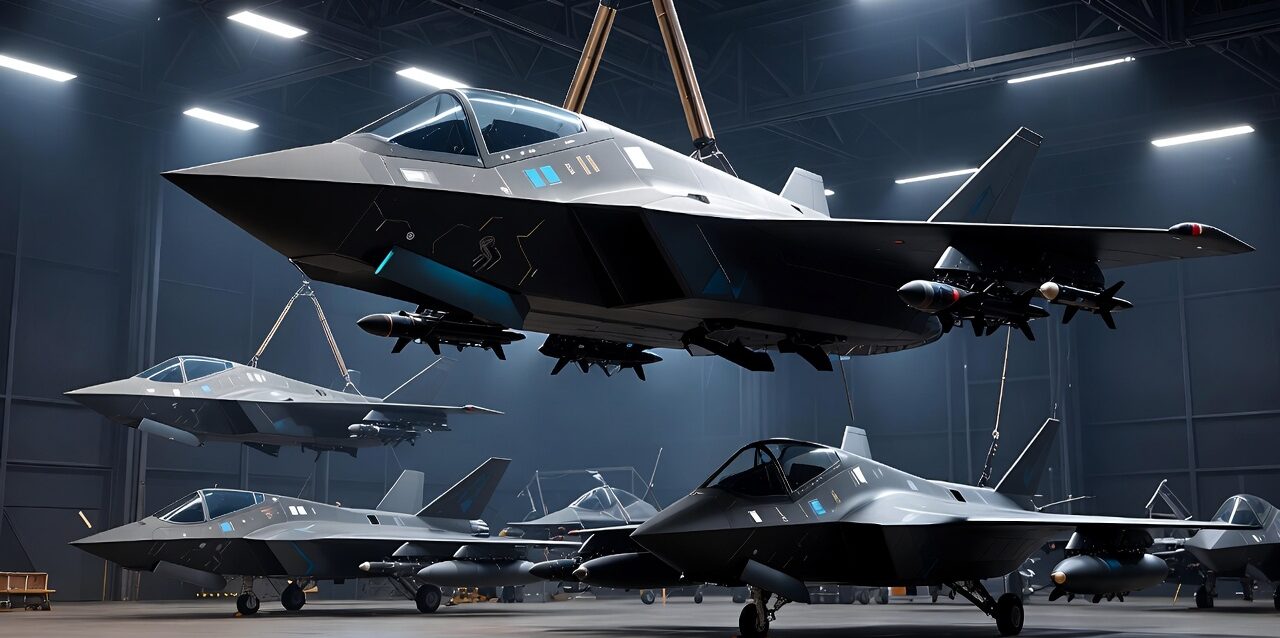
Air Weapons Technology in the Future
From Fifth-Generation Fighters to Sixth-Generation Dominance, Hypersonic Missiles, Directed Energy, and Loyal Wingman Swarms
As of 2026, air weapons technology is transitioning from fifth-generation stealth fighters (F-22, F-35, J-20, Su-57) toward sixth-generation concepts. The global military aircraft market exceeds $100 billion annually, with the United States, China, Russia, and Europe leading development. Key drivers include great-power competition, the need to penetrate advanced integrated air defense systems (IADS), hypersonic threats, and the proliferation of low-cost drones.
By 2040, air warfare evolves into AI-orchestrated, multi-domain, and hypersonic/supersonic dominance — with manned sixth-generation fighters acting as command nodes for massive loyal wingman drone swarms, directed-energy weapons becoming standard, and hypersonic missiles redefining speed and survivability.
1. Near-Term (2026–2030): Fifth-Gen Maturity & Sixth-Gen Foundations
- Fifth-Generation Fighters Peak
F-35 Block 4/5 upgrades deliver better sensors, weapons, and electronic warfare. China accelerates J-20 production and J-35 carrier variant. Russia struggles with Su-57 scale-up due to sanctions. - Loyal Wingman / CCA Programs Accelerate
U.S. Collaborative Combat Aircraft (CCA) program (Anduril, General Atomics, Boeing) fields first semi-autonomous drones that fly alongside F-35s. Australia, Japan, and Europe launch similar programs (e.g., FCAS Remote Carriers, GCAP Combat Air Team). - Hypersonic Missiles Deploy
U.S. ARRW, HAWC, and CPS hypersonics enter limited service. Russia fields Kinzhal and Avangard. China expands DF-17/DF-27 inventory. Hypersonic glide vehicles and scramjet cruise missiles become primary anti-access/area-denial (A2/AD) weapons. - Directed Energy Weapons (DEW) Enter Service
High-energy lasers (HEL) for counter-drone/rocket/missile defense (U.S. HELIOS, DE M-SHORAD) reach operational status on ships and ground vehicles. Airborne lasers remain experimental.
2. Medium-Term (2030–2035): Sixth-Generation Emergence & Swarm Warfare
- Sixth-Generation Fighters
U.S. NGAD (Next Generation Air Dominance) and F/A-XX programs field first operational aircraft (~2030–2035).
Key features: adaptive cycle engines, advanced stealth (broadband, low-observable coatings), AI-driven sensor fusion, directed-energy weapons, and loyal wingman integration.
Europe (FCAS) and UK/Italy/Japan (GCAP/Tempest) reach similar milestones. - Massive Loyal Wingman Swarms
CCA Increment 2 and follow-on programs field hundreds to thousands of low-cost, attritable drones per manned fighter.
Swarms perform saturation attacks, decoy roles, electronic warfare, and ISR — overwhelming enemy defenses. - Hypersonic & Directed Energy Maturity
Hypersonic weapons proliferate across U.S., China, Russia, India, and others. Directed-energy systems become primary for close-in defense on aircraft and ships.
3. Long-Term (2035–2040): Air Supremacy Redefined
- Manned + Massive Unmanned Symbiosis
Sixth-gen fighters act as “quarterbacks” for large drone swarms (10–100+ per aircraft).
Human pilots focus on high-level decision-making; AI handles tactical execution. - Hypersonic Dominance
Hypersonic missiles become the primary long-range strike weapon — Mach 5–12, maneuverable, difficult to intercept. Air-to-air hypersonics emerge for fighter engagements. - Directed Energy & Electronic Warfare
Lasers become standard for self-defense and offensive use (burn-through drones, missiles). High-power microwave weapons disable electronics at range. - Space-Air Integration
Space-based sensors and weapons (kinetic interceptors, lasers) support air operations. Air dominance requires space superiority.
Illustrative Air Weapons Scenarios by 2040
- Air Superiority Engagement — Sixth-gen fighter commands 50+ loyal wingman drones to saturate enemy IADS; hypersonic air-to-air missiles engage at 200+ km.
- Strike Mission — Hypersonic glide vehicle launched from standoff range penetrates defended airspace; directed-energy weapons clear close-in threats.
- Drone Swarm Defense — High-energy laser on aircraft burns incoming loitering munitions; AI coordinates countermeasures.
- Electronic Attack — High-power microwave pod disables enemy radar and communications at standoff range.
Key Numbers & Trends by 2040 (illustrative)
- Loyal wingman / CCA drones per sixth-gen fighter: 10–100+
- Hypersonic missile inventory (major powers): hundreds to thousands
- Directed energy weapons on combat aircraft: 50–80% of sixth-gen fighters
- Share of air-to-air kills by autonomous systems: 60–90% in contested environments
- Speed of hypersonic weapons: Mach 5–12 (operational)
Risks & Societal Shifts
- Escalation Risk — Hypersonic weapons and autonomous systems lower decision timelines, increasing accidental war risk.
- Proliferation — Hypersonics and drone tech spread to mid-tier powers and non-state actors.
- Ethics & Autonomy — Lethal autonomous weapons debates intensify; arms control treaties struggle.
- Cost & Industrial Base — Sixth-gen programs are multi-trillion-dollar efforts; industrial capacity becomes a strategic factor.
Bottom Line
By 2040 air weapons technology shifts from fifth-generation stealth fighters to sixth-generation, AI-orchestrated, hypersonic, and swarm-dominated systems.
The dominant paradigm becomes manned-unmanned teaming with hypersonic speed and directed-energy lethality — sixth-gen fighters act as command nodes for massive drone swarms, hypersonics redefine engagement ranges, and lasers/microwaves handle close-in defense.
Air superiority is no longer about one plane being stealthier — it’s about commanding a networked, intelligent, and multi-speed force that overwhelms defenses across domains.
The future isn’t better jets — it’s smarter, faster, and more autonomous air power that redefines who controls the sky.
The next air war will be decided not by pilots alone, but by the AI and machines they lead.