
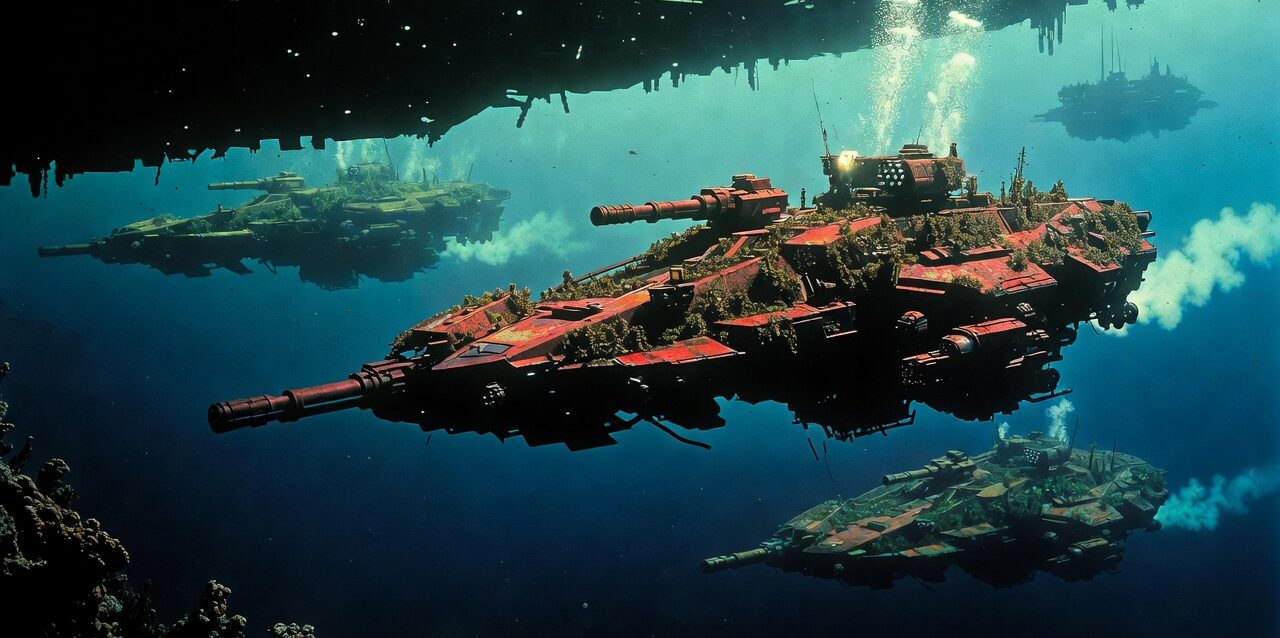
From Legacy Submarines to AI-Orchestrated, Swarm-Dominated, and Multi-Domain Undersea Supremacy
As of 2026, underwater war machines remain dominated by nuclear-powered attack submarines (SSNs) and advanced diesel-electric/AIP submarines.
The most capable platforms include:
- U.S. Virginia-class (Block V with Virginia Payload Module)
- Chinese Type 095/096 and Type 039C Yuan-class
- Russian Yasen-M and Borei-class
- British Astute-class
- French Suffren (Barracuda-class)
Global fleets total ~200–220 submarines (nuclear + conventional), with China rapidly expanding toward 80+ boats by 2035. Submarines are the most survivable and stealthy platforms for strategic deterrence, sea denial, intelligence collection, and power projection.
By 2040 underwater warfare shifts to AI-driven, unmanned-heavy, hypersonic-capable, and networked systems — with manned submarines serving primarily as command nodes for massive UUV (unmanned underwater vehicle) swarms, persistent autonomous networks, and emerging hypersonic underwater weapons.
1. Near-Term (2026–2030): Next-Generation SSNs & UUV Scale-Up
- Virginia-class Evolution & SSN(X) Foundations
Block V/VI Virginia-class boats continue delivery with enhanced sensors, payload, and unmanned integration.
SSN(X) (U.S. next-generation SSN) design matures — emphasis on speed, stealth, endurance, and large-scale UUV command capability. - Extra-Large UUV (XLUUV) Deployment
U.S. Orca XLUUV and Manta Ray programs reach operational status.
China, Russia, and Europe field similar large unmanned vehicles for ISR, mine-laying, anti-submarine warfare (ASW), and strike.
Smaller UUVs become standard equipment on every submarine. - Advanced AIP & Battery Systems
Lithium-ion batteries and next-generation AIP (fuel cells, Stirling engines) extend conventional submarine submerged endurance to weeks.
Hybrid propulsion systems become common in new conventional designs.
2. Medium-Term (2030–2035): Swarm Warfare & Hypersonic Underwater Weapons
- Manned-Unmanned Teaming (MUM-T) Maturity
Submarines command fleets of 10–100+ UUVs for saturation attacks, decoy operations, mine clearance, and ASW screening.
Swarms overwhelm defenses through sheer numbers and coordinated AI behavior. - Hypersonic & Supercavitating Weapons
Supercavitating torpedoes and underwater-launched hypersonic glide vehicles enter service (Russia Status-6 derivatives, U.S./Chinese equivalents).
Speeds exceed 200–400 knots in short bursts; long-range hypersonic underwater missiles become primary anti-ship and anti-submarine weapons. - Persistent Undersea Networks
Seabed sensors, autonomous UUV relays, and underwater communication buoys create persistent surveillance and command networks.
Submarines operate as mobile command posts within these networks.
3. Long-Term (2035–2040): Full Undersea Dominance & New Paradigms
- Autonomous Undersea Dominance
Level 4–5 autonomy allows UUVs to conduct independent operations for weeks/months.
Manned submarines become rare and highly specialized — primarily for nuclear deterrence (SSBNs) or high-end command roles. - Directed Energy & Electronic Warfare Underwater
High-power underwater lasers and acoustic weapons emerge for close-in defense and anti-UUV roles.
Advanced electronic warfare systems jam or spoof enemy sonar and communications. - Strategic Shifts
Undersea superiority becomes the decisive factor in great-power conflict.
Control of underwater critical infrastructure (cables, pipelines, seabed mining) drives new strategic competition.
Illustrative Underwater War Machine Scenarios by 2040
- Swarm Saturation Attack — Manned SSN releases 50+ UUVs; swarm overwhelms enemy surface group with coordinated torpedo strikes.
- Hypersonic Strike — Submarine launches long-range hypersonic underwater missile; target destroyed before countermeasures can react.
- Persistent Surveillance — XLUUV loiters for months on seabed, monitors adversary submarines, relays data via acoustic network.
- Autonomous ASW — UUV swarm detects and tracks enemy SSBN; manned submarine closes for final engagement.
Key Numbers & Trends by 2040 (illustrative)
- UUVs per manned submarine: 10–100+ (operational swarms)
- Hypersonic underwater weapon inventory (major powers): hundreds
- Submerged endurance (conventional subs): 30–60+ days with advanced AIP/batteries
- Share of undersea kills by autonomous systems: 60–90% in contested waters
- Global submarine fleet: ~250–300 (manned + large UUVs counted separately)
Risks & Societal Shifts
- Escalation Risk — Hypersonic underwater weapons and autonomous swarms compress decision timelines dramatically.
- Proliferation — Mid-tier powers and non-state actors acquire advanced UUVs and hypersonic torpedoes.
- Ethics & Autonomy — Lethal autonomous underwater weapons spark major international debate and possible treaty attempts.
- Industrial & Cost — Building and maintaining large UUV fleets and next-gen SSNs remains extremely expensive.
Bottom Line
By 2040 underwater war machines evolve from single-platform stealth boats to AI-orchestrated, swarm-dominated, and hypersonic undersea networks.
The dominant paradigm becomes manned-unmanned teaming with persistent autonomous swarms — manned submarines act as command nodes, while UUV fleets provide saturation, surveillance, and strike capability.
Hypersonic underwater weapons redefine engagement ranges and survivability.
Underwater superiority is no longer about having the stealthiest submarine — it’s about commanding the most capable, intelligent, and numerous undersea force.
The future silent service is not silent because it hides — it is silent because it is everywhere, coordinated by AI, and strikes before the enemy even knows it is there.
Underwater warfare becomes less about submarines and more about who owns the undersea domain.