
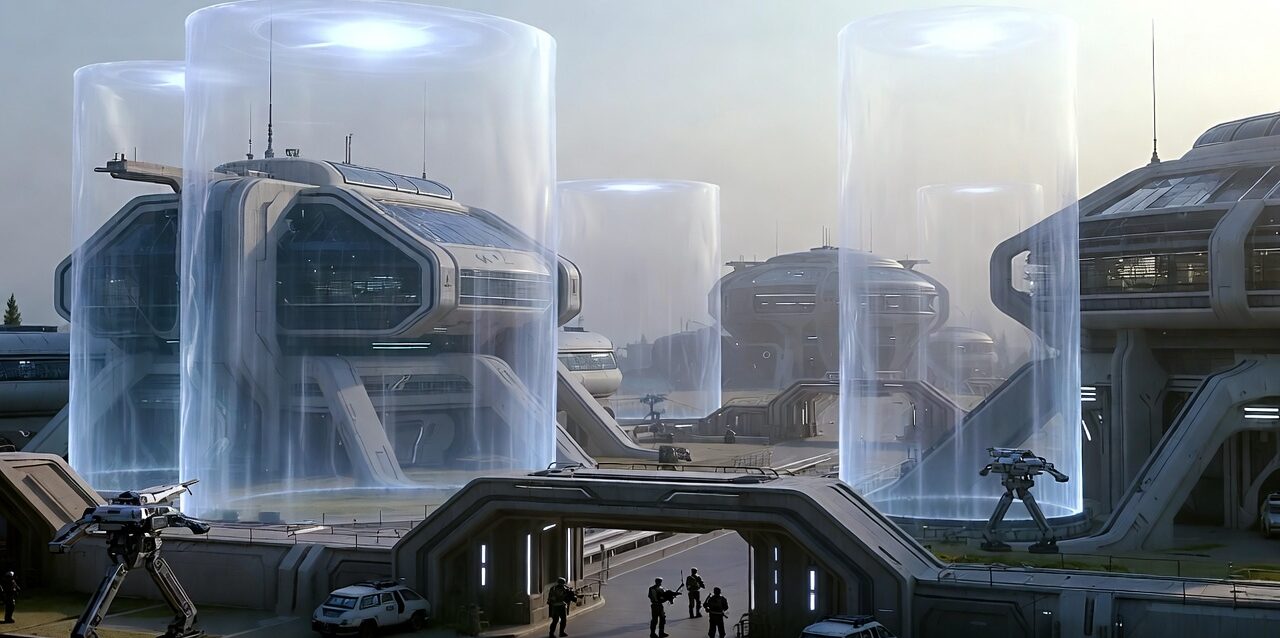
From Concrete Bunkers to Intelligent, Adaptive, Invisible & Hybrid Security Architectures
As of 2026 secure facilities (data centers, vaults, critical infrastructure sites, military bases, high-security prisons, government buildings, ultra-high-net-worth private compounds) are still predominantly physical-first: thick concrete walls, steel doors, multi-layered access control, armed guards, CCTV, intrusion sensors, ballistic glass, and man-traps.
By 2040 the concept of a “secure facility” has fundamentally changed. Physical hardening remains important for the highest-value targets, but the dominant paradigm shifts to intelligent, adaptive, distributed, and largely invisible security — where protection is achieved through layers of AI, cryptography, deception, redundancy, and predictive deterrence rather than sheer mass of concrete and steel.
1. Near-Term (2026–2030): Smart Physical + Digital Layering
- AI & Computer Vision Everywhere
Cameras + AI detect anomalies in real time: gait analysis for tailgating, unusual loitering, object left behind, facial recognition with liveness detection, behavioral profiling. False alarm rates drop dramatically. - Biometric & Multi-Factor Access Explosion
Face + iris + vein + behavioral biometrics become standard. Zero-trust architecture extends to physical access — continuous authentication, no static badges. - Deception & Active Defense
Honeypots, decoy servers, fake access points, and AI-generated fake data confuse attackers. Physical honeypots (fake server rooms, dummy vaults) appear in high-risk sites. - Quantum-Resistant Crypto
Post-quantum cryptography rolls out in critical systems (banks, government, military) to protect against future quantum attacks.
2. Medium-Term (2030–2035): Distributed & Predictive Security
- Distributed & Virtual Vaults
Physical vaults shrink for most use cases. High-value assets (gold, art, documents, crypto keys) are stored in multiple geographically distributed locations.
Digital vaults (HSM clusters, MPC wallets, sharded encrypted backups) become the norm for financial, intellectual property, and identity assets. - Predictive & Behavioral Security
AI models trained on years of data predict intrusions before they happen — unusual employee behavior, anomalous network patterns, even social engineering attempts. Preemptive lockdowns, credential rotation, and human response teams activate automatically. - Active Physical Deception
Smart walls/floors change appearance, fake doors/openings appear, robotic decoys move around. Some facilities use modular internal layouts that reconfigure on threat detection. - Private Fortress Facilities
Ultra-secure private compounds for billionaires and critical infrastructure operators expand (bunkers, islands, desert/mountain retreats) with military-grade security, autonomous drones, and AI-managed perimeters.
3. Long-Term (2035–2040): Invisible & Symbiotic Security
- Invisible & Ambient Security
Most “vaults” are no longer visible rooms — they are cryptographic layers, distributed across cloud, edge, and physical enclaves.
Physical access becomes rare; most high-value assets exist only in digital form with physical backups in ultra-secure, low-profile sites. - Quantum & Post-Quantum Dominance
Fully quantum-resistant systems are standard. Quantum key distribution (QKD) networks protect the most sensitive communications and data transfers. - AI-Driven Autonomous Defense
Facilities are defended by autonomous robotic sentries, drone swarms, non-lethal directed-energy weapons, and AI that can engage threats without human approval in extreme scenarios. - Zero-Trust at Physical Layer
Every person, device, and object inside a secure facility is continuously authenticated and authorized. No “inside trusted zone” concept — security follows the asset, not the perimeter.
Illustrative Secure Facility Scenarios by 2040
- Digital Bank Vault — No physical cash or gold. Assets are tokenized, sharded, encrypted backups in multiple hardened sites + MPC wallets. Access via biometric + behavioral + zero-knowledge proofs.
- Ultra-High-Net-Worth Compound — Surface looks like a luxury estate; underground levels contain private vault, data center, safe room, and escape tunnel. AI-managed drones and robotic sentries patrol perimeter.
- Government Critical Infrastructure Site — Distributed micro-vaults across regions. Physical access extremely rare; most control via quantum-secure remote command with continuous human-AI oversight.
- Corporate Data Fortress — No single “vault room” — data is sharded across multiple encrypted enclaves worldwide. Physical security is minimal; cryptographic security is absolute.
Key Numbers & Trends by 2040 (illustrative)
- Physical bank branch vaults in retail banking: down 80–95% from 2025
- Private ultra-secure vault facilities: up 4–8× in capacity and number
- Tokenized / digital asset custody value: $50–200+ trillion
- Percentage of high-value assets in “invisible vaults”: 70–90% for financial institutions & UHNWIs
- Traditional safety deposit box usage: <5% of 2025 levels in advanced economies
Bottom Line
By 2040 the traditional bank vault is largely obsolete for all but the most physical or symbolic assets.
The future “vault” is invisible, distributed, cryptographic, and intelligent — a combination of post-quantum encryption, sharded storage, zero-trust physical access, AI predictive defense, and private ultra-secure enclaves.
Physical security remains vital for the highest-value targets, but it is no longer the primary layer — it is the last line of defense.
The vault of the future is not a room with a thick door — it is a living, adaptive security fabric that surrounds data, assets, and people wherever they are.
The age of concrete bunkers ends — the age of omnipresent, unbreakable digital & hybrid fortresses begins.