From Language Barriers to Instant, Emotion-Aware, and Culturally Nuanced Universal Communication
As of 2026, language barriers still significantly impact global interaction. Real-time translation tools (Google Translate, DeepL, Microsoft Translator, iTranslate) achieve ~85–95% accuracy for common language pairs in text and ~70–85% for speech, but they often fail on idioms, cultural nuance, tone, sarcasm, and low-resource languages. Around 7,000 languages exist, but only ~100 are well-supported by AI translation.
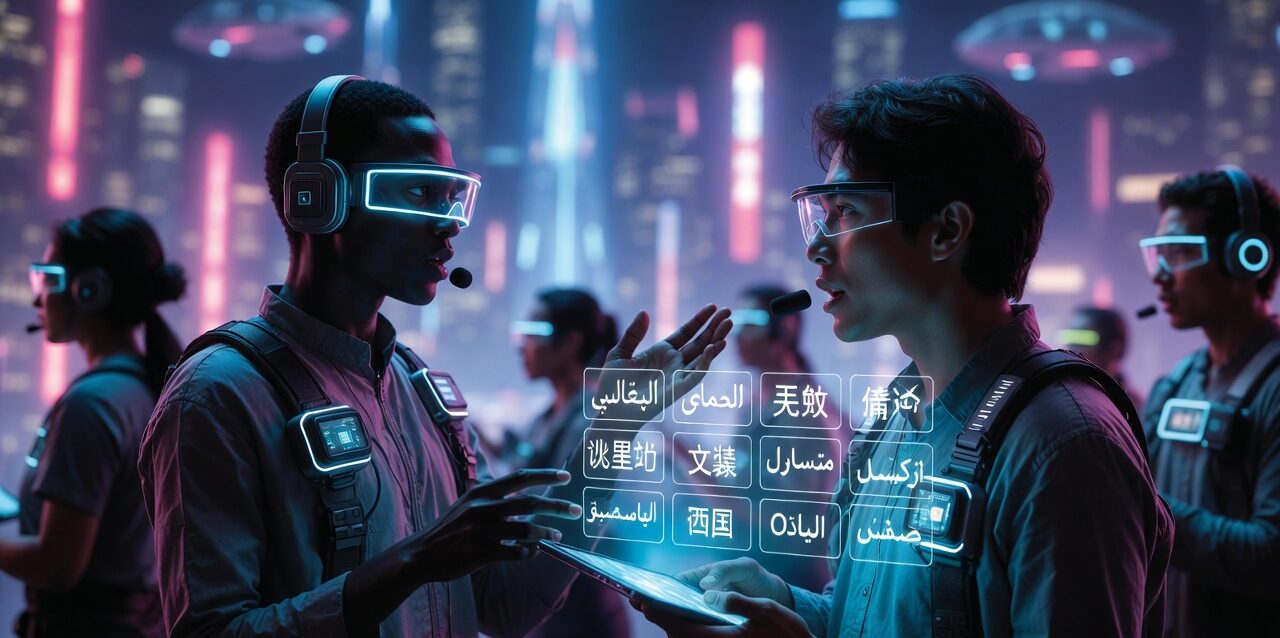
By 2040, speaking different languages ceases to be a meaningful barrier for the vast majority of human communication. Translation becomes instantaneous, context-aware, emotionally intelligent, culturally adapted, and nearly indistinguishable from native speech — delivered via earpieces, glasses, implants, or ambient systems.
1. Near-Term (2026–2030): Near-Perfect Real-Time Speech Translation
- Wearable & Earpiece Translation Dominates
In-ear devices (successors to Google Pixel Buds, Timekettle, Waverly Labs Ambassador) achieve ~95–98% accuracy for major languages, with latency dropping below 200–300 ms.
Translation includes tone, emotion, and prosody — you hear the speaker’s voice with natural intonation, not robotic monotone. - AR Glasses & Visual Overlays
AR glasses (Meta Orion-style, Apple Vision successors) show live subtitles in your field of view, with lip-sync matching.
They also provide cultural notes (“this phrase is polite in Japanese but direct in English”) and idiomatic explanations. - Low-Resource & Dialect Expansion
AI models trained on massive multilingual datasets (Common Voice expansions, self-supervised learning) bring high-quality translation to hundreds of low-resource languages and dialects.
2. Medium-Term (2030–2035): Emotionally Intelligent & Culturally Fluent Translation
- Emotional & Prosody Preservation
Translation systems preserve sarcasm, excitement, anger, affection, humor — you hear the emotional intent, not just words.
AI detects and adapts cultural communication styles (direct vs indirect, high-context vs low-context cultures). - Voice Cloning & Personalization
You hear the speaker in their own voice (cloned in real time), or in your preferred voice/accent.
Translation adapts to your personality — formal with your boss, casual with friends. - Multi-Modal & Contextual Awareness
Translation incorporates gestures, facial expressions, environment, and conversation history.
Example: if someone bows while speaking Japanese, the system explains the cultural meaning while translating the words.
3. Long-Term (2035–2040): Direct Concept Transfer & Language Fade
- Non-Verbal & Neural Communication
Early non-invasive brain-computer interfaces (BCI) allow thought-to-thought and concept-to-concept communication.
You “think” an idea → the other person receives the pure concept (no language needed).
Words become optional — especially in close relationships or professional settings. - Language as Optional Layer
Major global languages (English, Mandarin, Spanish, Hindi) remain for cultural identity, but day-to-day communication increasingly bypasses language entirely.
AI mediators handle nuance; misunderstandings become rare. - Cultural & Identity Preservation
Even as barriers vanish, people preserve their native languages for literature, humor, intimacy, and heritage.
AI helps endangered languages survive — generating native speakers, teaching fluency, and creating immersive cultural experiences.
Illustrative Communication Scenarios by 2040
- Business Meeting — Japanese executive speaks Japanese; you hear perfect English in her natural voice with polite tone preserved. AI subtly notes cultural context (“this phrasing shows respect”).
- Travel — In rural India you speak English; locals speak Hindi — both hear fluent, natural conversation with regional accent and slang.
- Romantic Moment — Partner in another country sends a “feeling packet” — you experience their affection directly via subtle haptics + neural link.
- Therapy Session — Therapist speaks one language; client another — both feel full emotional presence with no translation lag.
Key Numbers & Trends by 2040 (illustrative)
- Real-time speech translation accuracy: 98–99.5% for major languages, 90–97% for low-resource
- Latency: <50–150 ms (near simultaneous)
- Percentage of international conversations using AI mediation: 80–95%
- Non-verbal/concept-based communication share: 20–50% in close relationships & professional settings
- Endangered language preservation success: 50–70% via AI revival programs
Risks & Societal Shifts
- Cultural Homogenization — Risk of losing linguistic diversity and nuance if everyone defaults to AI-mediated “perfect” communication.
- Privacy & Manipulation — Constant listening/processing raises surveillance and deepfake concerns.
- Dependency — People may lose second-language skills; AI failures could cause breakdowns in communication.
- Inequality — Advanced neural-linked translation may remain elite for years.
Bottom Line
By 2040 speaking different languages stops being a barrier — it becomes almost irrelevant.
The dominant paradigm becomes instantaneous, emotionally intelligent, culturally aware, and increasingly direct communication — AI removes friction, preserves intent, and lets people connect at the speed of thought.
Language won’t disappear — it will become optional, preserved for identity, art, humor, and intimacy.
The future isn’t a single global language — it’s no language needed for most practical interaction, while the richness of human tongues survives as cultural treasure.
Communication becomes not just faster or clearer — it becomes deeper, truer, and more human than ever before.
The tower of Babel falls — not because we speak one tongue, but because we no longer need tongues at all.