
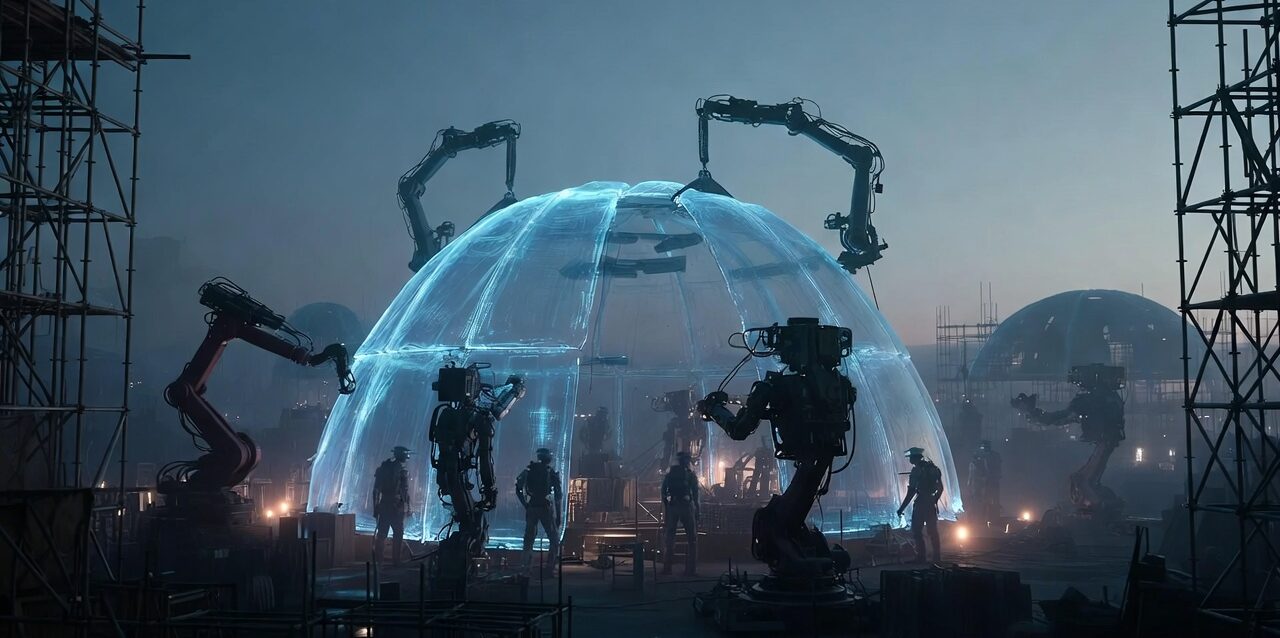
From Traditional Building Sites to Fully Automated, Regenerative, and Adaptive Construction Ecosystems
As of February 2026, the global construction industry is valued at approximately $12–14 trillion annually, yet it remains one of the least digitized and most labor-intensive sectors. Productivity has barely improved in decades, with issues like labor shortages, safety risks, material waste (~20–30%), schedule delays (average 20–80% overruns), and high carbon footprint (construction contributes ~39% of global CO₂ emissions).
By 2040, construction transforms into a highly automated, data-driven, and regenerative process — where buildings are largely 3D-printed, robot-assembled, and designed by AI, with human roles shifting to oversight, creativity, and complex decision-making.
1. Near-Term (2026–2030): Automation & 3D-Printing Scale-Up
- Large-Scale 3D Printing Becomes Mainstream
Concrete 3D printing (ICON, COBOD, Apis Cor) accelerates for residential, commercial, and infrastructure projects.
Multi-story buildings printed in weeks rather than months.
Cost reductions reach 20–50% vs traditional methods; waste drops dramatically. - Robotic Construction Swarms
Robotic arms, exoskeletons, and autonomous heavy machinery handle repetitive tasks (bricklaying, rebar tying, welding, painting).
Boston Dynamics-style quadrupeds and humanoid robots (Figure, Agility Robotics) perform indoor finishing and hazardous work. - AI-Driven Design & Planning
Generative AI produces optimized building designs in hours — maximizing energy efficiency, structural integrity, and material use.
Digital twins simulate entire construction processes, predicting delays, cost overruns, and safety risks before groundbreaking.
2. Medium-Term (2030–2035): Regenerative Materials & Modular Megaprojects
- Regenerative & Bio-Based Materials
Mass timber, mycelium-based composites, lab-grown concrete alternatives, and self-healing materials become standard.
Carbon-negative concrete (captures CO₂ during curing) and recycled aggregate dominate.
Buildings designed to be disassembled and reused (DfD — Design for Disassembly). - Modular & Off-Site Construction Dominates
70–90% of building components fabricated off-site in factories — assembled on-site like LEGO in days/weeks.
Entire skyscrapers and neighborhoods built from pre-fabricated modules delivered by autonomous trucks or drones. - Autonomous Construction Sites
Swarms of coordinated robots work 24/7 with minimal human oversight.
AI manages logistics, material flow, and safety — detecting hazards and rerouting workers/robots in real time.
3. Long-Term (2035–2040): Fully Adaptive & Self-Building Structures
- Self-Assembling & Adaptive Buildings
Modular, shape-shifting structures reconfigure based on need — office to residential, event space to warehouse.
4D printing (materials that change over time) allows buildings to adapt to climate, occupancy, or use. - AI & Swarm-Driven Megaprojects
Entire cities built by thousands of coordinated robots and drones — from foundation to finishing.
Construction time drops from years to months; costs fall 50–80%. - Regenerative & Circular Construction
Buildings designed to sequester carbon, generate energy, and recycle materials at end-of-life.
Construction becomes net-positive — removing more CO₂ than it emits.
Illustrative Construction Scenarios by 2040
- Residential Tower — 3D-printed core + modular apartments assembled by robot swarm in 6–12 weeks.
- Urban Micro-Housing — Self-assembling pod communities reconfigure layout based on resident needs.
- Infrastructure Project — Autonomous bridge-building robots work 24/7; AI predicts weather delays and adjusts.
- Disaster Recovery — Rapid-deployment 3D printers and modular robots rebuild communities in days.
Key Numbers & Trends by 2040 (illustrative)
- 3D-printed building share: 30–60% of new construction in urban areas
- Robotic labor share on-site: 50–80% of tasks
- Construction waste reduction: 70–90%
- Average project timeline reduction: 50–80%
- Carbon footprint of construction: down 60–90% (net-positive in leading projects)
Risks & Societal Shifts
- Job Displacement — Construction workforce shrinks dramatically; reskilling essential.
- Inequality — Advanced construction favors wealthy cities/countries.
- Safety & Reliability — Robot errors or material failures in autonomous sites could be catastrophic.
- Regulation — New standards needed for 3D-printed structures, robotic safety, and circular design.
Bottom Line
By 2040 construction shifts from labor-intensive, error-prone, and carbon-heavy work sites to AI-orchestrated, robotic, and regenerative production systems.
The dominant paradigm becomes automated, modular, and net-positive building — structures are printed, assembled, and adapted by machines, with humans focusing on vision, creativity, and oversight.
Construction stops being slow and wasteful — it becomes fast, precise, and planet-positive.
The future building isn’t hammered together by hand — it grows, assembles itself, and heals the environment while doing so.
The skyline of 2040 will be built not by workers, but by intelligent systems that make every structure more sustainable, adaptable, and beautiful than anything we can build today.