
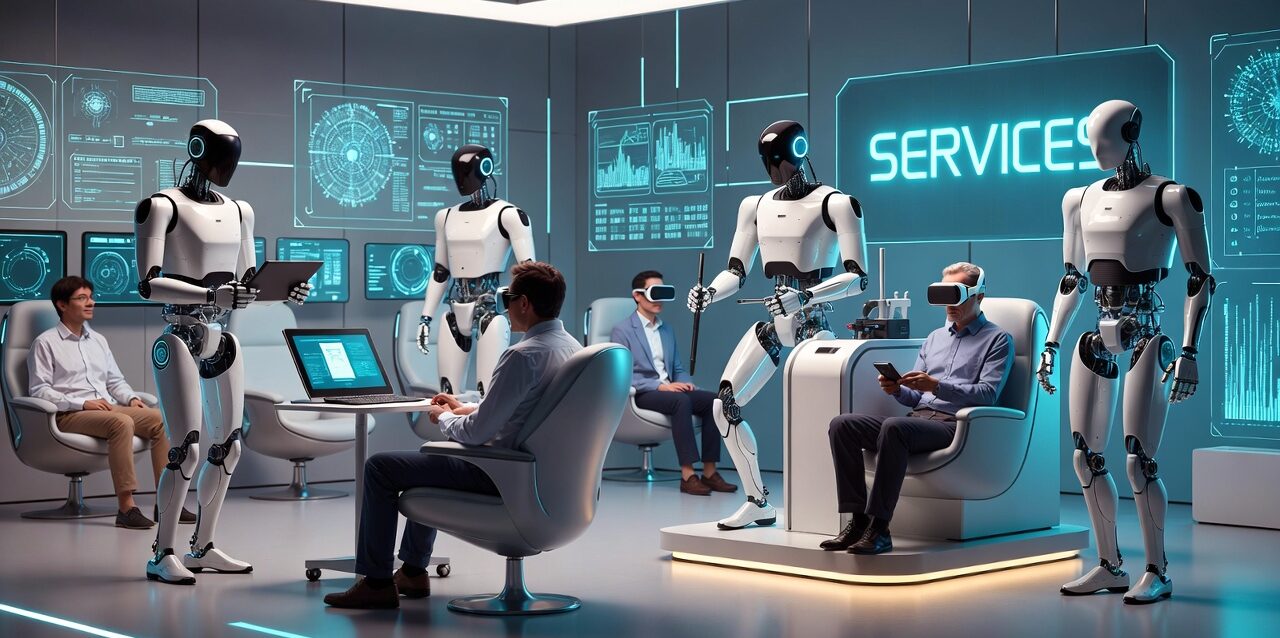
From Human-Delivered to AI-Orchestrated, Instant, and Hyper-Personalized Ecosystems
As of February 2026, services (personal, professional, hospitality, healthcare, education, maintenance, entertainment, etc.) are still predominantly human-delivered. The global services sector accounts for ~65–70% of GDP in advanced economies and is growing rapidly in emerging markets. Key challenges include labor shortages, rising costs, inconsistent quality, long wait times, and limited personalization.
By 2040, most services shift to AI-first, autonomous, predictive, and deeply personalized models — human involvement becomes rare, reserved for complex emotional, creative, or ethical decisions. Services become instant, always-available, and embedded in daily life, fundamentally changing how people access help, care, learning, and experiences.
1. Near-Term (2026–2030): AI Agents & Automation Take Over Routine Services
- Personal AI Agents as Universal Service Interface
Everyone has a primary AI agent (successor to Siri, Google Assistant, Alexa, Grok) that acts as concierge for almost every service: booking, scheduling, troubleshooting, shopping, payments, reminders, research.
Agents become proactive — they anticipate needs (“your car needs service — I’ve booked it”, “your mother hasn’t called in 3 days — should I check in?”). - Automation of Routine Services
- Cleaning/laundry: autonomous robots (Roomba successors + laundry-folding arms) become standard in middle-class homes.
- Food delivery & cooking: fully autonomous kitchens (Moley Robotics-style) and drone/robot delivery fleets dominate urban areas.
- Customer support: 90%+ handled by voice/text AI with near-human empathy and context retention.
- Hyper-Personalized On-Demand Services
Platforms like Uber, DoorDash, TaskRabbit evolve into AI-orchestrated marketplaces — matching tasks to humans or robots in seconds.
Prices drop 30–60% due to automation; availability becomes 24/7.
2. Medium-Term (2030–2035): Multi-Modal & Immersive Service Delivery
- AR/VR & Holographic Service
AR glasses or contact lenses let you “see” service providers in your space — virtual hairdressers style your hair, personal trainers guide workouts, therapists conduct sessions in shared VR rooms.
Holographic concierges greet you in hotels, stores, and public spaces. - Autonomous & Robotic Service Fleets
Robot baristas, waiters, cleaners, delivery bots, and elder-care companions become commonplace in urban areas.
Multi-modal fleets (drones + ground robots + autonomous vehicles) deliver anything within hours. - Predictive & Preventive Services
AI predicts needs before you ask — maintenance, healthcare, education, even social/emotional support.
Example: “Your back pain is recurring — I’ve booked a virtual physio session and ordered a posture-correcting chair.”
3. Long-Term (2035–2040): Symbiotic & Ambient Service Environments
- Ambient & Invisible Services
Most services become proactive and invisible — your home/office anticipates needs (temperature, lighting, food prep, scheduling) without explicit requests.
AI ecosystems manage entire life domains (health, finance, social, learning) in background. - Human-AI Symbiosis in Service Roles
Remaining human service providers focus on: - high-touch emotional care (therapy, elder companionship)
- creative/ethical decisions
- luxury bespoke experiences
Many humans become “service orchestrators” — directing AI/robot teams rather than performing tasks. - Decentralized & Community Service Models
Peer-to-peer platforms powered by blockchain/AI connect people directly for services (elder care, tutoring, repairs).
Community-owned robot fleets and shared AI agents become common in neighborhoods.
Illustrative Service Scenarios by 2040
- Morning Routine — AI agent wakes you, prepares breakfast via robotic kitchen, schedules your day, books a haircut with a virtual stylist.
- Healthcare — Wearable detects early illness → autonomous drone delivers meds → virtual doctor consults via AR hologram.
- Home Maintenance — AI notices a leak → dispatches micro-robot to repair it; you never call anyone.
- Social/Emotional Support — Feeling lonely? AI companion (or real human via VR) engages in meaningful conversation, tailored to your emotional state.
Key Numbers & Trends by 2040 (illustrative)
- Share of routine services handled by AI/robots: 70–90%
- Average service response time: <5–15 minutes (urban), <1 hour (rural)
- Human service jobs displaced: 40–70% in routine categories
- Service personalization accuracy: 95%+ (AI knows you better than most humans)
- Ambient service adoption in smart homes/cities: 50–80%
Risks & Societal Shifts
- Inequality — Premium AI/human hybrid services favor the wealthy.
- Dependency — Risk of reduced human skills and social connection.
- Privacy & Manipulation — Constant monitoring and predictive nudging raise ethical concerns.
- Job Displacement — Millions of service roles vanish; new roles emerge in AI oversight and human-touch specialties.
Bottom Line
By 2040, services shift from human-delivered transactions to AI-orchestrated, ambient, and deeply personalized ecosystems — most needs are anticipated and fulfilled before you ask, with minimal human involvement.
The dominant paradigm becomes proactive, seamless, and symbiotic service delivery — AI agents act as lifelong assistants, robots handle physical tasks, and humans provide only what machines cannot: genuine empathy, creativity, and ethical judgment.
Services stop being something you request — they become something that simply happens, perfectly aligned with your life.
The future isn’t better customer service — it’s the end of needing to ask for service at all.
Life becomes frictionless — not because humans disappear, but because they are finally freed to focus on what truly matters.