
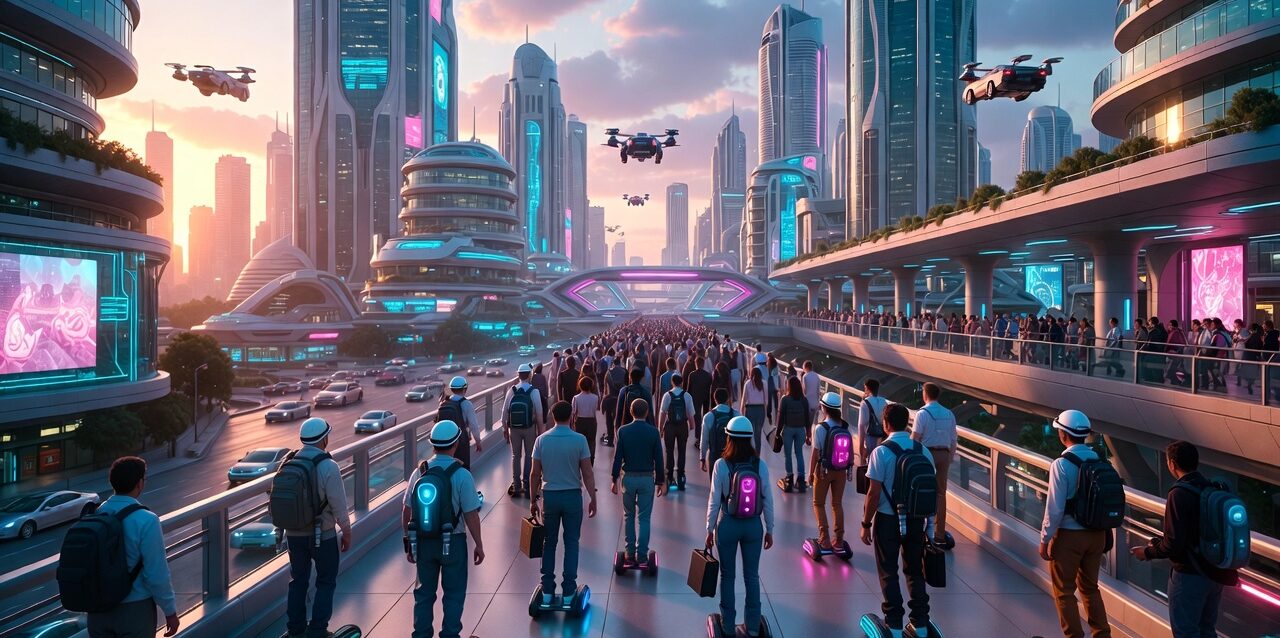
From Car Congestion and Fixed Schedules to Fluid, Autonomous, Multi-Modal, and Near-Zero-Friction Journeys
As of 2026, the daily work commute remains one of the most time-consuming and stressful parts of modern life.
In major cities, average one-way commute times range from 25–60 minutes (often longer in car-dependent metro areas), with traffic congestion costing billions in lost productivity and fuel.
Dominant modes: private car (especially in the US, Canada, Australia), public transit (metro, bus, commuter rail in Europe/Asia), and emerging micromobility (e-bikes, scooters).
Remote/hybrid work has reduced commute frequency for many knowledge workers (~30–50% of office roles), but most jobs still require physical presence.
By 2040 the work commute is almost unrecognizable — it becomes shorter, smoother, multi-modal, largely autonomous, and often productive or enjoyable rather than a chore. For many, “commuting” ceases to be a distinct activity; it blends into daily life.
1. Near-Term (2026–2030): Electrification + Autonomy + Urban Rebalancing
- Electric & Autonomous Vehicles Dominate
EVs reach 50–70% of new vehicle sales in leading markets; robotaxi fleets (Waymo, Cruise, Baidu Apollo, Tesla Robotaxi) scale in 20–50 major cities.
Ride-hailing becomes cheaper and faster than owning a car for many urban dwellers — no parking, no maintenance, no stress. - 15–20 Minute Cities & Proximity Living
Urban planning accelerates “15-minute city” principles — most people live within 15–20 minutes of work, shops, schools.
Companies offer housing subsidies or co-living near offices; reverse migration to smaller cities grows as high-speed rail and remote work blur boundaries. - Multi-Modal & Seamless MaaS
Mobility-as-a-Service apps unify eVTOL air taxis, autonomous pods, high-speed rail, e-bikes, and public transit — one app, one payment, optimized routing.
2. Medium-Term (2030–2035): High-Speed Corridors & Air-Ground Integration
- Hyperloop & High-Speed Underground/Overground
First commercial hyperloop routes (200–600 km) open — 600–1,000 km/h in low-pressure tubes.
Travel time between major cities drops to 20–40 minutes (e.g., Toronto–Montreal, Los Angeles–San Francisco, Riyadh–Jeddah). - eVTOL Air Commutes
Electric vertical takeoff and landing aircraft become routine for 50–150 km trips — rooftop pads in city centers and suburbs.
10–25 minute flights replace 60–90 minute road commutes. - Autonomous Road & Micro-Mobility
Dedicated autonomous lanes on highways; door-to-door pods reduce last-mile friction.
Personal e-bikes/e-scooters with AI route planning and battery-swapping stations become default for short commutes.
3. Long-Term (2035–2040): Frictionless, Productive, and Optional Commutes
- Commute Time Approaches Zero
Average urban commute drops to 5–15 minutes in leading cities via proximity living, hyperloop, eVTOL, and autonomous pods.
Many knowledge workers rarely commute physically — virtual offices in AR/VR feel identical to physical ones. - Productive & Rejuvenating Commutes
Autonomous vehicles become mobile offices, meditation pods, or sleep capsules.
You work, read, exercise, or rest during transit — time is reclaimed rather than lost. - Near-Zero-Emission & Shared Mobility
Personal car ownership falls to 20–40% in urban centers; most travel uses shared autonomous fleets.
Energy is 100% renewable/electric; transport emissions drop 70–90% in advanced regions.
Illustrative Work Commute Scenarios by 2040
- Urban Professional — Autonomous pod picks you up at home → 8-minute ride to vertical office hub → productive work during transit.
- Inter-City Commute — Hyperloop pod from suburb to city center — 25 minutes, onboard office setup, arrive fresh.
- Suburban Family — eVTOL air taxi from suburban home to downtown workplace — 15 minutes, scenic flight, no traffic stress.
- Global Remote Worker — Virtual commute via AR glasses — step into shared 3D office from anywhere in the world.
Key Numbers & Trends by 2040 (illustrative)
- Average urban commute time: 5–15 minutes (down from 25–60)
- Autonomous vehicle share of urban passenger-km: 70–95%
- Personal car ownership in city centers: down 50–80%
- Intercity travel time reduction on high-speed corridors: 50–80%
- Transport emissions from commuting: down 70–90% in leading regions
Risks & Societal Shifts
- Inequality — Premium eVTOL/hyperloop favors higher earners; rural areas lag.
- Privacy & Surveillance — Constant tracking in autonomous systems raises concerns.
- Job Displacement — Millions of drivers transition; new roles emerge in fleet oversight and mobility design.
- Urban Redesign — Parking lots become parks/housing; cities reclaim streets for people.
Bottom Line
By 2040 the work commute is no longer a daily tax on time and sanity — it becomes short, seamless, productive, and often enjoyable.
The dominant paradigm shifts to autonomous, multi-modal, and near-frictionless mobility — robotaxis, eVTOL, hyperloop, and proximity living eliminate most of the pain of getting to work.
Commuting stops being something you endure — it becomes something you barely notice, or even look forward to.
The future isn’t about faster cars or better trains — it’s about making the journey feel like part of life rather than a barrier to it.
Getting to work becomes invisible — so you can focus on living instead.