
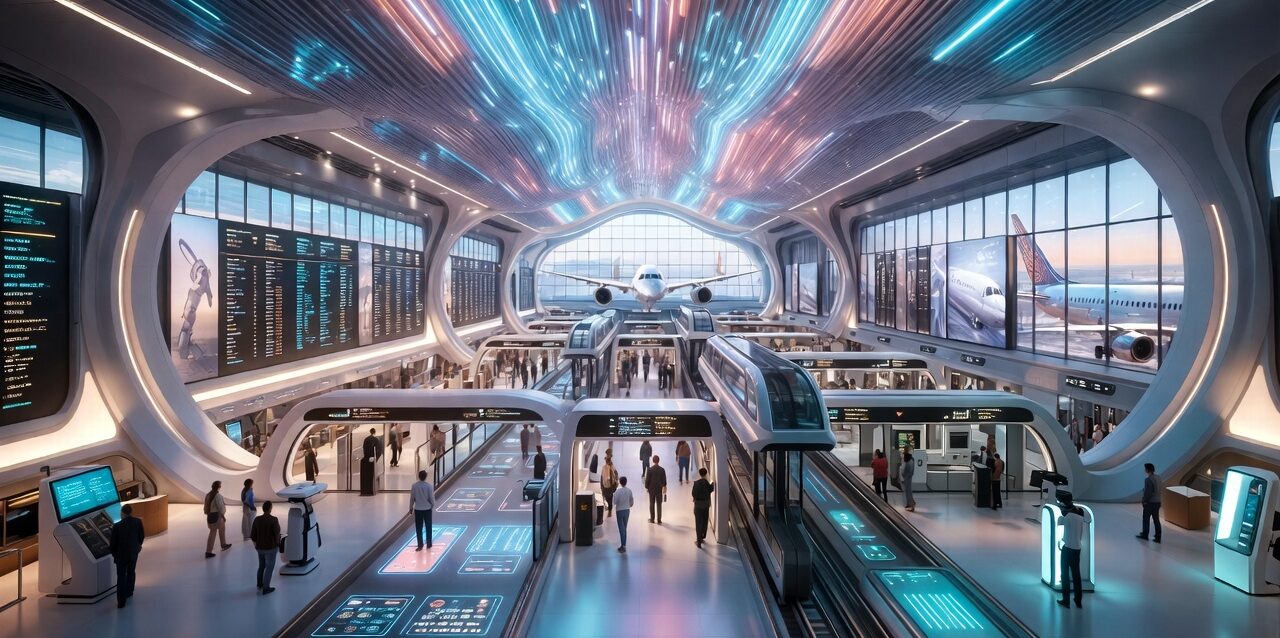
From Airport Chaos to Seamless, Hyper-Personalized, and Sustainable Global Journeys
As of 2026, international travel is fully recovered from the pandemic but still feels very 2019: long security lines, rigid airline schedules, paper/digital boarding passes, currency exchange hassles, language barriers, and significant carbon guilt. The global tourism industry generates ~$1.5–2 trillion annually, with air travel accounting for the majority of long-haul trips.
By 2040 traveling abroad becomes dramatically faster, smoother, cheaper, cleaner, and more personalized — for many people it feels almost frictionless, like moving between neighborhoods rather than crossing borders.
1. Near-Term (2026–2030): Friction Reduction & Electrification
- Airport & Border Process Transformation
Biometric e-gates and facial recognition become universal — no passport needed after initial enrollment (digital passport on phone or embedded token).
Security screening shifts to AI-driven passive scanners (walk-through body/ luggage analysis) — no removing shoes/belts/laptops.
Average airport time drops from 2–3 hours to 20–40 minutes. - Electric & Hybrid Long-Haul Aircraft
Short-haul electric flights (under 1,000 km) become common (e.g., Eviation Alice, Heart Aerospace ES-30).
Hybrid-electric narrowbodies (Airbus/Boeing concepts) enter service for medium-haul — 20–30% fuel savings.
Sustainable Aviation Fuel (SAF) blends reach 20–50% on many international routes. - Hyper-Personalized Travel Planning
AI agents plan entire trips — optimizing price, carbon footprint, layovers, experiences, and personal preferences (dietary needs, flight anxiety, cultural interests).
Virtual previews of hotels/destinations via VR become standard before booking.
2. Medium-Term (2030–2035): High-Speed & Air-Ground Integration
- Hyperloop & Vacuum-Tube Corridors
First inter-country hyperloop routes open (Europe, Middle East, China–SE Asia corridors).
600–1,000 km/h speeds make 300–800 km trips take 20–50 minutes — e.g., Paris–London 20 min, Tokyo–Osaka 25 min, Dubai–Riyadh 30 min. - eVTOL & Regional Air Taxis
Electric vertical takeoff and landing aircraft scale to regional travel (100–500 km).
City-center to city-center hops replace short-haul flights — rooftop vertiports become common. - Borderless & Digital Passports
Digital identity + biometric verification eliminates passport control for most travel.
Global agreements (similar to Schengen expansion) create seamless zones across continents.
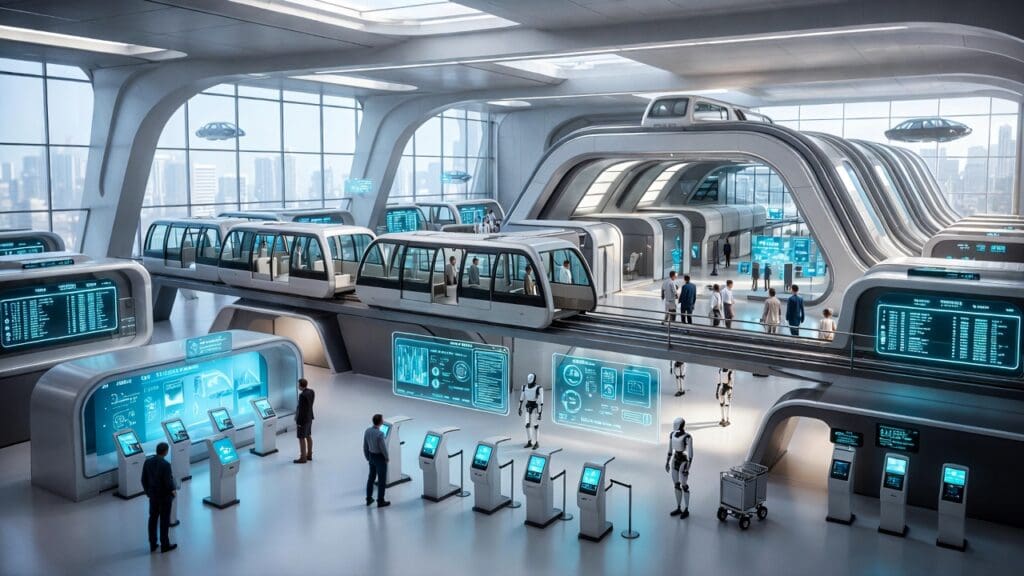
3. Long-Term (2035–2040): Frictionless, Sustainable, and Near-Teleportation Travel
- Near-Zero Friction Journeys
Average door-to-door international travel time for 1,000–3,000 km drops to 1–3 hours.
Seamless MaaS (Mobility-as-a-Service) platforms handle every leg — autonomous pod → hyperloop → eVTOL → final pod — one ticket, one app. - Supersonic & Suborbital Options
Boom Overture-style supersonic jets (Mach 1.7–2.2) become routine for transatlantic and transcontinental routes — New York–London in ~3.5 hours, Sydney–Los Angeles in ~6 hours.
Suborbital point-to-point flights (SpaceX Starship Earth-to-Earth) enter premium service — anywhere on Earth in under 1 hour. - Regenerative & Net-Zero Travel
Hydrogen and advanced battery aircraft dominate medium-haul.
Carbon-capture offsets and synthetic fuels make long-haul net-zero.
High-speed rail and hyperloop handle continental trips with near-zero emissions.
Illustrative City-to-City Travel Scenarios by 2040
- New York → London (5,500 km)
Suborbital flight: 45 minutes, premium price → autonomous pod pickup/drop-off at both ends. - Paris → Berlin (880 km)
Hyperloop: 25 minutes, €60–100, zero emissions. - Tokyo → Osaka (550 km)
Maglev upgrade: ~30 minutes, seamless high-speed rail. - Sydney → Melbourne (870 km)
eVTOL regional air taxi: 1 hour 15 minutes, city-center to city-center.
Key Numbers & Trends by 2040 (illustrative)
- Average international travel time reduction (medium/long-haul): 50–80%
- Share of intercity trips by high-speed rail/hyperloop/eVTOL: 50–70% in advanced regions
- Robotaxi/autonomous ground share of airport transfers: 80–95%
- Carbon intensity of air travel: down 70–95% (hydrogen, SAF, suborbital)
- Seamless border crossings (biometric/digital passport): 80–95% of international trips
Risks & Societal Shifts
- Inequality — Suborbital/supersonic and eVTOL remain premium; rural/less-connected regions lag.
- Privacy & Surveillance — Biometric borders and constant tracking raise concerns.
- Geopolitical — Control of hyperloop corridors and vertiports becomes strategic.
- Cultural — Risk of homogenized global travel experience; local immersion may decline.
Bottom Line
By 2040 traveling abroad becomes faster, cleaner, simpler, and more accessible than ever — often feeling like moving between neighborhoods rather than crossing continents.
The dominant paradigm shifts to seamless, multi-modal, and near-zero-emission global mobility — hyperloop and high-speed rail for medium distances, eVTOL for regional hops, suborbital for ultra-long-haul, and autonomous ground transport everywhere else.
The journey stops being the stressful part of travel — it becomes short, productive, or even enjoyable.
Borders become administrative rather than physical barriers.
The world truly shrinks — not just in time, but in emotional distance.
Traveling abroad in 2040 isn’t something you plan for months — it’s something you decide to do over breakfast.