
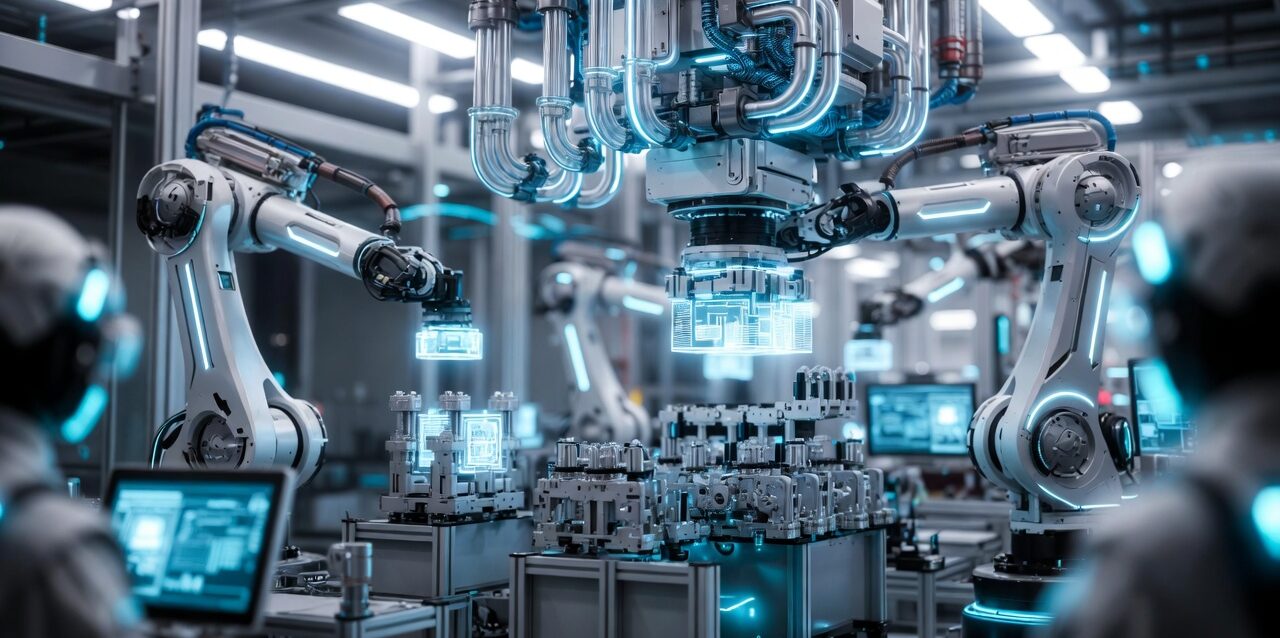
From Labor-Intensive Factories to Lights-Out, Regenerative, and Symbiotic Production Systems
As of 2026, global manufacturing contributes approximately 16–18% of world GDP, but the sector faces structural challenges:
- persistent labor shortages in developed economies
- rising wages and supply-chain fragility in emerging markets
- high material waste (20–30% in many industries)
- significant carbon footprint (~30% of global CO₂ emissions)
- slow productivity growth (almost flat for decades in many sectors)
By 2040 manufacturing has transformed into lights-out, AI-orchestrated, modular, circular, and often regenerative production ecosystems. Human presence on factory floors is minimal or optional; the focus shifts from cost-cutting through labor reduction to creating abundance with minimal environmental harm.
1. Near-Term (2026–2030): Lights-Out Scale-Up & AI-First Operations
- Lights-Out Factories Become Standard in High-Volume Sectors
Electronics, automotive components, consumer goods, and pharmaceuticals shift to 24/7 autonomous production.
Human workers move to remote oversight, robot maintenance, process design, and quality strategy. - AI & Digital Twins as Core Nervous System
Every factory runs a real-time digital twin that simulates, predicts, and optimizes every machine, material flow, energy use, and quality parameter.
Predictive maintenance reaches 90–95% accuracy; unplanned downtime drops below 1–2%. - Modular & Reconfigurable Production Lines
Plug-and-play robotic cells allow product changes in hours instead of weeks.
Mass customization becomes default — same production line outputs thousands of unique variants daily with zero tooling changes.
2. Medium-Term (2030–2035): Regenerative Materials & Swarm Robotics
- Closed-Loop & Regenerative Material Flows
Factories achieve near-100% material reuse — scrap is recycled on-site instantly (metals, plastics, composites).
Bio-based materials, lab-grown alternatives, self-healing polymers, and CO₂-derived feedstocks become mainstream.
Many facilities become net-positive — generating surplus energy and feeding it to the grid or local community. - Swarm & Humanoid Robotics Take Over
Thousands of small, task-specialized robots work in coordinated swarms — self-organizing, self-repairing, adaptive.
General-purpose humanoid robots (Tesla Optimus, Figure, 1X Neo successors) handle unstructured, complex, and creative tasks (final assembly, quality inspection, maintenance). - Distributed & On-Demand Micro-Factories
Small, urban micro-factories (3D printing hubs, robotic cells) produce custom parts and short-run products locally.
Global supply chains shorten dramatically; production relocates closer to consumption.
3. Long-Term (2035–2040): Self-Building, Self-Optimizing, and Carbon-Negative Manufacturing
- Self-Building & Self-Improving Factories
Robotic swarms construct and expand factories — adding lines, reconfiguring layouts, optimizing for new products without human intervention.
AI continuously redesigns the entire facility in real time based on demand, energy prices, material availability, and climate conditions. - Zero-Waste & Carbon-Negative Production
Every factory operates on fully circular principles — inputs are recycled or bio-sourced, outputs are reusable or biodegradable.
Many facilities actively sequester carbon or produce carbon-negative materials as a byproduct. - Human Role Relegated to Strategic & Creative Oversight
Humans act as factory architects, AI trainers, ethical guardians, and innovation directors.
Physical presence on factory floors becomes rare — most work is remote or occasional.
Illustrative Factory Scenarios by 2040
- Lights-Out Electronics Gigafactory
Fully autonomous, zero human presence for months; AI self-optimizes yields, repairs robots, and adapts to new chip designs overnight. - Urban Micro-Factory
Compact robotic cell in a city warehouse produces custom parts on demand — customers pick up same-day via drone or autonomous pod. - Regenerative Apparel Plant
Produces clothing from recycled textiles and bio-fibers; captures CO₂ during dyeing; waste becomes new feedstock for the next run. - Self-Building Modular Factory
Robot swarm adds new production lines overnight based on rising demand; the factory literally grows and evolves itself.
Key Numbers & Trends by 2040 (illustrative)
- Share of manufacturing tasks handled by robots/AI: 70–95% in structured industries
- Average factory downtime: <1–2% (predictive + self-repairing systems)
- Material waste reduction: 80–95% in advanced facilities
- Energy self-sufficiency in new factories: 70–100% (often net-positive)
- Human on-site workforce per factory: down 60–90% from 2025 levels
- Global manufacturing carbon footprint reduction: 60–90% (net-negative in leading plants)
Risks & Societal Shifts
- Massive Job Displacement — Tens of millions of traditional manufacturing roles disappear; reskilling and universal basic income become central policy debates.
- Geographic & Economic Inequality — Advanced automated factories concentrate in wealthy nations/regions; developing economies risk being left behind.
- Cyber & Systemic Risk — Fully autonomous plants are vulnerable to hacking, supply-chain attacks, or single-point AI failures.
- Over-Reliance — Risk of fragility if intelligent orchestration systems collapse.
Bottom Line
By 2040 factories cease to be noisy, labor-intensive, resource-consuming sites — they become quiet, self-sustaining, regenerative, and hyper-efficient production organisms.
The dominant paradigm shifts to lights-out, AI-orchestrated, modular, and circular manufacturing — robots and AI handle 90%+ of physical execution, while humans focus on vision, creativity, strategy, and ethical stewardship.
Factories no longer extract from the planet — they regenerate it, producing goods with minimal waste and often net-positive environmental impact.
The future factory isn’t a place of sweat and smoke — it’s a silent, intelligent system that creates abundance without destruction.
Manufacturing stops being about making things cheaply — it becomes about making things beautifully, sustainably, and in harmony with both people and the planet.
The factory of 2040 doesn’t need lights — because the future is bright enough already.