
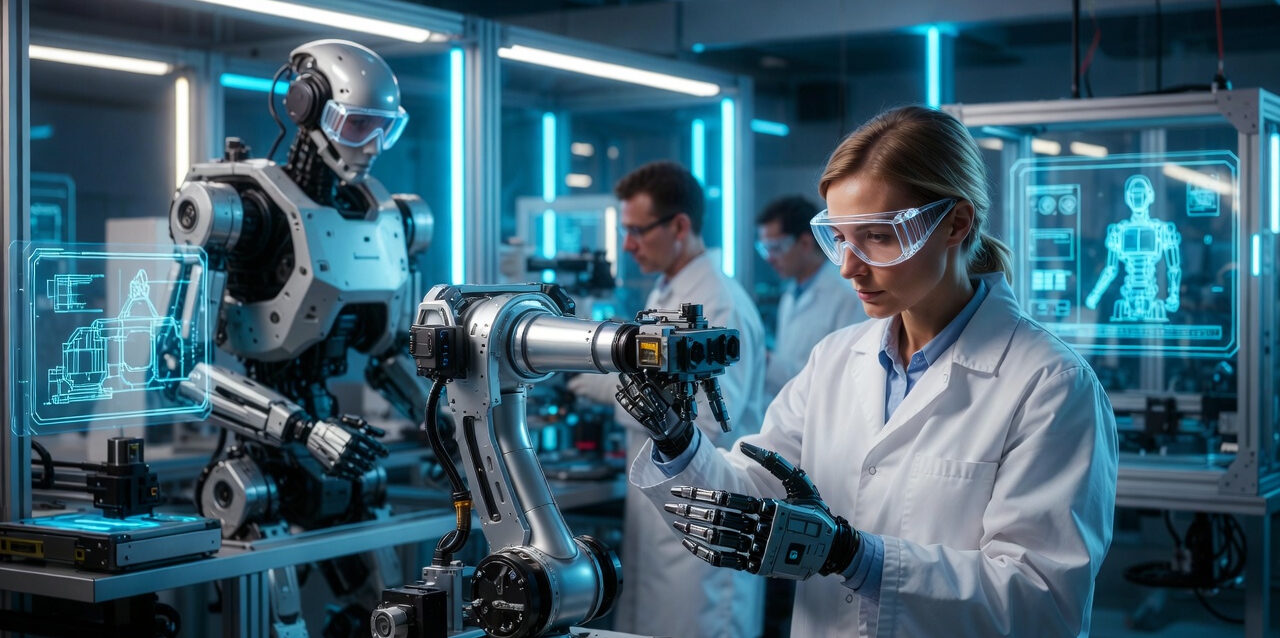
From Specialized Machines to Physical AI, Humanoid Labor, and Adaptive Ecosystems
As of February 2026, robotics engineering is at a pivotal juncture. The global robotics market is valued at around $50–70 billion, dominated by industrial arms in manufacturing, but expanding rapidly into service, healthcare, and consumer spaces. Key drivers include AI advancements, falling hardware costs, and labor shortages. Forecasts project the market reaching $200–500+ billion by 2030–2035, with CAGR of 15–30%+ driven by humanoids, cobots, and agentic systems. By 2040, robotics engineering shifts from rigid, task-specific designs to adaptive, cognitively intelligent, and human-symbiotic platforms — blurring lines between robots, AI, and humans.
1. Near-Term (2026–2030): Physical AI and Humanoid Pilots
- Rise of Physical AI & Agentic Systems
Robotics engineering focuses on “Physical AI” — combining analytical AI for decision-making with generative AI for adaptability. Agentic AI enables robots to handle unstructured tasks, perceive environments, and make decisions autonomously. Early applications: manufacturing (machine tending, inspection), healthcare (patient assistance), and homes (basic chores). - Humanoid Robots Enter Production
Tesla Optimus, Figure 01/02, and Chinese equivalents move from prototypes to pilots in factories and warehouses. By 2030, mass production begins in China, targeting 1–5 million units annually for labor-intensive industries. Engineering challenges: dexterity, balance, energy efficiency solved via simulation-first development and open ecosystems. - Cobots & Versatility in Workplaces
Collaborative robots (cobots) gain traction in SMEs via Robots-as-a-Service (RaaS) models, addressing labor shortages in manufacturing and construction. IT/OT convergence breaks silos, enabling versatile robots for dynamic environments.
2. Medium-Term (2030–2035): Simulation-First, Swarms, and Human-Robot Symbiosis
- Simulation-First Engineering & “Simulate-Then-Procure”
Robotics development adopts a “simulate-then-procure” economy — digital twins and advanced simulations (NVIDIA Omniverse-style) test designs before physical build, reducing costs 50–70% and speeding deployment. Vision-language-action models enable robots to learn from simulations and adapt to real-world variability. - Swarm Robotics & Multi-Agent Systems
Engineering focuses on coordinated swarms (10–100+ units) for complex tasks in manufacturing, construction, and disaster response.
Humanoids integrate with swarm ecosystems — e.g., a humanoid overseer directing cobot teams in dynamic factories. - Human-Robot Symbiosis & Emotional Intelligence
Robots gain “self-sustaining” capabilities — fast learning, adaptability, and creativity — moving from fenced industrial arms to co-workers in homes and offices. Engineering incorporates emotional AI for healthcare and service roles, with humanoids providing companionship and support.
3. Long-Term (2035–2040): Ubiquitous Humanoids, Ethical Frameworks, and Societal Integration
- Mass Humanoid Deployment
Humanoids reach billions in scale (optimistic forecasts), with engineering focused on reliability, affordability, and open ecosystems. Applications: elder care, construction (reducing hazards by 72%), and home assistance. - Ethical Engineering & Global Standards
Robotics engineering incorporates bias mitigation, safety protocols, and “robot rights” debates. Open ecosystems drive interoperability and rapid innovation. - Societal & Economic Impact
Robots address labor gaps in manufacturing, agriculture, and caregiving; RaaS models make automation accessible to SMEs. Engineering shifts toward “digital nervous systems” — interconnected, adaptive robotic networks.
Illustrative Robotics Engineering Scenarios by 2040
- Manufacturing Floor — Humanoid overseer directs cobot swarm for assembly; AI adapts to supply changes in real time.
- Elder Care Home — Emotionally intelligent humanoid provides companionship, monitors health, and assists with tasks.
- Construction Site — Swarm of quadruped robots builds structures; simulation-first design ensures safety and efficiency.
- Daily Life — Home humanoid handles chores, learns family preferences, and integrates with smart home AI.
Risks & Societal Shifts
- Job Displacement — 10–30% of manual labor roles automated; reskilling critical.
- Supply Chain Splits — Geopolitical tensions create dual robotics ecosystems (West vs. China).
- Ethical Concerns — Bias in AI, humanoid rights, and over-reliance on robots.
- Safety & Reliability — Early failures in humanoids highlight need for standardization.
Bottom Line
By 2040, robotics engineering evolves from task-specific machines to physical AI, humanoid, and swarm-based systems that integrate seamlessly into human environments. The dominant paradigm becomes self-sustaining, adaptable, and symbiotic robotics — addressing labor gaps, enhancing safety, and transforming industries. Engineering shifts to simulation-first, open ecosystems, and ethical design. The future isn’t robots replacing humans — it’s robots enabling humans to focus on creativity and purpose. Robotics won’t just automate work — it will redefine life.