
The Godfather Reborn: A Cyberpunk Reimagining in 2047
What if the Corleone family never truly escaped the shadows? What if, instead of fading into “legitimate” obscurity, their empire evolved into something far more dangerous—and far more inescapable—in a world ruled by code, corporations, and constant surveillance?
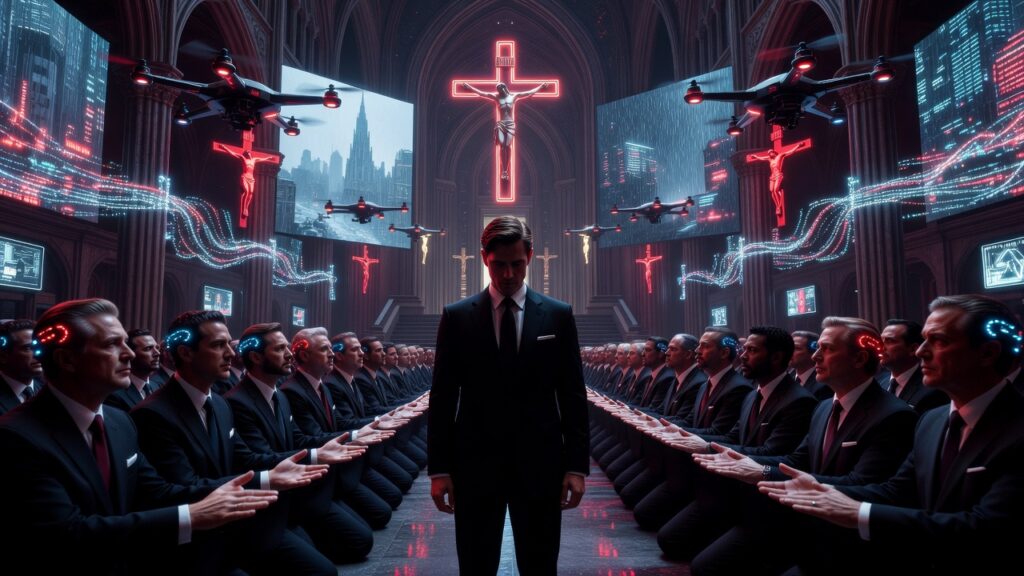
Picture this: It’s 2047. The old New York brownstones have given way to towering megastructures wrapped in holographic ads. Drones hum overhead like mechanical vultures. Neural implants track every thought, every deal, every betrayal. And the Corleone name? It’s no longer whispered in back alleys—it’s etched into blockchain ledgers, encrypted servers, and the predictive algorithms that run private security empires.
Welcome to The Godfather: Legacy Protocol—a fan-concept reimagining of Mario Puzo’s timeless saga, transplanted into a high-tech, low-life future where family loyalty clashes with AI overlords.
The Evolution of the Family Business
In this version, the Corleones have “gone legitimate”—on paper. Corleone Dynamics is a megacorp specializing in loyalty-enforcing neural nets, predictive threat analytics, and encrypted dark-web infrastructure. They sell “protection” to the ultra-wealthy: algorithms that foresee assassinations, implants that ensure unbreakable oaths, and autonomous security swarms that eliminate problems before they arise.
But the old ways die hard.
Vincent Mancini-Corleone, the hot-headed heir from Part III, is now an elderly shadow chairman in his late 70s. Cybernetic enhancements keep him sharp—augmented retinas for reading lies in micro-expressions, neural dampeners to quiet the ghosts of past sins. Yet the glitches come at night: flashes of Michael’s final collapse, Michael’s voice echoing through faulty implants.
The new face of the family is Elena Corleone, Vincent’s brilliant granddaughter. Raised in the sterile glow of Silicon Valley academies, she’s an AI ethicist who helped design the very Loyalty Protocol that binds the family’s made men. She believes in redemption, in breaking the cycle. Until a rival syndicate—Nexus Imperium—hacks the system, frames the Corleones for a catastrophic global data breach, and forces her back into the fold.
Here, the family curse isn’t just blood—it’s code written into their DNA and their digital footprints.
Reimagined Icons in Neon and Code
The classic moments get a futuristic twist:
- The opening “baptism” sequence becomes a synchronized neural-implant ceremony. New recruits link minds in a VR cathedral while drone swarms deliver precise, silent retribution across continents. Elena watches from an oversight feed, horrified as the family “cleanses” its enemies in real time.
- “Leave the gun, take the cannoli” evolves into “Leave the drone, take the neural lace.” A trusted enforcer retrieves a black-market implant from a rain-soaked alley while autonomous hit-drones circle overhead.
- The Sicilian pilgrimage returns: A fortified villa on a warming Mediterranean coast, solar flares scrambling global networks. Deals must happen face-to-face again—old-school whispers in analog rooms—because “you can’t hack a handshake in person.”
- And Michael’s ghost? An AI reconstruction trained on decades of recordings. Holographic visions of Al Pacino appear to Elena in glitching blue light, reciting warped lines: “Just when I thought I was out… they pull me back in.” The voice distorts into static, binary warnings about power’s true cost.
Why This Future Feels Inevitable
The core themes remain eternal: Power corrupts. Family is both shield and chain. The dream of going straight is always just out of reach.
But in 2047, those truths hit harder. Surveillance erodes free will. Algorithms decide guilt before innocence. Legacy isn’t stories passed down—it’s unerasable data trails. The cannoli might be lab-grown, the gun a neural spike, but the tragedy is the same: You can upgrade the body, the empire, the world—but you can’t patch the soul.
This isn’t just a reboot. It’s a warning. In our accelerating present—where Big Tech plays godfather to entire economies, where loyalty is enforced by code, where betrayal can be predicted and preempted—the Corleones feel more relevant than ever.
Would Elena burn it all down and walk away? Or is the family curse hardcoded, inescapable across generations and centuries?
One thing’s certain: In this future, offers aren’t refused. They’re rendered obsolete.
What do you think—could the Corleones survive (or thrive) in a cyberpunk world? Or would the machines finally end the cycle? Drop your thoughts below.