
Titanic: Event Horizon
In the year 2147, humanity had outgrown the cradle of Earth. The oceans were relics, choked by rising seas and corporate mining rigs. The stars beckoned, and the grandest answer was the Titan Horizon—the largest interstellar liner ever built, a kilometer-long behemoth of graphene hulls, fusion drives, and opulent decks designed to carry 3,200 souls from the orbital docks of Luna to the fledgling colony worlds of Proxima Centauri b.
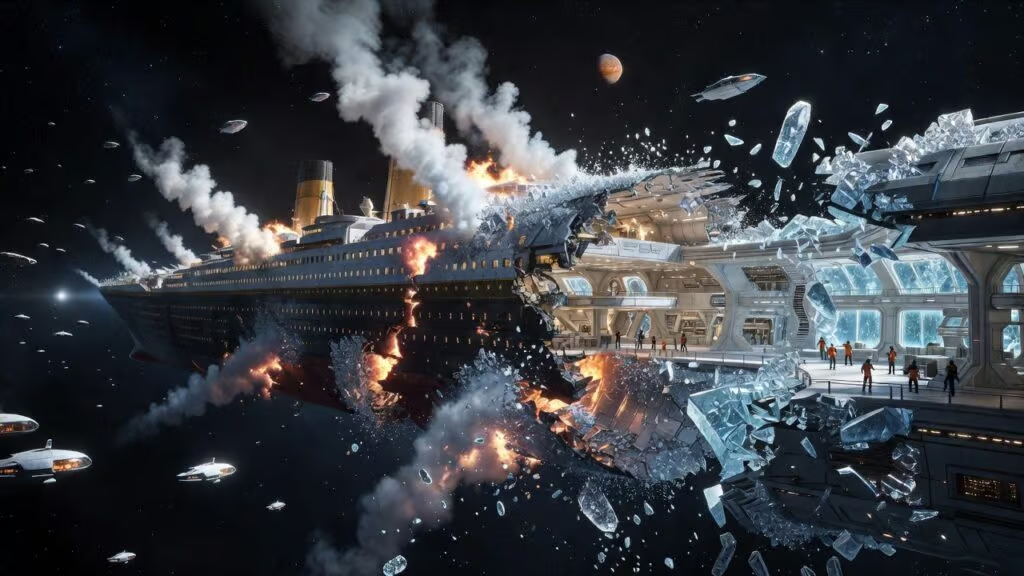
It was marketed as unsinkable in the vacuum. No icebergs in deep space, only the cold certainty of physics. The ship boasted tiered classes: the glittering Observation Promenade for the ultra-wealthy, mid-deck habitats for skilled colonists, and the cramped cargo bays repurposed for indentured workers paying passage with labor contracts. The voyage was billed as the pinnacle of human ambition—a floating city bound for new horizons.
Rose Valerian boarded at Lunar Gateway Station, escorted by her fiancé Caledon Hockley III, heir to the asteroid-mining conglomerate that had partially funded the ship. She wore a gown of smart-fabric that shifted colors with her mood, a necklace of lab-grown blue diamonds—the Heart of Eternity—draped around her neck like a chain. Rose hated it. She hated the arranged merger of families, the scripted future, the way every smile felt like a transaction. On the eve of departure, she slipped to the stern observation deck, the vast transparent alloy dome revealing the black expanse and the faint blue marble of Earth below.
She leaned over the railing, contemplating the drop into nothingness. No water to drown in, just the silent rush of vacuum if the emergency seals failed.
A voice cut through her thoughts.
“Don’t.”
She turned. A young man in third-class coveralls leaned against a bulkhead, sketching on a battered haptic tablet. Jack Dawson—no last name on record, just a drifter who’d won his ticket in a zero-g poker game on the station. His eyes were kind, unguarded.
“You’re not supposed to be up here,” Rose said.
“Neither are you.” He smiled faintly. “But the view’s better than the sims in steerage.”
They talked. For hours. Jack showed her his drawings—portraits of workers in the lower decks, the curve of Earth from orbit, abstract swirls of nebulae he’d seen in holovids. Rose laughed for the first time in months. When Caledon’s security drones pinged her location, she slipped away, but the seed was planted.
The Titan Horizon jumped to hyperspace on schedule, engines humming like distant thunder. The first weeks were paradise: zero-g balls in the grand atrium, live orchestras playing in the promenade, dinners where silverware floated until the artificial gravity kicked in. Jack and Rose met in secret—stolen moments in maintenance corridors, dances in the lower cargo holds where the gravity plating was glitchy and forgiving. He drew her one night, nude except for the necklace, the blue diamonds catching the soft glow of emergency strips. She felt seen, not owned.
Then came the anomaly.
Deep in the Oort Cloud fringe, long-range sensors picked up a rogue comet swarm—fragments of a shattered Kuiper object, tumbling at relativistic speeds. The captain, a polished corporate appointee named Edward J. Smithson, dismissed the early warnings. “We’re built for worse than dust,” he said in the daily broadcast. “Full speed ahead.”
The impact came without warning.
Not a single crash, but a shotgun blast of ice and rock punching through the forward ablative shielding at fractions of lightspeed. Alarms screamed. Sections of the hull vented atmosphere in white plumes. The ship’s AI, designed to prioritize first-class evacuation, locked blast doors and rerouted power to the luxury pods. In the lower decks, lights flickered, gravity failed, and people were sucked toward breaches before emergency fields snapped on.
Rose found Jack in the chaos of the mid-deck atrium. Water—recycled hydroponic fluid—poured from ruptured lines, freezing into crystalline shards in the depressurizing air. They ran, hand in hand, toward the lifeboat bays.
But the boats were already launching—half-empty, reserved for the elite. Caledon appeared, flanked by private guards, shoving toward a priority pod.
“You’re coming with me,” he snarled at Rose.
She looked at Jack, then at the necklace. In one motion, she tore it off and pressed it into Jack’s hand.
“Find a way out,” she whispered. “Promise me you’ll live.”
Jack shook his head. “Not without—”
A bulkhead buckled. Cold rushed in. Caledon’s guards dragged Rose toward the pod. Jack fought, but a stun pulse dropped him.
Rose was pulled inside. The door sealed. Through the viewport, she saw Jack pressed against the glass, mouthing words she couldn’t hear over the alarms. The pod jettisoned.
The Titan Horizon broke apart slowly, majestically, a constellation of debris glittering against the stars. Rose’s pod tumbled away, automated systems putting her into cryo-sleep as distress beacons fired toward the nearest relay.
She woke 87 years later aboard a salvage cruiser, the Keldysh Dawn, orbiting the wreck. An old woman now, she told her story to a team of artifact hunters chasing the Heart of Eternity—said to be priceless, a symbol of lost hubris.
They found the drawing in a sealed locker, still intact. Rose smiled, tears freezing on her lashes in the low gravity.
She floated to an airlock, the diamond in her palm. With a gentle push, she released it into the void.
It drifted toward the shattered hulk of the Titan Horizon, glinting once in the distant starlight before vanishing among the ice and silence.
Rose watched until it was gone.
“Make each day count,” she whispered, echoing words from a life long past.
The wreck turned slowly, a ghost ship adrift forever, carrying the echoes of love, class, and the arrogance that thought the stars could be tamed.
In the end, the void claimed them all the same.