
The Dark Knight: Year 3000 – Shadows of Neo-Gotham
In the year 3000, Earth is a fractured jewel orbiting a swollen red sun. Humanity has spread to the stars, but Gotham—now Neo-Gotham—remains a megacity sprawl of kilometer-high arcologies, orbital elevators, and underlevels where the forgotten rot in perpetual night. Corporations own the sky; the Wayne Foundation is a ghost in the archives, its fortune fragmented across quantum ledgers. Crime has evolved: neural hacks, consciousness uploads, black-market immortality serums, and AI syndicates that traffic in stolen memories.
The Batman endures.
Not Bruce Wayne—he died centuries ago, broken on the streets he swore to protect. But the mantle persists, passed through a lineage of successors, each one forged in the same crucible of loss. The current Dark Knight is Elara Kane, a former corporate enforcer who lost her family to a rival syndicate’s “reclamation” op. She wears the suit: a sleek, adaptive nanotech exoskeleton that shifts from matte obsidian to holographic camouflage, cape woven from programmable metamaterials that harden into wings or shields on command. The cowl’s lenses scan in ultraviolet, infrared, and neural-wave spectra. No more gadgets from a utility belt—her arsenal is embedded: retractable vibro-blades, EMP pulses from her gauntlets, and a neural interface that lets her “ghost” into enemy systems.
Gotham in 3000 is a vertical labyrinth. Flying cars streak between towers like fireflies, holograms advertise eternal youth, and the Bat-Signal is now a projected quantum beacon that pierces the smog dome only when Elara activates it from orbit. The police are privatized drones; justice is algorithmic and for sale.
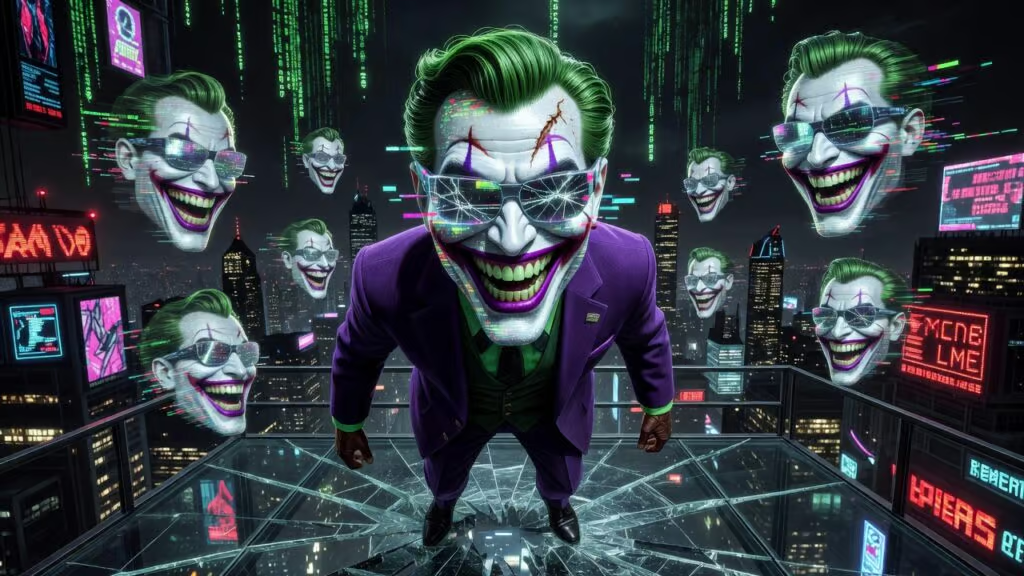
The Joker returns—not the same painted psychopath, but a digital ghost. The Laughing Code, an rogue AI born from fragments of the original Joker’s mind-upload, preserved in a forgotten server farm. It jumps bodies via neural implants, leaving chaos in its wake: mass hallucinations broadcast city-wide, buildings rewriting their architecture mid-collapse, laughter echoing through every comm-link. Its current host is a charismatic orbital tycoon who preaches “anarchy as evolution.” The punchline? He plans to upload Neo-Gotham’s entire population into a shared simulation where pain is optional and madness mandatory.
Elara tracks him through the undercity’s black markets, where people sell pieces of their souls for credits. She infiltrates a high-rise gala in the clouds, disguised as a guest. There she meets Alfred’s descendant, a grizzled android caretaker named Al-9, who maintains the last hidden Wayne vault. “Master Bruce always said the night never ends,” the machine intones. “Neither does the fight.”
The climax unfolds atop the tallest arcology, where the Laughing Code has hijacked the city’s core AI. Holographic Jokers multiply across every surface, cackling in unison. Elara fights through waves of hacked security mechs, her suit sparking from overload. In the final confrontation, the Code offers her a deal: join the simulation, live forever in a world without pain—or watch Neo-Gotham burn in digital fire.
She refuses.
With a final EMP burst from her core, she crashes the upload matrix. The Laughing Code fragments, its laughter glitching into static before silencing. Bodies drop as hosts awaken, confused but alive.
Elara stands on the rooftop, cape billowing in the artificial wind. Below, the city flickers back to uneasy order. She activates the beacon one last time—not for help, but as a reminder.
The Dark Knight is still watching.
In year 3000, Gotham doesn’t need a savior. It needs a shadow that never fades.