
12 Angry Men: Reimagined in 2147 – “Twelve Neural Jurors”
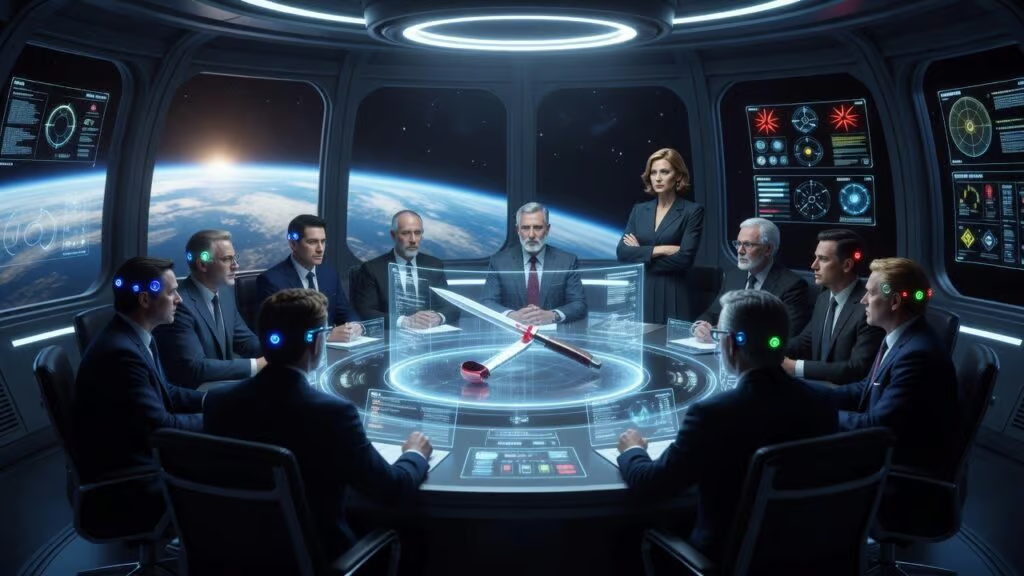
In a future where justice is outsourced to neural-linked juries and AI-assisted verdicts, the stakes of a single “reasonable doubt” have never been higher. The year is 2147. Earth is a network of megacities governed by the Global Concordance, a corporate-state hybrid that uses predictive algorithms to sentence defendants. Traditional courtrooms are relics; most trials are decided by neural consensus in virtual deliberation chambers. But for high-profile capital cases—like the one involving a young augmented immigrant accused of murdering his corporate-overlord father—human oversight is still required. Twelve jurors, selected for “cognitive diversity,” are sequestered in a sealed high-security pod orbiting low Earth, their minds linked via mandatory neural implants that broadcast thoughts, emotions, and biases in real time.
The defendant: a 19-year-old from the underlevels, neuro-enhanced for labor but not citizenship. Evidence seems ironclad—drone footage of the stabbing, neural memory logs from witnesses, a motive tied to inheritance disputes. The Concordance AI recommends guilty in under 3 seconds. Death by neural overwrite: personality erased, body repurposed for organ farms.
The jurors enter the deliberation pod: a sterile, circular chamber with holographic evidence tables, floating data orbs, and walls that pulse with biometric readouts. No windows—just the faint blue glow of orbital sunrise filtering through polarized shielding. The air is recycled, the temperature precisely 22°C. Tempers rise fast.
The Jurors, Reimagined
- Juror 8 (the lone dissenter, a quiet ex-hacker turned ethics professor): Votes “not guilty” on the first neural poll. “I have doubt. That’s enough.” His implant glitches slightly—he’s running an old privacy filter that blocks full emotional bleed. He insists they dissect the evidence, not just accept the AI summary.
- Juror 3 (the angry holdout): A retired security exec whose son was killed in a similar underlevel incident. His biases flood the shared neural space: red anger spikes, memories of loss projected as overlays.
- Juror 10 (the prejudiced one): A mid-level corp manager who sees the defendant as “one of those augmented slum-rats.” His rants about “those people” trigger automated bias alerts, but he overrides them, insisting class and mods prove guilt.
- Juror 9 (the elderly observer): An ancient augmented veteran who spots the subtle age in Juror 8’s hesitation. “He’s the only one not afraid of being wrong.”
- Others: A neural-interface tech who questions the drone footage’s timestamp integrity, a marketing exec swayed by narrative flaws, a medic who doubts the autopsy logs, and more—each one’s prejudices and logic exposed in vivid holographic bursts.
Key Reimagined Moments
- The knife: Not a switchblade, but a monomolecular vibro-shiv. Juror 8 produces a similar black-market model (smuggled via drone drop) and demonstrates how the “unique” wound pattern could be replicated. The shared neural sim replays the stab in slow-motion VR—jurors feel the virtual resistance, forcing empathy.
- The old witness’s testimony: A bedridden elder who “saw” the crime from his window. In this future, his neural feed is played back: grainy, laggy, corrupted by cheap implants. Juror 8 points out the audio mismatch—thunder masking footsteps—and the witness’s failing eyesight is proven when a holo-recreation shows he couldn’t have seen the door from his angle.
- The second witness (the woman across the tracks): Her neural memory shows the boy fleeing. But Juror 4 notices she rubs her temple during recall—classic sign of a cheap ocular mod. When they force a deeper dive, the implant’s facial recognition was glitching from a power surge.
- Climax: Juror 3’s breakdown. As doubt creeps in, his implant overloads with conflicting emotions—his son’s death overlaying the defendant’s face. He screams in the shared mindspace: “Not guilty!” The room falls silent. One by one, votes flip via neural consensus.
The verdict: Not guilty. The pod doors unseal. The jurors disperse to Earth, their implants logging the deliberation for public record. The AI’s recommendation is overridden—human doubt still matters.
In this future, the story’s core endures: prejudice blinds, certainty is dangerous, and one person’s refusal to rush judgment can save a life. But now, every bias is visible, every doubt quantifiable, every mind exposed.
The room empties. A single holographic note lingers: “Reasonable doubt achieved. Justice served… barely.”