
From Brick Phones to Neural Interfaces: How Technology Went from Visible to Invisible
In 1987, Gordon Gekko stood on a sun-drenched beach, barking orders into a device the size of a small loaf of bread. The Motorola DynaTAC 8000X—forever immortalized as “the brick”—wasn’t just a phone. It was power made manifest: expensive, heavy, and impossible to ignore.
Fast-forward to today (or rather, 2026), and that same act of distant command happens through a wafer-thin slab in your pocket—or increasingly, through nothing at all. Voice assistants listen silently. Neural interfaces (still early, but accelerating) promise to bypass the device entirely.
Technology’s most striking evolution isn’t speed or storage. It’s invisibility. Once loud, bulky, and ostentatious, our tools are disappearing into our bodies, our environments, and our thoughts.
Let’s walk the timeline through a few iconic leaps—communication and presidential mobility—and glimpse what comes next.
1. The 1980s Power Symbol: Gordon Gekko and the Brick
In Oliver Stone’s Wall Street, Gordon Gekko (Michael Douglas) didn’t just trade stocks—he performed dominance. One of the film’s most quoted scenes shows him on a Hamptons beach at dawn, suit impeccable, gripping the massive DynaTAC to his ear while waves crash behind him.
That phone cost the equivalent of ~$12,000 today, weighed nearly 2 pounds, took 10 hours to charge, and gave you maybe 30 minutes of talk time. Yet it screamed success. Carrying one meant you were connected when no one else was.
Contrast that with 2026: the same beach, same golden light, but the executive holds (or simply speaks to) a foldable screen measured in molecules rather than pounds. No visible effort. No status display required—because everyone assumes connectivity.
The brick was theater. Today’s tech is ambient.
2. When the President Flew in Propellers: From Sacred Cow to Jet Age
Presidential air travel tells a parallel story of shrinking spectacle and growing seamlessness.
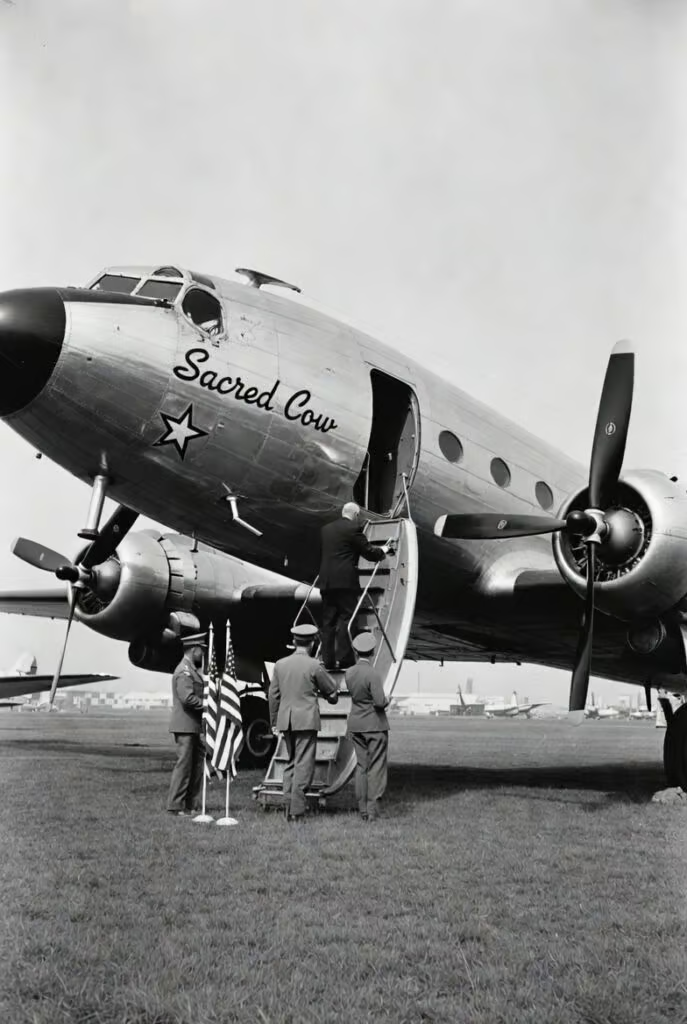
In 1945, Franklin D. Roosevelt became the first sitting president to fly while in office—on a specially modified Douglas C-54 Skymaster nicknamed the Sacred Cow. It had a conference room, sleeping quarters, and even an elevator for FDR’s wheelchair. Propellers, silver skin, and a very visible American flag made it look every bit the flying Oval Office.
By 1953, Dwight Eisenhower’s Lockheed VC-121A Constellation—Columbine II—became the first aircraft to carry the official call sign “Air Force One.” Still prop-driven, still gleaming, but faster and more refined.
The jet era arrived in 1959 with the Boeing VC-137 Stratoliner (also called “Queenie”). A sleek silver jet that looked unmistakably modern compared to its propeller predecessors.
Today’s VC-25A (modified Boeing 747-200B) is the iconic blue-and-white giant most people picture. Two identical aircraft rotate duty, each a flying fortress with mid-air refueling, EMP hardening, secure comms, and enough space to run the country from 30,000 feet.
But even this behemoth is becoming less visible in function. Future presidential transport concepts lean toward smaller, faster, stealthier platforms—or distributed networks where “Air Force One” is less a single plane and more a resilient cloud of drones, satellites, and secure links.
3. The Briefcase Era: Satellite Phones of the 1990s
In the early 1990s, true global connectivity arrived via Inmarsat and early Iridium systems. But “portable” meant something different: briefcase-sized terminals weighing 20–30 pounds, with fold-out umbrella antennas. Explorers, journalists, and military personnel lugged them to remote corners of the planet.
By the late 1990s, Iridium’s handheld phones shrank to roughly the size of a large contemporary cell phone—but still bulky and expensive. The leap from suitcase to pocket was monumental.
Now? Starlink terminals fit in a backpack, and consumer satellite messaging runs on standard smartphones. Connectivity is no longer carried; it’s everywhere.
4. The Invisible Present—and the Neural Tomorrow
We’ve gone from devices that demanded attention to ones that demand none. Smartphones became portals, then earbuds, then ambient assistants. Neural interfaces (Neuralink, Synchron, and emerging competitors) point toward the ultimate disappearance: thought becomes command.
Imagine dictating this article not by speaking or typing, but by thinking the words. No screen. No sound. Just intent translated to output.
The trajectory is clear: technology stops being a thing we hold and becomes a layer we inhabit. From Gekko’s brick to silent neural uplink, the story is one of reduction—size, friction, visibility—until technology merges seamlessly with humanity itself.

That’s not just evolution. That’s transcendence.
What was once a status symbol on a beach in 1987 may soon be remembered as the last era when technology still needed to shout to be noticed.