
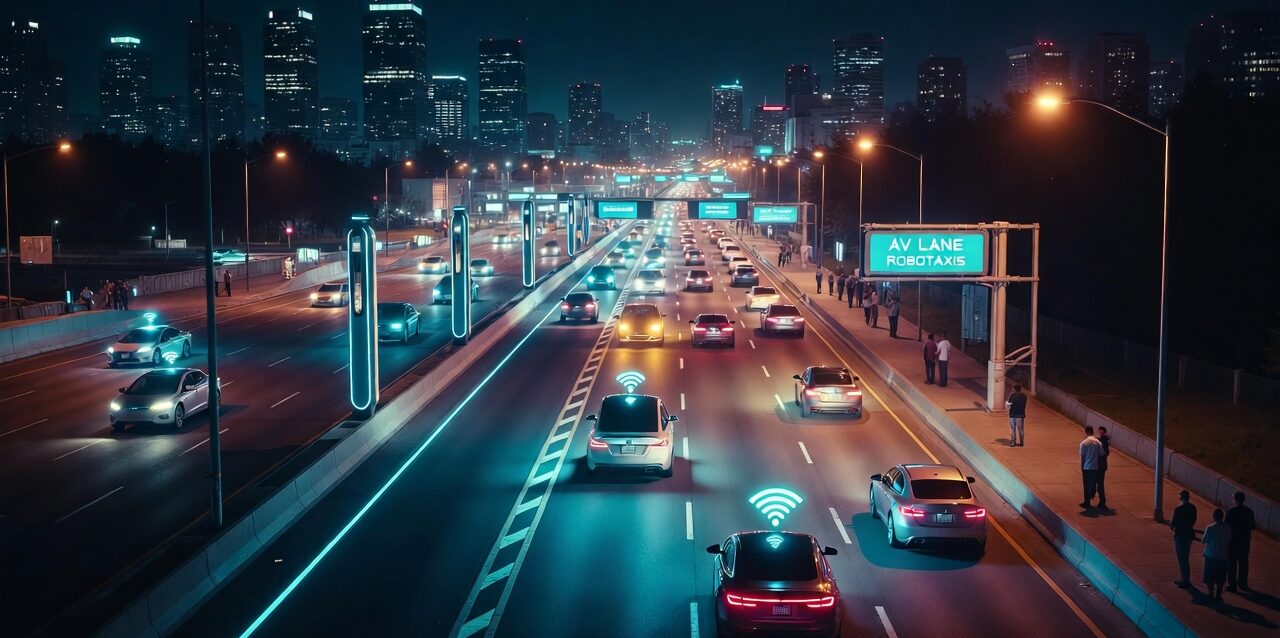
Autonomous Vehicles Didn’t Just Change Driving – They Changed Cities
From Human-Driven Sprawl to AV-Orchestrated, Compact, and Sustainable Urban Ecosystems
As of 2026, autonomous mobility remains in early commercial stages, with Level 2+ systems common in premium vehicles and Level 4 pilots limited to robotaxis in select cities (e.g., Waymo in 5 US cities with 1,500+ vehicles); city design is still car-centric, with 55%+ urban population facing congestion costing billions annually, and infrastructure focused on human drivers:
- Roads prioritize fixed lanes, parking (occupying 20–30% urban land), and signals
- AV adoption <5% of sales; market size ~$68B, growing but regulatory hurdles persist
- Fatalities >1.3M/year globally; urban planning emphasizes highways over multi-modal integration
By 2040 autonomous mobility and city re-design converge into predictive, shared, and human-centered systems — where AVs (50–90% fleet share) enable dynamic infrastructure, reduce parking needs by 95%, cut fatalities 60–90%, and reshape cities into walkable, green hubs with 30–100% higher road capacity.
1. Near-Term (2026–2030): AV Pilots + V2X Foundations + Initial Urban Retrofits
- Robotaxi & Fleet Expansion
Level 4 AVs scale to 35,000 robotaxis in US (from 1,500), capturing 8% rideshare; global sales hit 4% L3+; cities pilot dedicated AV lanes, reducing crashes 85% in tests. - V2X & Connected Infrastructure
C-V2X penetration ~60%; roadside units enable real-time alerts, cutting congestion 10–20%; inductive charging trials support EV fleets. - City Planning Shifts
Urban retrofits reclaim 10–20% parking for green spaces; 15-minute city pilots integrate AV shuttles.
2. Medium-Term (2030–2035): Scalable AV Adoption + Dynamic Roads + Mixed-Use Re-Design
- AV Market Dominance
12–37% new sales L3+; robotaxi revenue $7B in US, CAGR 90%; shared fleets reduce ownership 20–30%, easing urban density. - Intelligent & Adaptive Infrastructure
V2X full rollout; dynamic lanes/platooning boost capacity 30–50%; solar pavements, self-healing materials cut maintenance 40%. - Urban Form Evolution
Parking reductions free 30–50% land for parks/bike lanes; polycentric hubs emerge, curbing sprawl.
3. Long-Term (2035–2040): Ubiquitous Autonomy + Regenerative Cities
- Predictive Mobility Networks
AI forecasts demand months ahead; AVs 50–90% fleet, platooning cuts energy 10–40%. - Zero-Emission, Signless Corridors
Full V2X eliminates signals, boosting throughput 100%; bidirectional charging grids support cities. - Global Urban Integration
Standards unify AVs/multi-modal; equitable access reclaims land for livability, reducing emissions 30%.
Illustrative Scenarios by 2040
- Congestion-Free Commute — AV predicts rush → joins platoon → dynamic lane optimizes flow → halves time, saves $1,400/year.
- Reclaimed Urban Core — Reduced parking → converts lots to parks → boosts walkability, cuts sprawl.
- Safe Rural Link — V2X warns hazards → AV navigates → extends access, drops fatalities 60–90%.
- Shared Fleet Hub — Robotaxi swarm → integrates transit → curbs ownership, eases congestion 50–70%.
Key Numbers & Trends by 2040 (illustrative)
- AV market size: $980B (up from $135B in 2030, CAGR 22.3%)
- AV penetration: 50–90% fleet (from <5%)
- Fatalities reduction: 60–90%
- Congestion savings: 30–100% capacity boost
- Parking land reclaimed: 30–95% in cities
Risks & Societal Shifts
- Inequality & Sprawl — AVs may spur suburban growth, widening urban-rural divides.
- Cyber Vulnerabilities — V2X hacks could disrupt networks.
- Job Losses — 92M roles affected; reskilling essential.
- Over-Reliance — Reduced human skills; privacy concerns from data.
Bottom Line
By 2040 autonomous mobility and city re-design shift from car dependency to strategic enablers of livable, efficient urbanism.
The dominant paradigm becomes predictive, shared, and regenerative mobility — AVs anticipate needs, roads adapt, and cities reclaim space for people.
Mobility stops being about ownership — it becomes symbiotic systems that enhance safety and sustainability.
The future citizen isn’t stuck in traffic — it’s the one who arrives before congestion forms.
Lives are saved not by rules alone, but by intelligent networks that prevent harm.
The next generation won’t remember parking lots — they’ll remember vibrant streets where machines serve humanity.