
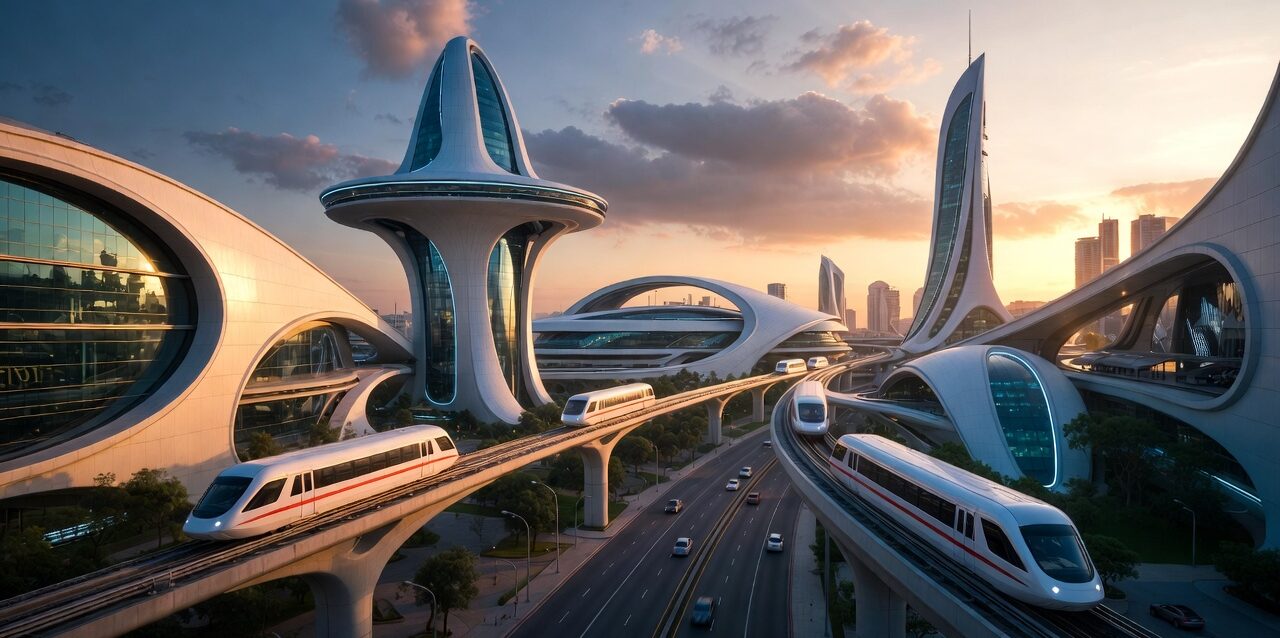
From Aging Legacy Systems to Intelligent, Resilient, Decentralized and Regenerative Networks
As of 2026, modern infrastructure (transport, energy, water, digital connectivity, waste management) in most countries is still heavily reliant on 20th-century design: centralized power grids, car-dependent road networks, aging bridges & tunnels, and siloed utility systems. Global infrastructure investment needs are estimated at $94 trillion by 2040 (Global Infrastructure Hub & Asian Development Bank), with a massive funding gap in both developed and developing economies.
By 2040 infrastructure becomes intelligent, adaptive, decentralized, climate-resilient, and increasingly regenerative — designed not just to withstand future shocks, but to actively support human well-being, economic efficiency, and planetary boundaries.
1. Near-Term (2026–2030): Electrification, Smart Grids & Early Resilience
- Mass Electrification & Smart Grids
Electricity becomes the dominant energy carrier — demand rises 40–80% by 2035 due to EVs, heat pumps, data centers and industry.
Smart grids with distributed energy resources (DERs), battery storage and AI optimization become standard in new and retrofitted systems. - Transport Electrification & Autonomy
EVs reach 40–70% of new sales in leading markets. Autonomous shuttles/pods appear on dedicated lanes.
High-speed rail and hyperloop pilots expand in select corridors (California, Texas, Europe, China). - Digital & Sensor Infrastructure
5G/6G + IoT sensors blanket urban areas — real-time monitoring of bridges, roads, pipelines, air quality and traffic.
Digital twins of major infrastructure assets enable predictive maintenance and scenario simulation.
2. Medium-Term (2030–2035): Decentralized Systems & Climate Adaptation
- Decentralized Energy & Water Networks
Microgrids and virtual power plants (VPPs) proliferate — neighborhoods, campuses and industrial parks generate, store and trade energy locally.
Water systems become circular: advanced desalination, rainwater harvesting, greywater recycling, and smart leak detection reach 90%+ efficiency. - Resilient & Adaptive Transport
Roads and rail incorporate self-healing concrete, modular bridges, and floodable designs.
Urban air mobility (eVTOL) networks mature for city-to-city and last-mile trips. Autonomous electric freight corridors reduce road congestion. - Underground & Multi-Layer Infrastructure
Cities expand underground utility corridors, freight tunnels, and multi-level transport.
Underground data centers (natural cooling) and energy storage (pumped hydro, compressed air) become common.
3. Long-Term (2035–2040): Regenerative & Symbiotic Infrastructure
- Regenerative Infrastructure
Roads, bridges and buildings actively sequester carbon, generate energy (solar roads, kinetic floors), and recycle stormwater/heat.
Infrastructure becomes net-positive — producing more resources than it consumes. - AI-Orchestrated & Self-Healing Systems
AI manages city-wide infrastructure in real time — rerouting traffic, balancing energy, repairing leaks, and predicting failures days/weeks ahead.
Self-healing materials (concrete that repairs cracks, pipes that seal themselves) become standard. - Biophilic & Human-Centric Design
Every resident lives within 300 m of green space. Infrastructure integrates nature — green roofs, vertical forests, urban rivers, and wildlife corridors.
Cities prioritize mental/physical health — noise reduction, air purification, and walkable/bikeable design.
Illustrative Modern Infrastructure Scenarios by 2040
- Daily Commute — Autonomous electric pod on dedicated lane → eVTOL air taxi → final 5-min walk/bike — total time under 30 min.
- Energy Resilience — Neighborhood microgrid with rooftop solar + community battery + vehicle-to-grid — powers homes during outage.
- Extreme Weather Event — Floodable streets absorb storm surge; underground utilities remain operational; AI reroutes traffic and activates emergency systems.
- Urban Retrofit — 1960s building upgraded with smart skin, geothermal, vertical farm, and modular interiors — becomes net-positive.
Key Numbers & Trends by 2040 (illustrative)
- Urban population share: 68–70% globally
- Renewable energy share in electricity: 70–90% in advanced economies
- Electric vehicle penetration: 70–95% of new sales
- Infrastructure carbon footprint reduction: 50–80% vs 2025 levels
- Average commute time reduction in leading cities: 30–50%
- Green space per resident: 15–30 m² (up from 5–10 m² in many cities)
Risks & Societal Shifts
- Inequality — Smart/resilient infrastructure concentrates in wealthy cities; retrofitting older areas lags.
- Tech Dependence — System failures could cascade across energy, transport, water.
- Privacy — Constant sensor/AI monitoring risks surveillance.
- Funding Gap — Trillions needed; public-private models must scale.
Bottom Line
By 2040 modern infrastructure evolves from aging, siloed systems to intelligent, decentralized, regenerative, and human-centered networks.
The dominant paradigm becomes adaptive, multi-functional, and planet-positive infrastructure — cities generate energy, recycle water, grow food, and move people efficiently while enhancing health and resilience.
Infrastructure stops being a cost center — it becomes an active asset that produces value, sequesters carbon, and improves quality of life.
The future city isn’t about more roads or bigger airports — it’s about smarter, greener, kinder systems that make every resident feel supported by the built environment.
The next great infrastructure boom isn’t concrete and steel — it’s intelligence, circularity, and harmony with nature.