
From Airplanes and Cars to High-Speed, Autonomous, and Low-Impact Mobility Networks
As of February 2026, intercity travel is still dominated by three main modes:
- Air travel (fastest for >500–600 km)
- High-speed rail (competitive in 300–800 km corridors in Europe, China, Japan)
- Private car / bus (dominant for <400 km in most countries)
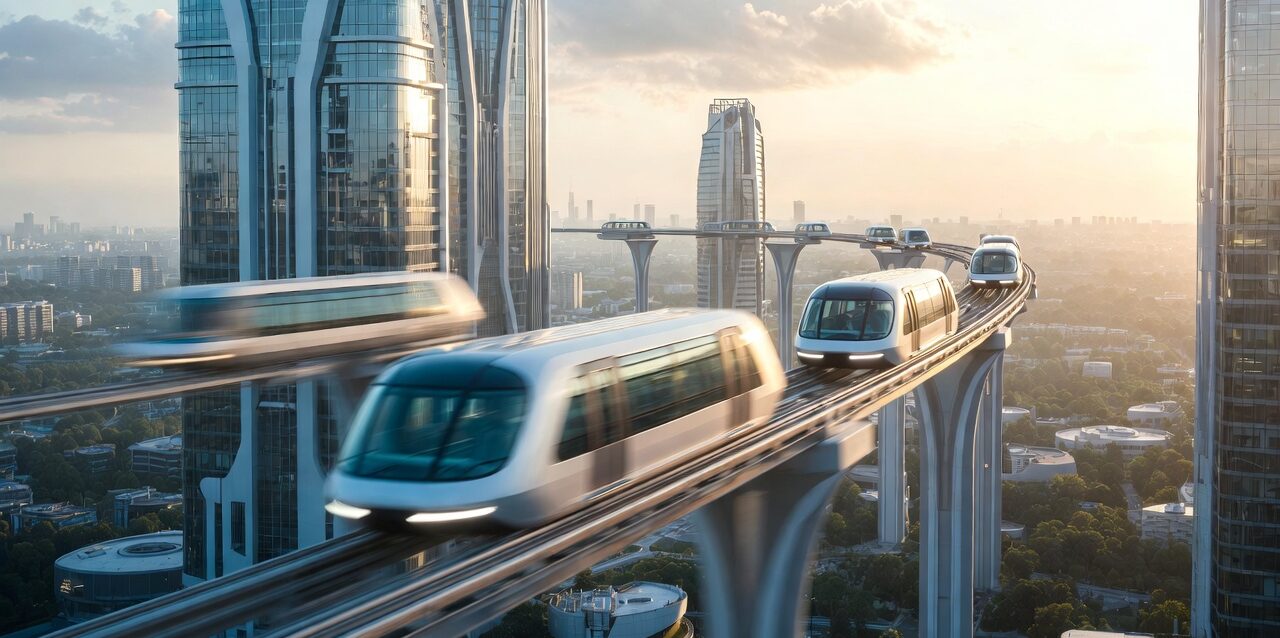
By 2040 city-to-city travel has changed dramatically. The dominant paradigm becomes high-speed, autonomous, low-carbon, and door-to-door — with multiple overlapping systems competing and complementing each other depending on distance, geography, cost, and traveler priorities.
1. Near-Term (2026–2030): High-Speed Rail & Electric Road Revival
- High-Speed Rail Expansion
China continues to build the world’s largest network. Europe pushes forward with cross-border corridors (Paris–Berlin, Madrid–Lyon–Milan). California High-Speed Rail opens first segments. Texas Central (Dallas–Houston) and Brightline West (Las Vegas–Los Angeles) start operations.
Average speeds: 300–350 km/h commercial, 380–400 km/h test runs. - Electric Road & Autonomous Shuttles
Battery-electric long-distance coaches and autonomous shuttles (Level 4) appear on major corridors. Tesla Semi and similar trucks start replacing diesel in freight.
Electric car ranges reach 600–800 km routinely; fast-charging corridors (350–500 kW) become widespread. - Urban Air Mobility (eVTOL) Early Adoption
Air taxi services launch in dense corridors (Los Angeles, New York, Paris, Dubai, Singapore, Shanghai). 4–6 seat eVTOLs cover 50–150 km hops at 200–300 km/h, cutting airport-to-airport time significantly.
2. Medium-Term (2030–2035): Hyperloop Pilots & Mass Electrification
- Hyperloop / Low-Pressure Tubes
First commercial intercity hyperloop routes open (e.g., 200–600 km corridors). Speeds reach 600–1,000 km/h in low-pressure tubes.
Hardt, TransPod, Swisspod, and Virgin Hyperloop successors demonstrate viability for city pairs (e.g., Toronto–Montreal, Riyadh–Jeddah, Los Angeles–San Francisco). - Autonomous Road Corridors
Dedicated autonomous electric vehicle lanes appear on major highways (US I-95 corridor, European TEN-T network, China expressways).
Door-to-door autonomous shuttles and pods reduce need for personal car ownership for intercity trips. - eVTOL Networks Mature
Urban air taxi fleets scale to thousands of aircraft. Regional eVTOL (10–30 seats) connects secondary cities and airports, competing with short-haul flights.
3. Long-Term (2035–2040): Multi-Modal, Seamless, and Near-Zero-Emission Travel
- Integrated Door-to-Door Ecosystems
Seamless mobility platforms (Mobility-as-a-Service 2.0) combine high-speed rail, hyperloop, eVTOL, autonomous pods, and last-mile drones/robots.
One ticket/app handles entire journey — e.g., autonomous pod → hyperloop → eVTOL → final pod. - Hyperloop & Vacuum Systems Scale
Several major corridors operate at 800–1,200 km/h. Travel time between large cities drops to 20–50 minutes.
Magnetic levitation + low-pressure tubes become the gold standard for 300–1,000 km trips. - Near-Zero-Emission Dominance
Electric, hydrogen, and battery-electric systems cover 80–95% of intercity passenger-km in advanced regions.
Sustainable aviation fuel (SAF) and hydrogen aircraft remain for longest routes (>1,500 km).
Illustrative City-to-City Trips in 2040
- Paris–London (350 km)
Hyperloop pod: 25 minutes door-to-door, €50–80, zero emissions. - Los Angeles–San Francisco (550 km)
Hyperloop or autonomous electric high-speed rail: 45–60 minutes, seamless transfer at stations. - New York–Washington D.C. (370 km)
Autonomous electric shuttle on dedicated lane + eVTOL bypass: under 90 minutes total. - Tokyo–Osaka (550 km)
Maglev upgrade reaches 600 km/h: ~50 minutes.
Key Numbers & Trends by 2040
- Average intercity speed in developed corridors: 400–1,000 km/h
- Share of intercity trips by high-speed electric/rail/hyperloop: 50–80% in leading regions
- Private car share for intercity travel: down to 20–40%
- Door-to-door time reduction: 40–70% on many corridors
- Emissions per passenger-km: down 70–95% vs 2025
Bottom Line
By 2040 traveling city to city is faster, cleaner, more seamless, and often door-to-door than ever before.
The dominant paradigm becomes high-speed, autonomous, low-carbon, and integrated mobility — hyperloop and maglev handle medium distances, eVTOL covers short hops, and autonomous electric systems provide last-mile flexibility.
Travel time between major cities shrinks dramatically (often under 1 hour), emissions plummet, and the journey itself becomes frictionless.
The future isn’t about faster planes — it’s about making the entire trip feel like one smooth, almost effortless experience.
Getting from city to city stops being something you endure — it becomes something you barely notice.
That’s the real revolution.