
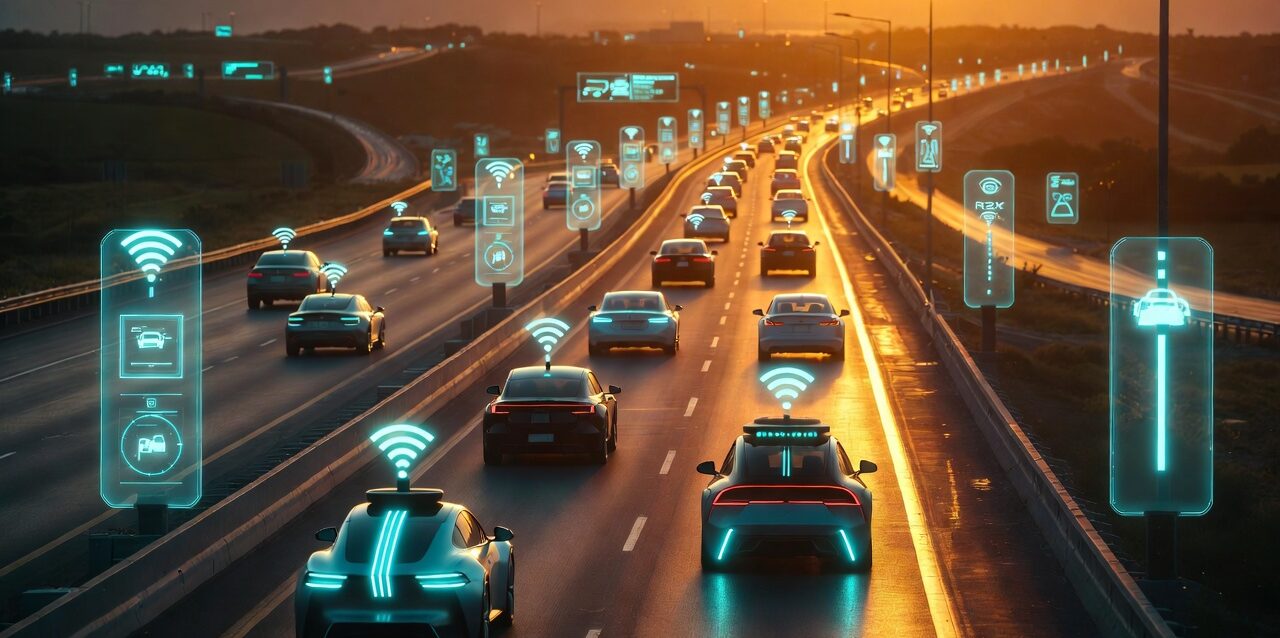
From Asphalt to Intelligence: The Complete Reinvention of Roads
From Asphalt Arteries Dominated by Human Drivers to Intelligent, Electrified, and Adaptive Mobility Corridors
As of 2026, roads remain predominantly passive infrastructure designed for human-driven vehicles, with over 1.4 billion vehicles worldwide, heavy reliance on fossil fuels, and persistent challenges in congestion, safety, and emissions:
- Traditional highways and urban streets with fixed lanes, basic signage, and limited connectivity
- Average urban congestion costs billions annually; road fatalities exceed 1.3 million per year globally
- Early pilots of smart elements (V2X in select corridors, inductive charging trials in Europe/USA) and autonomous vehicle testing on controlled segments
- Infrastructure aging rapidly; maintenance backlogs in trillions; EV adoption growing but charging relies on stationary stations
By 2040 roads have transformed into predictive, multi-modal, and zero-emission mobility networks — where embedded sensors, dynamic lanes, wireless charging, and V2X/I communication enable seamless integration of autonomous, connected, and electric vehicles, dramatically reducing congestion, fatalities, and environmental impact while supporting shared and on-demand mobility.
1. Near-Term (2026–2030): Connected Infrastructure + Early AV Readiness + Electrification Foundations
- V2X & Sensor Rollout
Vehicle-to-everything (V2X) communication expands on highways and urban corridors; roadside units and embedded sensors provide real-time traffic, hazard, and weather data to vehicles, improving safety and flow in pilots (e.g., US/China/Europe deployments). - Dynamic & Managed Lanes
Managed lanes with dynamic tolling and AV-priority access tested; early inductive charging segments (e.g., Detroit pilot, European trials) enable partial on-the-move EV charging for fleets. - AV-Ready Retrofits
Road markings standardized, signage digitized; dedicated testing corridors for Level 3–4 AVs; AI traffic management reduces urban delays by 10–20% in smart cities.
2. Medium-Term (2030–2035): Smart Pavements + Dynamic Charging + Multi-Modal Integration
- Embedded Intelligence & Charging
Smart pavements with inductive/dynamic wireless charging lanes become viable on high-traffic routes; V2I/IoT networks enable platooning and real-time rerouting, boosting capacity 30–50% on equipped corridors. - Adaptive & Reconfigurable Lanes
Dynamic lane allocation via sensors and AI; reversible lanes, variable speed limits, and shared AV/robotaxi priority reduce congestion in urban areas; solar-integrated surfaces and energy-harvesting materials emerge in pilots. - Fleet & Shared Mobility Dominance
AV penetration reaches 10–30% in new sales; roads support mixed fleets with dedicated zones; reduced parking demand frees curb space for active mobility and micro-mobility integration.
3. Long-Term (2035–2040): Fully Autonomous Ecosystems + Regenerative & Predictive Networks
- Predictive & Self-Healing Infrastructure
AI forecasts demand and hazards weeks ahead; pre-deployable modular elements and self-healing materials (e.g., advanced composites) minimize disruptions; roads as energy hubs with bidirectional charging and grid support. - Near-Zero Human-Driven Travel
AVs dominate (50–90% fleet share); dedicated autonomous corridors eliminate many signs/lanes; platooning and ultra-efficient flow cut energy use 40–70% and emissions near zero on equipped networks. - Global & Cross-Domain Connectivity
Roads integrate with rail, air, and drone corridors via unified standards; international frameworks enable seamless cross-border travel; equity measures (subsidized access) address disparities in rural/urban adoption.
Illustrative Road Scenarios by 2040
- Urban Highway Platoon — AI predicts peak demand → dynamic lanes allocate for AV platoons → inductive charging maintains battery levels → congestion drops 50–70%, travel time halves.
- EV Fleet Corridor — Dynamic wireless charging on major route → heavy-duty trucks charge on-the-move → eliminates stops → reduces range anxiety and supports 24/7 logistics with zero tailpipe emissions.
- Adaptive Urban Street — Sensors detect low demand → lanes reconfigure for pedestrian zones or bike priority → AI reroutes traffic → transforms street into vibrant public space during off-peak.
- Rural Smart Link — Predictive maintenance flags wear → autonomous repair drones deploy → V2X warns of hazards → enables safe AV access to remote areas with minimal human intervention.
Key Numbers & Trends by 2040 (illustrative)
- AV penetration in new vehicles: 50–90% (up from <5% in 2026)
- Road capacity increase via smart tech: 30–100% on equipped segments
- Fatalities reduction: 60–90% with widespread AV adoption
- Energy consumption per mile: down 40–70% via platooning and efficiency
- Inductive/dynamic charging lane coverage: 10–30% of major highways
Risks & Societal Shifts
- Transition Inequality — AV benefits concentrate in urban/wealthy areas; rural and low-income users lag without subsidies.
- Cyber & Infrastructure Vulnerability — Hacking of V2X networks or power-dependent smart roads could cause widespread disruption.
- Job & Economic Displacement — Trucking, taxi, and maintenance roles decline; reskilling critical.
- Over-Reliance & Privacy — Dependence on connected systems; data collection raises surveillance concerns.
Bottom Line
By 2040 roads shift from passive conduits to the strategic backbone of intelligent, sustainable mobility.
The dominant paradigm becomes predictive, electrified, and autonomous-first infrastructure — sensors anticipate flow, charging sustains motion, and networks optimize for safety and efficiency.
Roads stop being about moving vehicles — they become adaptive ecosystems that enable seamless, low-impact travel before congestion arises.
The future traveler isn’t navigating traffic — it’s the one whose vehicle flows with the system before delays form.
Mobility is achieved not by more asphalt alone, but by intelligent corridors that make journeys safer, cleaner, and smarter.
The next generation won’t remember traffic jams or gas stations — they’ll remember the silent, flowing networks that carried humanity forward without waste or waste.