
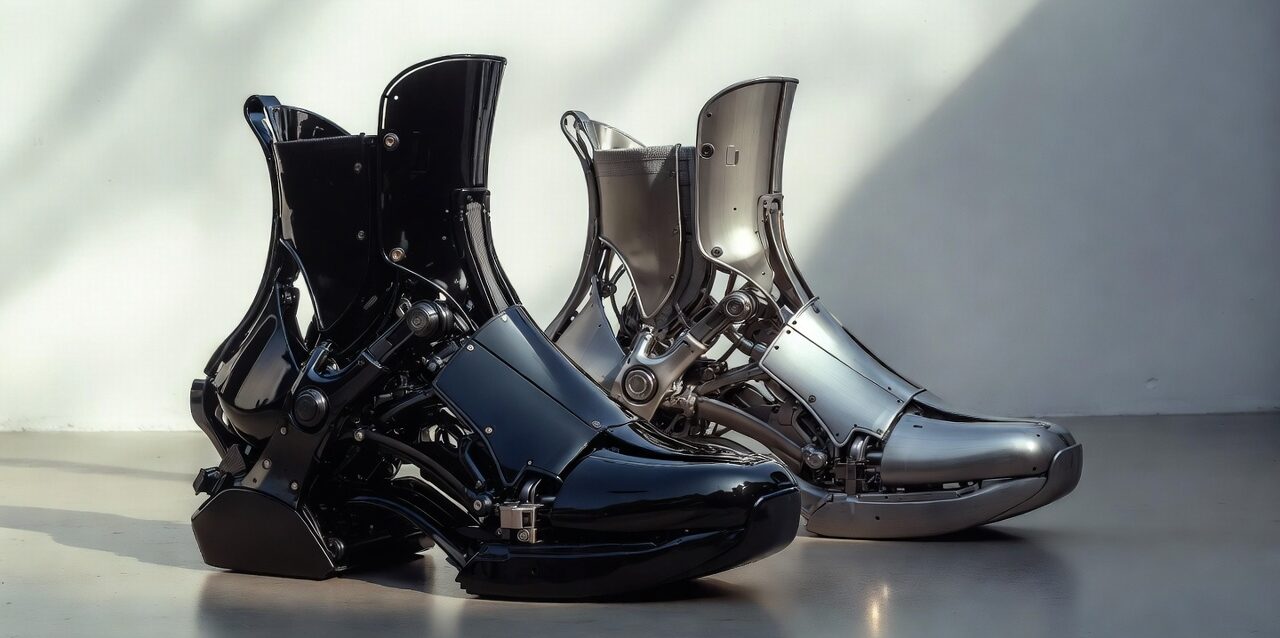
As of February 2026, the global footwear market is valued at approximately $400–450 billion annually, with athletic/sneaker categories leading growth (Nike, Adidas, On, Hoka, New Balance). Shoes are still largely passive products — focused on cushioning, style, durability, and performance — with only early smart features (sensors in some high-end running shoes, Nike Adapt auto-lacing).
By 2040, shoes evolve into active, intelligent, and regenerative health & mobility platforms — collecting data, adapting in real time, supporting injury prevention/recovery, and integrating with the body and environment in ways that make today’s footwear feel primitive.
1. Near-Term (2026–2030): Smart Sensing & Adaptive Comfort
- Embedded Sensors & Real-Time Feedback Mid- to high-end shoes embed pressure, motion, temperature, and gait sensors. AI analyzes stride, pronation, impact, and fatigue — delivering alerts via app or haptic feedback (“slow down”, “change landing pattern”, “replace insoles soon”).
- Adaptive & Customizable Fit Auto-adjusting laces, inflatable bladders, and shape-memory materials dynamically change fit during activity or throughout the day. 3D-printed midsoles and uppers become more common — customized via smartphone scan or gait analysis.
- Health & Performance Integration Shoes sync with wearables to track running economy, recovery status, and injury risk. Early “smart insoles” (e.g., Arion, Digitsole successors) become standard in performance and medical markets (diabetic foot care, post-surgery rehab).
2. Medium-Term (2030–2035): Energy-Generating & Regenerative Shoes
- Energy Harvesting & Power Generation Piezoelectric, triboelectric, and kinetic materials in soles generate usable electricity — charging wearables, powering embedded LEDs, or feeding small amounts back to the grid/phone. Range-extending power for e-shoes or exoskeleton assists.
- Self-Healing & Regenerative Materials Microcapsule-based self-healing polymers repair small tears/cuts. Bio-based and lab-grown leather alternatives (mycelium, lab collagen) become mainstream in premium lines. Recyclable and biodegradable shoes reach high-end and mid-market.
- Medical & Therapeutic Shoes Shoes actively support recovery — vibration therapy for circulation, cooling/heating zones for inflammation, pressure redistribution for diabetic/ulcer prevention, and micro-actuators for gait retraining post-injury.
3. Long-Term (2035–2040): Symbiotic & Body-Integrated Footwear
- Active Assistance & Exo-Features Lightweight exoskeleton elements (micro-motors, artificial tendons) provide powered assistance — reducing fatigue on long walks, aiding seniors, or amplifying performance. Shoes “push back” on impact or assist propulsion.
- Biometric & Health-Optimized Design Shoes monitor blood flow, skin temperature, hydration proxies, and early infection markers. AI predicts blisters, plantar fasciitis, stress fractures — recommending rest, orthotics, or medical consultation. Personalized 3D-printed shoes update seasonally based on foot changes.
- Fully Integrated & Modular Footwear Shoes become modular platforms — swap midsoles, uppers, sensors, or power packs. Some designs merge with clothing (sock-shoe hybrids) or become semi-permanent (implantable or skin-integrated interfaces in extreme cases).
Illustrative Shoe Scenarios by 2040
- Daily Commuter Shoe — Self-adjusting fit, kinetic charging for phone, posture/gait coaching, predictive injury alerts.
- Performance Running Shoe — Energy-return soles + micro-actuators, real-time stride optimization, regenerative foam that repairs micro-damage.
- Medical/Therapeutic Shoe — Active compression, targeted vibration therapy, ulcer-prevention pressure mapping, remote doctor monitoring.
- Sustainable Luxury Shoe — Fully recyclable/bio-based, self-healing upper, modular components, carbon-negative production.
Risks & Societal Shifts
- Inequality — High-end smart/regenerative shoes remain luxury items; basic function still dominates lower-income markets.
- Privacy — Gait and biometric data collection raises surveillance and profiling concerns.
- Over-Reliance — Risk of reduced natural foot strength/mobility if assistance is too constant.
- Sustainability — Recycling infrastructure for complex smart shoes must scale.
Bottom Line
By 2040 shoes are no longer passive footwear — they become active, intelligent, and symbiotic health & mobility platforms. The dominant paradigm shifts to smart, regenerative, and body-integrated shoes — monitoring, adapting, assisting, and protecting feet and overall health in real time. Shoes won’t just carry you — they will understand you, heal you, and extend your active years. The future of shoes isn’t about looking better — it’s about moving better, feeling better, and living better, one intelligent step at a time.