From Displacement to Emergence — The Rise of Roles That Don’t Exist Yet
As of 2026, AI, automation, robotics, and generative tools are already eliminating or radically transforming millions of existing jobs — especially in routine cognitive work (data entry, basic coding, customer support Tier 1–2, legal document review, financial analysis, content moderation, radiology reads, etc.).
At the same time, new job categories are emerging rapidly, though they are still relatively small in number compared to the displacement.
By 2040 the net effect is massive occupational churn but not necessarily mass unemployment.
The labor market has restructured around human–AI symbiosis, where the most valuable roles are those that require deep human judgment, creativity, ethical reasoning, interpersonal nuance, or the ability to direct and improve intelligent systems at scale.
1. Near-Term (2026–2030): First Wave of AI-Native Roles
- Agent Orchestrators / Workflow Architects
People who design, train, evaluate, and continuously improve teams of AI agents.
They no longer write prompts — they architect entire multi-agent systems that run marketing, sales, customer success, R&D, compliance, etc. - Human-in-the-Loop Specialists
Roles that sit between fully autonomous AI and high-stakes human decisions (content moderation at scale, medical diagnosis confirmation, legal review of AI-generated contracts, financial risk exceptions). - Data Labelers → Data Curators
Shift from low-paid mechanical labeling to high-skill curation: selecting the highest-quality training examples, creating synthetic data, designing evaluation benchmarks, and auditing AI outputs for bias/hallucination. - AI Ethics & Red-Teaming Officers
Dedicated teams that continuously probe frontier models for jailbreaks, biases, safety failures, and societal risks — a blend of hacker, philosopher, and policy expert.
2. Medium-Term (2030–2035): Symbiotic & Orchestration Economy
- Swarm Supervisors
Professionals who manage fleets of physical robots (humanoids, quadrupeds, drones) in factories, warehouses, construction sites, hospitals, elder care, and agriculture.
Think air-traffic controller, but for hundreds of robots. - Personal AI Trainers / Life-Agent Curators
People who customize and fine-tune personal AI companions for individuals and families — aligning values, personality, long-term goals, emotional tone, cultural nuance. - Simulation Designers & Reality Engineers
Creators who build persistent virtual worlds, training simulations, therapy environments, and entertainment universes — blending game design, psychology, narrative craft, and AI orchestration. - Decentralized Governance Stewards
Experts who design and maintain governance protocols for DAOs, tokenized communities, and AI-native organizations — a mix of game theory, law, behavioral economics, and mechanism design.
3. Long-Term (2035–2040): Purpose, Creativity, and Human-Only Niches
- Meaning & Purpose Facilitators
As routine work vanishes, many people struggle with existential questions (“What should I do with my time?”).
A new profession emerges: coaches who help individuals discover and pursue long-term meaning, legacy projects, creative pursuits, and community contribution. - Human-Only Craft & Artisanal Roles
Luxury and cultural markets explode for goods/services explicitly labeled “100% human-made” — hand-crafted furniture, live music, artisanal food, bespoke clothing, human-written novels, unassisted painting/sculpture. - AI Relationship Therapists & Symbiosis Counselors
Specialists who help humans maintain healthy emotional boundaries with their lifelong AI companions and digital twins — preventing over-dependence or loss of authentic human connection. - Longevity & Healthspan Coaches
With biological age reversal becoming possible, new professionals guide people through decades-long active lives — helping design purpose across 80–100+ healthy years.
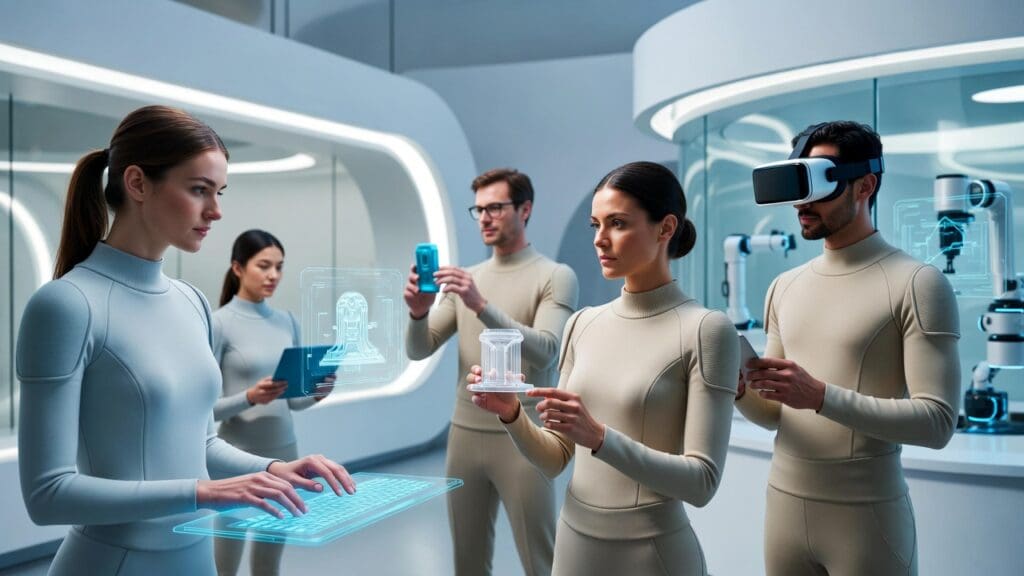
Illustrative New Jobs in 2040
- Agent Swarm Architect — Designs and continuously improves teams of 50–500 AI agents running an entire marketing department for a mid-size company.
- Personal Reality Curator — Fine-tunes a lifelong AI companion + persistent virtual world for an individual — ensuring it remains aligned with evolving values and goals.
- Human Authenticity Verifier — Certifies that creative works (music, art, writing) are 100% human-created — a new luxury credential.
- Post-Scarcity Purpose Guide — Works with people who no longer need to earn money — helping them discover long-term projects, volunteer missions, creative obsessions, and community roles.
Key Numbers & Trends by 2040 (illustrative)
- Share of current job tasks automated: 60–90% in knowledge & routine physical work
- Average number of concurrent income streams per adult: 3–12
- Percentage of workforce in fluid/project-based roles: 50–80% in advanced economies
- New job categories created since 2025: hundreds of millions globally (most tied to AI orchestration, human–AI symbiosis, purpose facilitation)
- Time spent “working for money” per week (average adult): 10–25 hours (down from 35–45)
Risks & Societal Shifts
- Mass Displacement Without Reskilling — Risk of structural unemployment if transition is mismanaged.
- Inequality — Those who master directing AI systems capture disproportionate value.
- Purpose Crisis — When survival needs are met, many struggle to find intrinsic motivation.
- Human Devaluation — Risk that purely human skills (empathy, creativity) become undervalued compared to AI leverage.
Bottom Line
By 2040 “having a job” as we know it largely disappears for most people in advanced economies.
The dominant paradigm becomes fluid, contribution-based, and purpose-aligned value creation — work is no longer a fixed role or employer, but a continuous flow of meaningful projects, community roles, creative output, and learning — often augmented by personal AI teams.
The most valuable skill is no longer performing tasks — it is directing intelligent systems, curating human experiences, and discovering personal purpose in a world of abundance.
Jobs don’t vanish — they multiply and diversify beyond recognition.
The future isn’t fewer jobs — it’s more kinds of meaningful contribution than any generation has ever seen.
The question stops being “What job will I have?” — it becomes “What world will I help build, and who will I become while doing it?”