
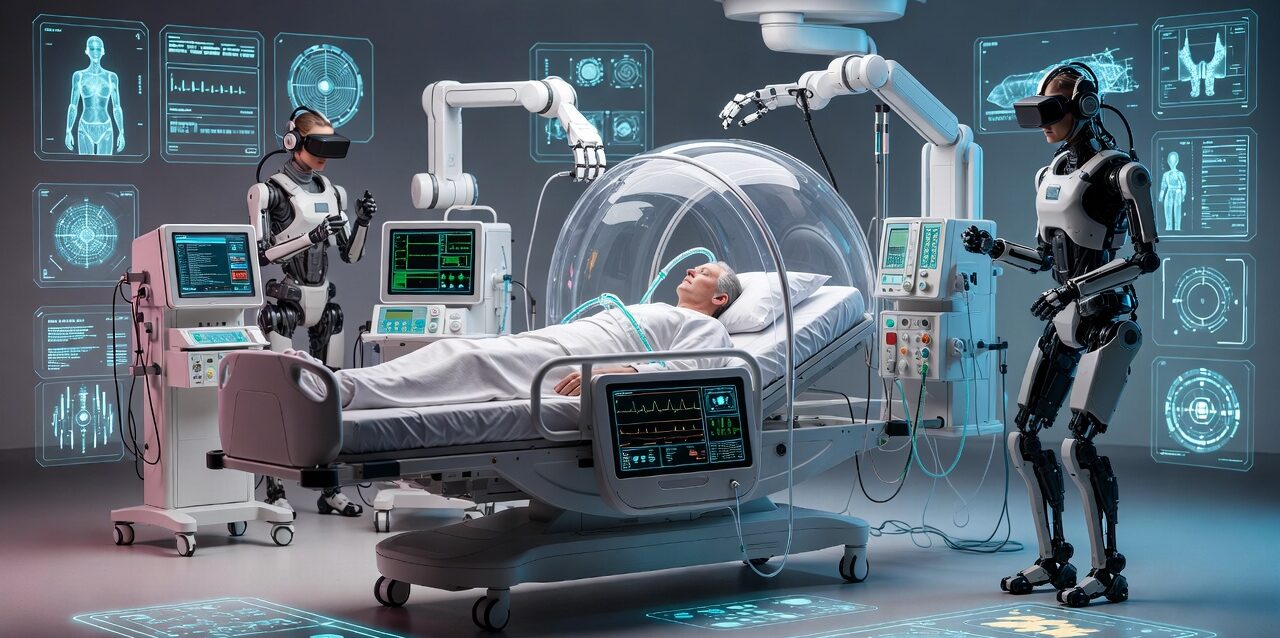
From Episodic, Hospital-Centric Treatment to Continuous, Predictive, Personalized, and Mostly At-Home Care Ecosystems
As of February 2026, patient care remains predominantly reactive, episodic, and facility-based:
- Patients seek help when symptoms appear or worsen
- Most care occurs in hospitals, clinics, or doctor’s offices
- Average wait times for non-emergency specialist appointments range from weeks to months
- Chronic disease management is still largely manual (pill reminders, periodic check-ups)
- Global healthcare spending exceeds $10 trillion annually, yet outcomes lag behind costs in many regions
By 2040 patient care shifts to continuous, predictive, hyper-personalized, mostly home-based, and prevention-first systems. The hospital becomes the exception rather than the default; most care happens where the patient lives — supported by always-on monitoring, AI orchestration, and early intervention that stops disease progression before it becomes serious.
1. Near-Term (2026–2030): Continuous Monitoring & Virtual-First Care
- Clinical-Grade Wearables & Home Sensors
Devices become medical-grade: continuous glucose monitoring, blood pressure patches, smart rings/watches/patches track dozens of biomarkers (inflammation, hormones, cardiac signals, oxygen, sleep quality, gait stability, voice patterns, skin temperature).
Home sensors monitor air quality, movement patterns, and even early signs of illness via voice/exhaled breath analysis. - AI-Driven Virtual Care & Triage
AI agents act as first-line providers: - Symptom checkers with 90–95% accuracy for common conditions
- Virtual primary care visits with AI + human oversight
- Predictive alerts (“your inflammatory markers are rising — early signs of flare; adjusting medication now”)
- Hospital-at-Home Expansion
Acute care moves home for many conditions (heart failure, pneumonia, post-surgery recovery, COPD exacerbations).
Remote monitoring + nurse visits + tele-rounds reduce hospital stays by 40–60%.
2. Medium-Term (2030–2035): Predictive & Preemptive Medicine
- Liquid Biopsies & Multi-Omics Screening
Annual or biannual blood tests detect 50–70+ cancers at stage 0–I with 90–98% sensitivity.
Multi-omics (genomics + proteomics + metabolomics + microbiomics) create comprehensive risk profiles years in advance. - Ambient & Implantable Monitoring
Subdermal or ingestible sensors provide continuous streams of dozens of biomarkers.
Smart homes/offices detect environmental triggers (pollutants, allergens) and physiological changes (stress hormones, early infection signals). - AI “Digital Twin” Medicine
Every patient has a continuously updated digital twin — a virtual model of their body that simulates interventions and predicts outcomes.
Treatment plans are tested virtually before real-world application.
3. Long-Term (2035–2040): Symbiotic, Preemptive & Regenerative Care
- Preemptive & Regenerative Interventions
AI predicts disease onset months to years ahead with high confidence → preventive therapies (gene editing, senolytics, immune modulation) begin early.
Regenerative medicine (stem cells, organoids, tissue engineering) repairs damage before it becomes clinical disease. - Robotic & Nanotech Assistance
Home robots provide physical care (lifting, medication administration, wound care).
Early nanomedicine targets pre-cancerous cells, clears arterial plaque, or modulates inflammation at the molecular level. - Health as Ambient Infrastructure
Care becomes invisible — homes, clothing, and environments continuously monitor and optimize health.
“Care” is no longer something you seek — it is something that happens automatically and seamlessly.
Illustrative Patient Care Scenarios by 2040
- Cardiovascular Risk — Wearable + home sensors detect rising plaque risk 18 months ahead → AI initiates personalized statin + lifestyle protocol → progression halted without ever visiting a hospital.
- Cancer Prevention — Routine liquid biopsy detects stage 0 colorectal cancer → AI coordinates targeted therapy → tumor eliminated before it becomes detectable on imaging.
- Chronic Disease Management — Type 2 diabetes patient has continuous glucose + AI insulin micro-dosing implant → HbA1c stays normal; no daily finger pricks or visible disease progression.
- Mental Health Renewal — Ambient sensors + wearable detect early depression markers → AI-guided VR therapy + neurofeedback + micro-dosed psychedelic → mood restored before clinical diagnosis.
Key Numbers & Trends by 2040 (illustrative)
- Continuous biomarker monitoring adoption: 60–85% in developed economies
- Multi-cancer early detection sensitivity (stage I): 90–98%
- Hospital admissions for chronic conditions: down 50–80%
- Average time from detection to intervention: hours to days (vs weeks/months)
- Biological age reversal potential: 5–15 years through personalized regimens
- Healthcare cost savings from prevention: $2–5 trillion annually (global)
Risks & Societal Shifts
- Inequality — Advanced monitoring and preemptive therapies initially available only to affluent populations.
- Privacy & Autonomy — Continuous health data creates unprecedented surveillance risk; consent and ownership debates intensify.
- Over-Diagnosis & Medicalization — High sensitivity may pathologize normal variations → overtreatment and anxiety.
- Human Touch — Risk of dehumanized care; emotional support must remain human-led.
Bottom Line
By 2040 patient care shifts from episodic, reactive, and hospital-centric to continuous, predictive, preemptive, and mostly home-based.
The dominant paradigm becomes always-on, AI-orchestrated, and regenerative health intelligence — disease is detected and often stopped before symptoms appear, hospitals become rare endpoints rather than default destinations, and health becomes an active, background process rather than a crisis response.
The future of medicine isn’t about better hospitals or stronger drugs — it’s about never needing them in the first place.
Care stops being something you receive when sick — it becomes something that keeps you well, every moment of every day.
The era of “fighting illness” ends — the era of living in continuous health begins.