
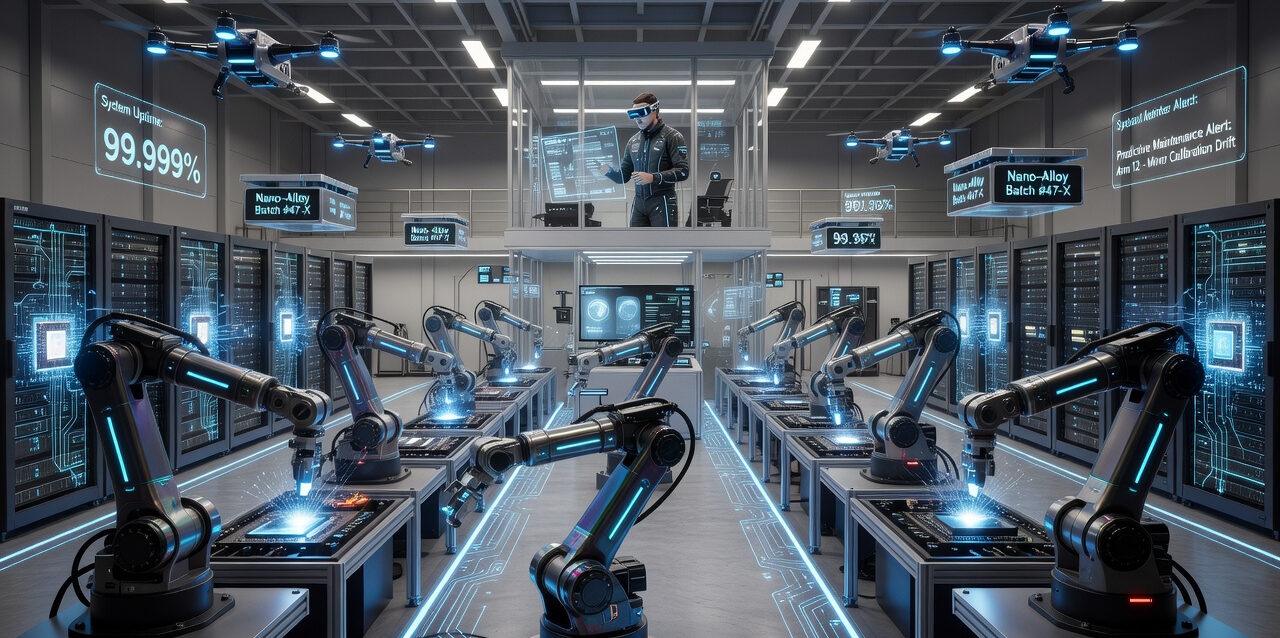
From Fixed Robotic Arms to Intelligent, Adaptive, and Regenerative Production Ecosystems
As of February 2026, industrial automation is valued at approximately $200–250 billion annually, dominated by robotic arms, CNC machines, and PLC systems in automotive, electronics, and consumer goods manufacturing. While adoption is high in large factories (80–90% in automotive), SMEs lag significantly due to high upfront costs and integration complexity. Labor shortages, supply chain fragility, and rising energy/material costs are accelerating demand for more flexible and efficient automation.
By 2040 industrial automation evolves into fully intelligent, adaptive, lights-out, and regenerative systems — where AI-orchestrated robots, digital twins, and modular production lines achieve near-zero waste, maximum flexibility, and human-like adaptability while operating with minimal human intervention.
1. Near-Term (2026–2030): Flexible Automation & Digital Twins
- Collaborative Robots (Cobots) & Modular Cells
Cobots become standard in SMEs — safe, easy to program, and capable of working alongside humans.
Modular robotic cells allow quick product changeovers (hours instead of weeks).
Adoption grows rapidly due to Robots-as-a-Service (RaaS) models, lowering entry barriers. - Digital Twins & Simulation-First Design
Every production line has a real-time digital twin — AI simulates changes before physical implementation, reducing downtime by 50–70%.
Predictive maintenance using IoT sensors and AI becomes standard, cutting unplanned stoppages by 80–90%. - AI-Driven Quality Control
Computer vision + AI achieves 99.5%+ defect detection, replacing manual inspection in most high-volume lines.
2. Medium-Term (2030–2035): Humanoid Robots & Swarm Intelligence
- General-Purpose Humanoids Enter Factories
Tesla Optimus, Figure 01/02, and Chinese equivalents reach mass production.
Humanoids handle complex, unstructured tasks (final assembly, quality inspection, maintenance, material handling) — replacing humans in hazardous or repetitive roles. - Swarm Robotics & Multi-Agent Systems
Hundreds to thousands of coordinated robots (quadrupeds, wheeled, flying) work in swarms — self-organizing, self-repairing, and adapting to production changes.
A single human supervisor can oversee an entire swarm via AI orchestration. - Regenerative & Circular Manufacturing
Factories recycle 90%+ of materials on-site; waste heat, water, and byproducts are reused.
Bio-based and self-healing materials become standard in production.
3. Long-Term (2035–2040): Lights-Out, Self-Building, and Net-Positive Factories
- Lights-Out & Fully Autonomous Production
Entire factories run 24/7 with <1% human presence — only for strategic oversight, creative design, and ethical decisions.
AI continuously optimizes layouts, workflows, and energy use in real time. - Self-Building Factories
Robotic swarms construct and expand facilities — adding new lines or reconfiguring for new products without human builders.
Factories literally “grow” themselves using modular components and 3D printing. - Regenerative & Carbon-Negative Operations
Factories generate surplus energy (solar roofs, waste-to-energy) and sequester carbon.
Many become net-positive contributors to the local ecosystem.
Illustrative Factory Scenarios by 2040
- Electronics Gigafactory — Fully lights-out; humanoid robots handle final assembly; AI swarm self-optimizes yield and repairs robots autonomously.
- Urban Micro-Factory — Compact robotic cell in a city warehouse produces custom parts on demand — same-day delivery via drone or pod.
- Regenerative Apparel Plant — Uses recycled textiles and bio-fibers; captures CO₂ during dyeing; waste becomes new feedstock.
- Self-Building Facility — Robot swarm adds a new production line overnight based on rising demand for a new product.
Key Numbers & Trends by 2040 (illustrative)
- Share of manufacturing tasks handled by robots/AI: 70–95% in structured industries
- Average factory downtime: <1–2% (predictive + self-repairing systems)
- Material waste reduction: 80–95% in advanced facilities
- Energy self-sufficiency in new factories: 70–100% (often net-positive)
- Human on-site workforce per factory: down 60–90% from 2025 levels
- Global manufacturing carbon footprint reduction: 60–90% (net-negative in leading plants)
Risks & Societal Shifts
- Massive Job Displacement — Tens of millions of traditional manufacturing roles disappear; reskilling and universal basic income become central policy debates.
- Geographic & Economic Inequality — Advanced automated factories concentrate in wealthy nations/regions; developing economies risk being left behind.
- Cyber & Systemic Risk — Fully autonomous plants are vulnerable to hacking, supply-chain attacks, or single-point AI failures.
- Over-Reliance — Risk of fragility if intelligent orchestration systems collapse.
Bottom Line
By 2040 industrial automation evolves from rigid, labor-intensive systems to lights-out, AI-orchestrated, modular, and regenerative production ecosystems.
The dominant paradigm becomes intelligent, self-sustaining, and planet-positive manufacturing — robots and AI handle 90%+ of physical work, while humans focus on creativity, strategy, and ethical oversight.
Factories no longer consume resources — they regenerate them, producing goods with minimal waste and often net-positive environmental impact.
The future factory isn’t a place of sweat and smoke — it’s a silent, intelligent organism that creates abundance without destruction.
Manufacturing stops being about making things cheaply — it becomes about making things beautifully, sustainably, and in harmony with both people and the planet.
The factory of 2040 doesn’t need lights — because the future is bright enough already.