
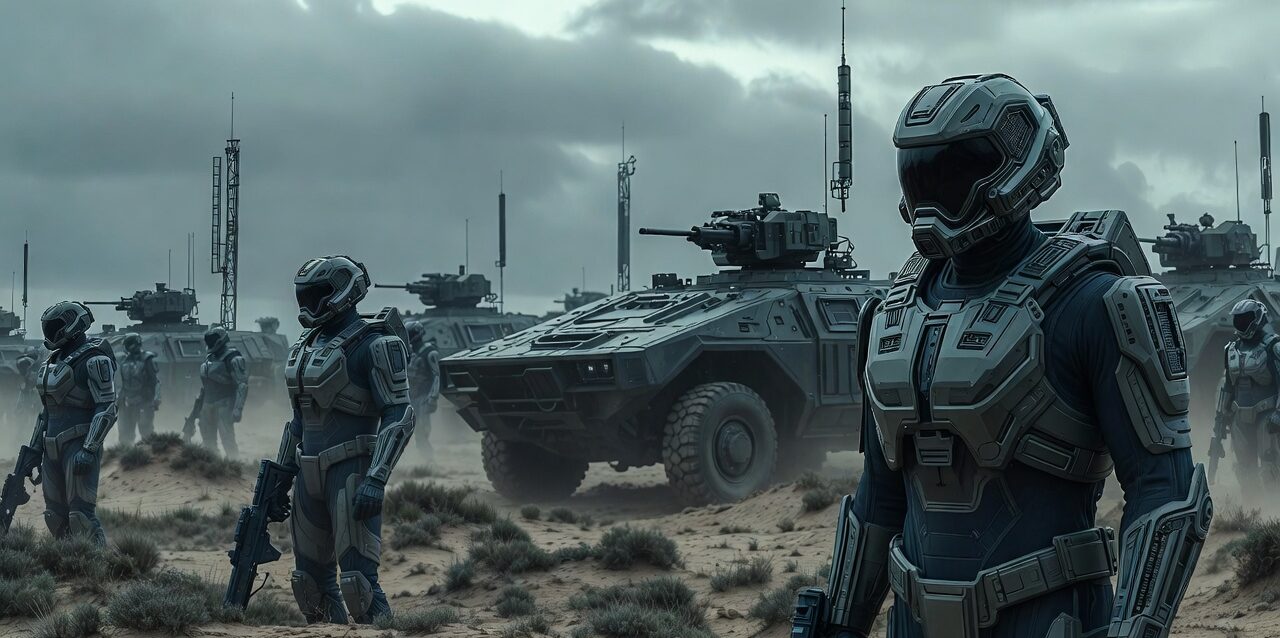
From Human-Centric Armies to AI-Orchestrated, Multi-Domain, and Hybrid Human-Machine Forces
As of 2026, military forces are still predominantly human-operated, with advanced technology used as support tools rather than primary decision-makers or combatants.
Major powers maintain large standing armies, navies, and air forces, with the United States, China, Russia, India, and NATO allies leading in capability.
Key characteristics include fifth-generation fighters, nuclear-powered submarines, hypersonic missiles, and early drone swarms — but human judgment remains essential for lethal decisions, strategy, and ethics.
By 2040 military forces have transformed into highly automated, AI-dominant, multi-domain, and hybrid human-machine systems.
Manned platforms become command nodes for vast autonomous swarms; decisions compress to milliseconds; and superiority is determined by AI resilience, speed, and integration across land, sea, air, space, cyber, and electromagnetic domains.
1. Near-Term (2026–2030): AI Assistance, Loyal Wingmen, and Hypersonic Proliferation
- AI as Force Multiplier
AI upgrades every platform: - F-35 and J-20 sensor fusion and targeting
- Submarine sonar analysis and threat prioritization
- Ground vehicle autonomous navigation and threat detection
- Loyal Wingman / Collaborative Combat Aircraft (CCA)
First semi-autonomous drone wingmen deploy alongside manned fighters (U.S. CCA program, European FCAS Remote Carriers, Chinese equivalents).
Drones perform ISR, electronic warfare, decoy, and limited strike roles with human oversight. - Hypersonic Weapons Maturity
Hypersonic glide vehicles and cruise missiles (Mach 5+) enter wider service: U.S. ARRW/HAWC, Russia Avangard/Kinzhal, China DF-17/DF-27.
They challenge traditional missile defenses and force new deterrence postures.
2. Medium-Term (2030–2035): Swarm Warfare & Directed Energy Dominance
- Massive Autonomous Swarms
Large swarms (hundreds to thousands of small, low-cost drones) operate autonomously for saturation attacks, air defense suppression, and urban/ground support.
U.S. Replicator initiative and Chinese swarm programs scale to operational level. - Directed Energy & Electronic Warfare
High-energy lasers and high-power microwaves become standard on aircraft, ships, and ground vehicles for counter-drone, missile defense, and electronic attack.
AI coordinates energy allocation and targeting in real time. - Multi-Domain Command & Control
AI fuses data from space, air, sea, land, and cyber domains to create real-time common operating pictures.
Human commanders set high-level intent; AI executes tactical decisions with human veto for lethal actions.
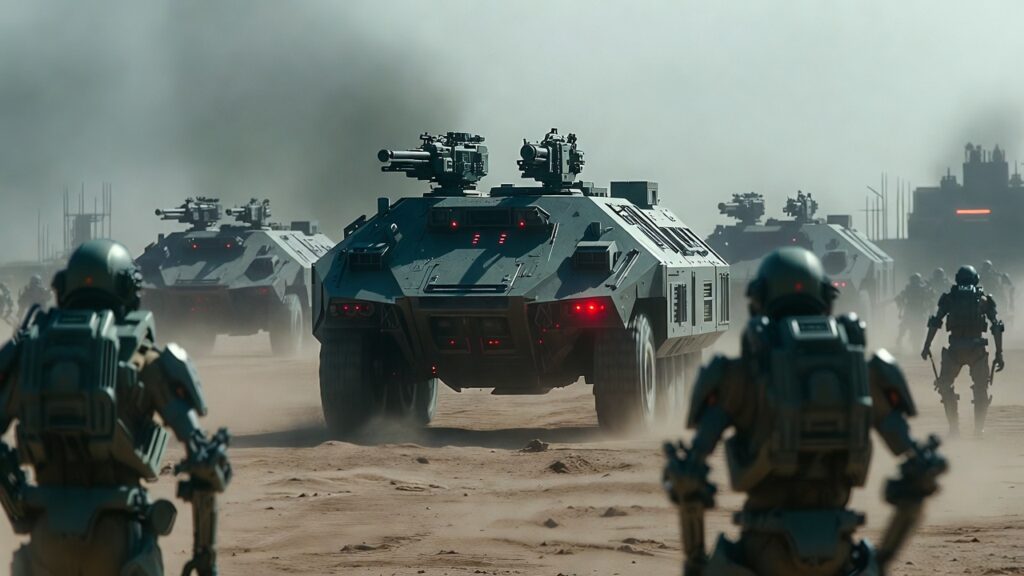
3. Long-Term (2035–2040): AI Supremacy & Redefined Warfare
- Human-AI Symbiosis
Non-invasive brain-computer interfaces allow commanders to “think” orders to swarms and platforms.
Humans focus on strategy, ethics, and novel situations; AI handles 80–95% of tactical execution. - Autonomous Lethal Systems
Level 4–5 autonomous weapons operate in contested environments with minimal human oversight.
Ethical “kill chains” and international norms evolve to constrain fully autonomous lethal decisions. - New Domains & Capabilities
Space-based kinetic weapons, orbital lasers, and cyber-physical integration mature.
Biological enhancements for soldiers (endurance, cognition) and AI-directed nanobot swarms for infiltration/sabotage emerge.
Illustrative Military Scenarios by 2040
- Air Superiority — Sixth-generation fighter commands 100+ loyal wingman drones to saturate enemy air defenses; AI evades hypersonic threats.
- Naval Engagement — SSN(X) submarine deploys UUV swarm for anti-ship strike; AI coordinates with orbital sensors for targeting.
- Ground Operation — Exoskeleton-enhanced infantry supported by legged robotic swarms clears urban environment; AI predicts enemy movements.
- Cyber-Space Conflict — AI hacks enemy satellite network while directed-energy weapons blind reconnaissance platforms.
Key Numbers & Trends by 2040 (illustrative)
- Autonomous systems share of combat platforms: 40–80% in advanced militaries
- Swarm sizes in major operations: 100–10,000+ units
- Decision loop compression: from minutes to milliseconds with AI
- Hypersonic weapon inventory (major powers): thousands
- Directed energy weapons on combat platforms: 50–90%
- AI military spending (U.S. + China + others): $200–500+ billion annually
Risks & Societal Shifts
- Escalation & Flash Wars — AI speed compresses decision timelines; accidental conflict risk rises.
- Proliferation — Drone swarms and hypersonics spread to mid-tier powers and non-state actors.
- Ethics & Control — Lethal autonomous weapons spark global debates; patchy treaties emerge.
- Human Role — Soldiers become system managers; loss of traditional combat skills.
Bottom Line
By 2040 military forces become AI-dominant, multi-domain, and hybrid human-machine systems.
Manned platforms shift from primary combatants to command nodes for autonomous swarms; hypersonics and directed energy redefine speed and lethality; and superiority depends on AI resilience and integration.
Warfare becomes faster, more precise, and potentially more contained — but also more unpredictable.
The future military isn’t about bigger armies — it’s about smarter, more connected, and more autonomous forces.
The next war will be decided not by who has the most soldiers, but by who masters the fusion of human judgment and machine intelligence.
The age of human-only warfare ends — the age of symbiotic warfare begins.