
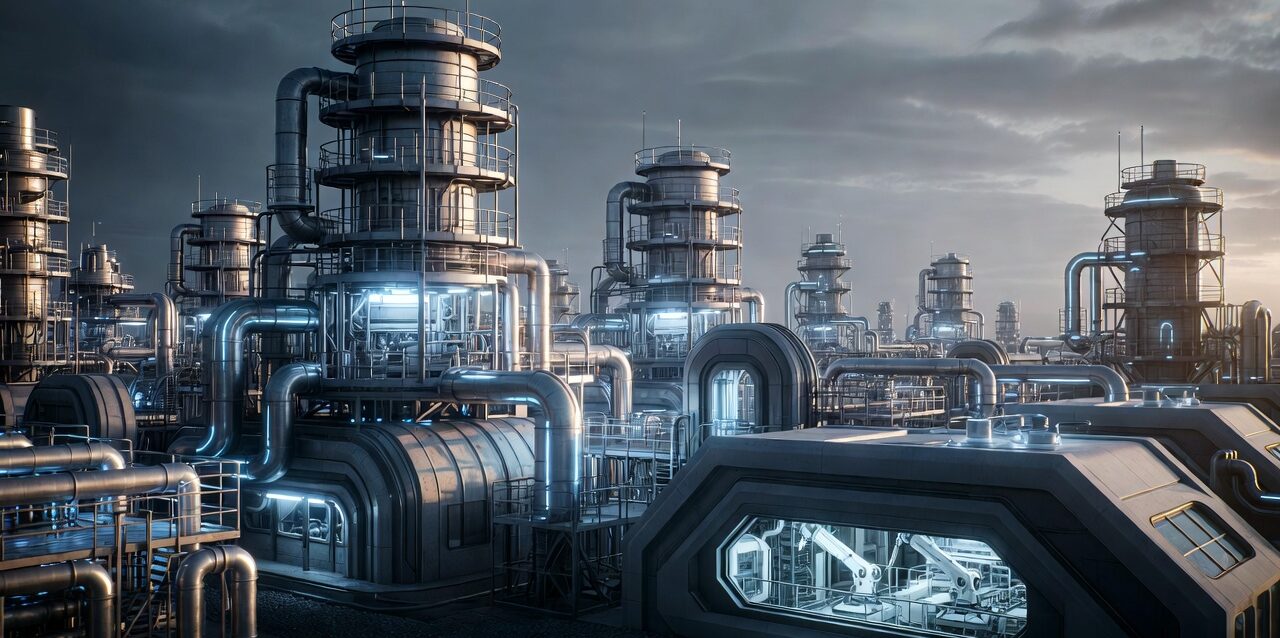
From Human-Led Assembly Lines to Fully Autonomous, Lights-Out, and Regenerative Production Ecosystems
As of 2026, most factories still rely heavily on human labor for complex assembly, quality control, and maintenance, while automation is concentrated in repetitive, high-volume tasks (automotive welding, electronics pick-and-place, packaging).
Global manufacturing contributes ~16–18% of world GDP, but faces chronic challenges: labor shortages in developed economies, rising wages in emerging markets, supply-chain fragility, high energy and material waste (~20–30% in many sectors), and increasing pressure to decarbonize (manufacturing accounts for ~30% of global CO₂ emissions).
By 2040 factories become lights-out, AI-orchestrated, modular, and regenerative production engines — human presence is minimal or optional, output is hyper-efficient, waste approaches zero, and facilities actively contribute to environmental restoration rather than depletion.
1. Near-Term (2026–2030): Lights-Out & AI-Driven Optimization
- Lights-Out Factories Scale
24/7 autonomous production becomes standard in electronics, automotive components, consumer goods, and pharmaceuticals.
Human workers shift to remote oversight, robot maintenance, and creative/process design roles.
First fully lights-out gigafactories (batteries, semiconductors) operate with <5% on-site human presence. - AI & Digital Twins at Core
Every factory runs a real-time digital twin — AI simulates, predicts, and optimizes every machine, material flow, and energy use.
Predictive maintenance reaches 90%+ accuracy; downtime drops 70–90%.
Generative AI redesigns production layouts and workflows overnight for maximum efficiency. - Modular & Reconfigurable Lines
Factories adopt plug-and-play robotic cells — change products in hours instead of weeks.
Mass customization becomes default — same line produces thousands of unique variants daily.
2. Medium-Term (2030–2035): Regenerative Materials & Swarm Robotics
- Closed-Loop & Regenerative Production
Factories achieve near-100% material reuse — scrap is immediately recycled on-site (metal, plastic, composites).
Bio-based and self-healing materials dominate; carbon-capture concrete and CO₂-derived polymers become standard.
Many facilities become net-positive — generating surplus energy (solar roofs, waste-to-energy) and feeding it back to the grid. - Swarm & Collaborative Robotics
Thousands of small, specialized robots work in coordinated swarms — self-organizing, self-repairing, and adaptive.
Humanoid robots (Tesla Optimus, Figure, Agility) handle complex, unstructured tasks (final assembly, quality inspection, maintenance). - On-Demand & Distributed Factories
Micro-factories appear in urban areas — 3D printing hubs, small-batch robotic cells serving local demand.
Global supply chains shorten; production moves closer to consumption.
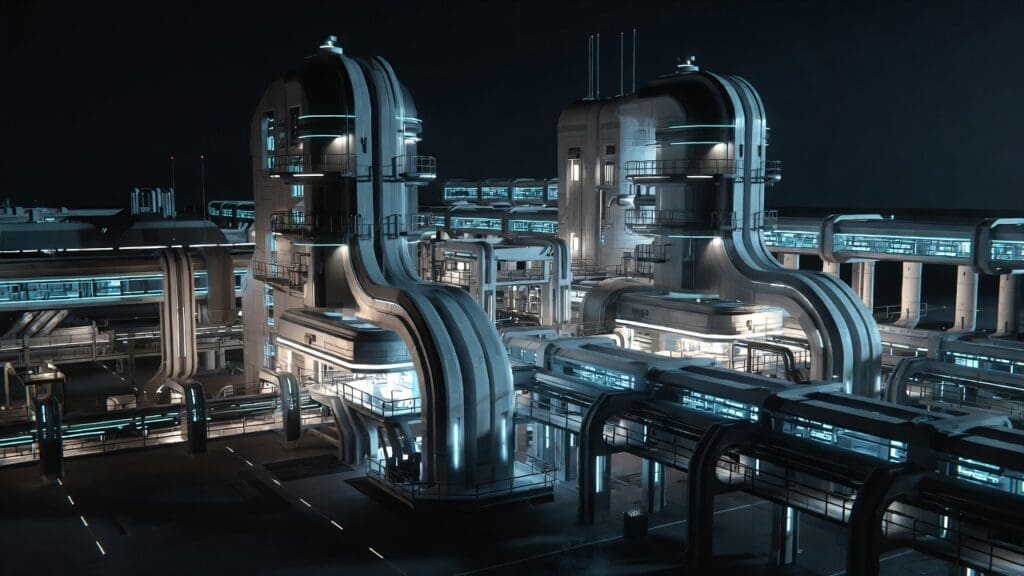
3. Long-Term (2035–2040): Fully Symbiotic & Self-Building Factories
- Self-Building & Self-Optimizing Facilities
Factories construct and expand themselves — swarms of construction robots add lines, reconfigure layouts, and optimize for new products.
AI redesigns the entire factory in real time based on demand, energy prices, material availability, and climate conditions. - Zero-Waste & Carbon-Negative Production
Every factory is circular by design — inputs are recycled or bio-sourced, outputs are fully reusable or biodegradable.
Many facilities actively sequester carbon or produce carbon-negative materials as a byproduct. - Human Role Redefined
Humans act as strategic overseers, creative directors, and ethical guardians.
Most factory workers become “factory architects” or “AI trainers” — remote or occasional on-site roles.
Illustrative Factory Scenarios by 2040
- Lights-Out Electronics Gigafactory — Fully autonomous, 24/7 operation, zero human presence for months; AI self-optimizes yields and repairs robots autonomously.
- Urban Micro-Factory — Small robotic cell in city warehouse produces custom parts on demand — customers pick up same-day via drone or pod.
- Regenerative Apparel Plant — Produces clothes from recycled textiles and bio-fibers; captures CO₂ during dyeing; waste becomes new feedstock.
- Self-Building Modular Factory — Robot swarm adds new production lines overnight based on rising demand; factory literally grows itself.
Key Numbers & Trends by 2040 (illustrative)
- Share of manufacturing tasks handled by robots/AI: 70–95% in structured industries
- Average factory downtime: <1–2% (predictive + self-repairing systems)
- Material waste reduction: 80–95% in advanced facilities
- Energy self-sufficiency in new factories: 70–100% (often net-positive)
- Human on-site workforce per factory: down 60–90% from 2025 levels
- Global manufacturing carbon footprint reduction: 60–90% (net-negative in leading plants)
Risks & Societal Shifts
- Job Displacement — Tens of millions of traditional manufacturing jobs vanish; reskilling and universal basic income debates intensify.
- Inequality — Advanced automated factories concentrate in wealthy nations/regions.
- Security & Cyber Risk — Fully autonomous plants vulnerable to hacking or sabotage.
- Over-Reliance — Risk of systemic failure if AI orchestration breaks down.
Bottom Line
By 2040 factories cease to be noisy, labor-intensive sites — they become quiet, self-sustaining, and regenerative production engines.
The dominant paradigm shifts to lights-out, AI-orchestrated, modular, and circular manufacturing — robots and AI handle 90%+ of physical work, while humans focus on creativity, strategy, and ethical oversight.
Factories no longer consume resources — they regenerate them, producing goods with minimal waste and often net-positive environmental impact.
The future factory isn’t a place of sweat and smoke — it’s a silent, intelligent organism that feeds society while healing the planet.
Manufacturing stops being about making things — it becomes about creating abundance without destruction.
The factory of 2040 doesn’t need lights — because the future is bright enough already.