
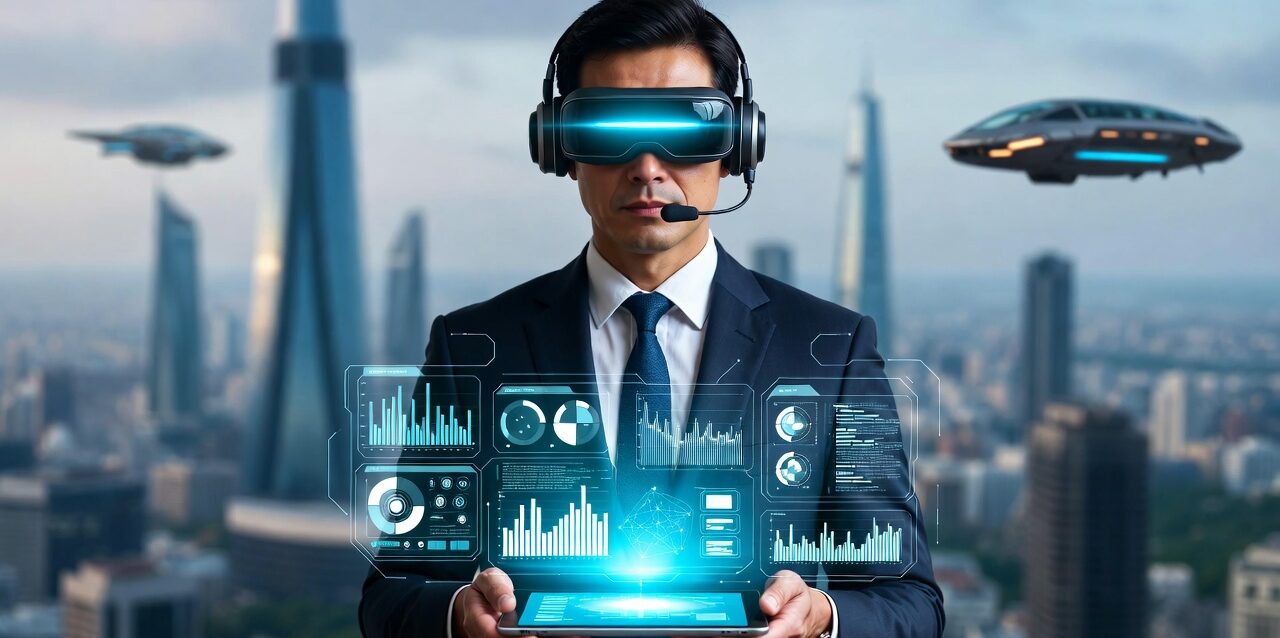
From Interruption & Mass Messaging to Symbiotic, Predictive, Emotion-Aware & Co-Created Value Exchange
As of 2026, marketing is still largely interruption-based, data-hungry, and channel-fragmented:
- Global ad spend exceeds $900 billion annually, with digital now ~75% of total
- Most advertising relies on attention capture (social feeds, display ads, video pre-rolls)
- Personalization is improving via first-party data and AI, but still feels creepy or generic to many consumers
- Consumer trust in brands is low; ad-blockers, subscription fatigue, and “skip ad” culture are widespread
By 2040 marketing has transformed into invisible, symbiotic, predictive, and regenerative value creation — brands no longer “push” messages; they become trusted life partners that anticipate needs, enhance experiences, and co-create meaning with individuals and communities.
1. Near-Term (2026–2030): Hyper-Personalization & Attention Collapse
- End of Interruption Advertising
Attention becomes the scarcest resource. Banner blindness is near-total; traditional display/video ads shrink to <10% effectiveness.
Brands pivot to zero-friction, value-first touchpoints: utility (tools, calculators, AI assistants), entertainment (branded games, AR filters), and emotional resonance (storytelling, user co-creation). - AI Agents as Primary Brand Interface
Every person has a personal AI agent that filters, curates, and negotiates brand interactions.
Brands must “convince the agent” rather than the human — agents block 90%+ of unwanted messages and only surface offers with high relevance and trust. - Zero-Party & Decentralized Data
Consumers share preferences explicitly via “data wallets” or zero-knowledge proofs.
Brands pay users for high-quality first-party data; privacy becomes a competitive advantage.
2. Medium-Term (2030–2035): Immersive & Emotionally Intelligent Marketing
- Persistent Brand Worlds & Co-Creation
Brands build always-on virtual spaces (metaverse successors) where customers live parts of their digital life.
Marketing becomes co-creation: fans design products, vote on campaigns, and earn revenue shares via tokenized participation. - Neuro & Emotion-Responsive Advertising
Non-invasive wearables and early neural interfaces read emotional states in real time.
Ads appear only when someone is receptive (e.g., after a workout, during a good mood spike) and match the exact emotional need (“you seem stressed — here’s a 5-min mindfulness experience sponsored by Calm”). - Regenerative & Purpose-Led Brands
Sustainability shifts from marketing claim to core business model.
Brands must prove net-positive impact (carbon negative, biodiversity gain, social equity) to earn attention.
3. Long-Term (2035–2040): Symbiotic & Ambient Brand Relationships
- Ambient & Predictive Value Delivery
Brands anticipate needs before they form (“your running shoes are wearing out — here’s a custom 3D-printed replacement arriving tomorrow”).
Marketing disappears as a separate activity; value arrives silently and perfectly timed. - Decentralized & Community-Owned Brands
Many top brands are DAOs or tokenized communities — fans own equity, vote on product direction, and share profits.
Marketing becomes internal community storytelling rather than external promotion. - Neural & Shared-Experience Marketing
Early brain-computer interfaces allow brands to create shared emotional experiences (“feel the excitement of driving this car”).
Luxury brands sell “feeling packages” — direct neural access to awe, serenity, or belonging.
Illustrative Marketing Scenarios by 2040
- Daily Life — Your AI agent quietly orders new running shoes when wear is detected; the brand’s virtual ambassador thanks you in AR and offers a personalized training plan.
- Brand Community — You own governance tokens in your favorite coffee brand; you vote on next roast and earn dividends from sales.
- Emotional Campaign — Luxury car brand offers 30-second neural “test drive” — you feel acceleration, wind, and prestige without leaving your chair.
- Regenerative Product Launch — Sustainable fashion brand plants 10 trees per purchase; blockchain tracks every tree’s growth and shows your impact in real time.
Key Numbers & Trends by 2040 (illustrative)
- Share of marketing spend on traditional ads: <10–15% (down from 70–80%)
- AI agent mediation of brand interactions: 80–95%
- Consumer-owned brand equity (via tokens/DAOs): 20–40% in lifestyle categories
- Time spent on paid advertising per day: <5–10 minutes (vs 30–60 today)
- Brand value tied to net-positive impact: 50–80% of premium brand equity
Risks & Societal Shifts
- Manipulation & Addiction — Hyper-personalized emotional targeting risks exploitation.
- Inequality — Brands with best AI agents dominate; smaller players struggle.
- Privacy Erosion — Constant behavioral/emotional data collection creates surveillance economy.
- Authenticity Crisis — When everything is co-created, genuine human expression becomes rare and premium.
Bottom Line
By 2040 marketing ceases to be interruption or persuasion — it becomes invisible, symbiotic, and regenerative value creation.
The dominant paradigm shifts to AI-mediated, emotionally intelligent, and community-owned relationships — brands no longer sell products; they co-create meaning, belonging, and well-being with individuals and communities.
The future isn’t better ads — it’s the end of advertising as we know it.
Brands that survive will not be the loudest — they will be the most trusted, useful, and quietly indispensable parts of people’s lives.
Marketing stops being something done to consumers — it becomes something done with them, for mutual flourishing.
In 2040, the most powerful brand isn’t the one you see everywhere — it’s the one you feel inside, every day, without ever noticing.