From Linear, Reactive Chains to Autonomous, AI-Orchestrated, Circular, and Hyper-Resilient Networks
As of 2026, supply chain management is still largely reactive, fragmented, and human-dependent. Global supply chains rely on spreadsheets, legacy ERP systems, manual forecasting, and physical inspections. Recent shocks (COVID-19, Suez Canal blockage, geopolitical tensions, chip shortages) exposed vulnerabilities: long lead times, single-source risks, poor visibility, and high carbon footprints (supply chains account for ~60–90% of many companies’ total emissions).
By 2040 supply chain management evolves into intelligent, autonomous, circular, and near-real-time systems — powered by AI agents, blockchain, digital twins, IoT everywhere, predictive analytics, and regenerative practices. The chain becomes a living, self-healing network rather than a rigid pipeline.
1. Near-Term (2026–2030): End-to-End Visibility & AI Forecasting
- Digital Twins & Real-Time Visibility
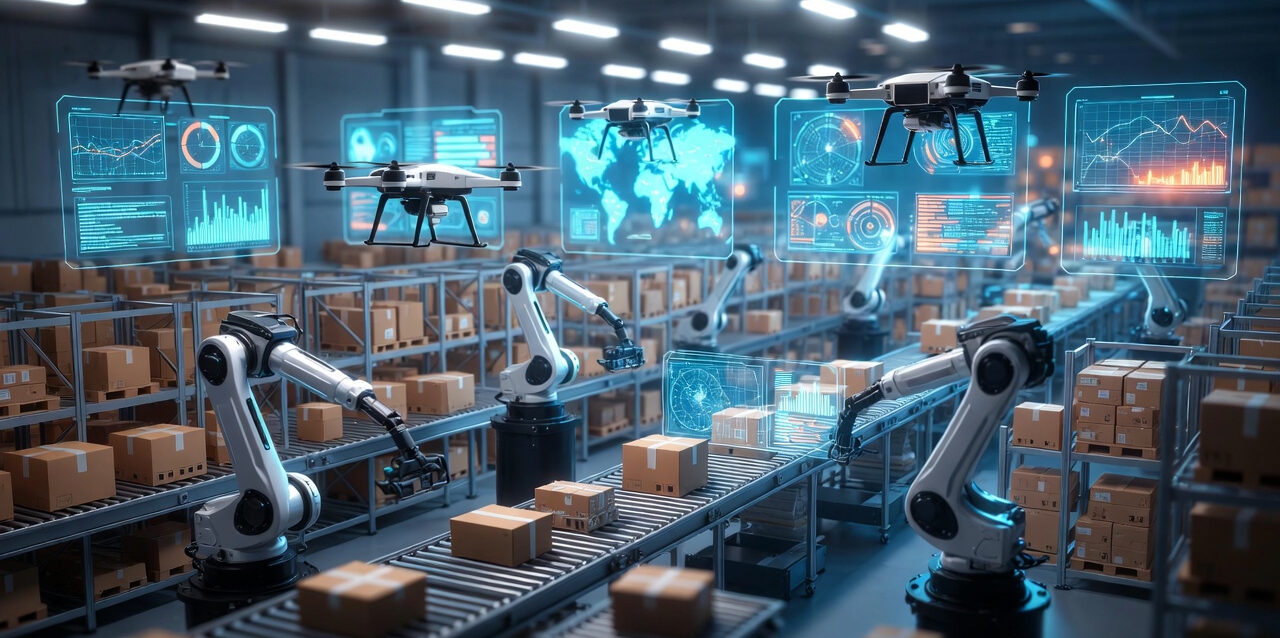
Every major supply chain has a live digital twin — a virtual replica updated every few minutes with IoT sensor data from factories, trucks, containers, warehouses, and even retail shelves.
Visibility reaches 95–99% (location, condition, temperature, humidity, predicted arrival). - Agentic AI Takes Over Planning
AI agents replace traditional planners: they continuously re-optimize routes, inventory, sourcing, and production based on real-time demand signals, weather, geopolitics, and disruptions.
Companies achieve 30–60% reduction in inventory holding costs and 20–40% faster response to disruptions. - Blockchain & Traceability Mandates
Blockchain becomes mandatory for high-risk categories (food, pharmaceuticals, critical minerals).
End-to-end traceability from raw material to finished product is standard, with digital product passports required by regulation (EU, US, China).
2. Medium-Term (2030–2035): Autonomous Execution & Circular Loops
- Autonomous Physical Execution
Fully autonomous warehouses (lights-out), robot fleets, drone delivery, and self-driving trucks operate at scale.
Last-mile delivery is 70–90% autonomous (ground robots + drones); intercity freight shifts to autonomous electric trucks and hyperloop-style cargo tubes. - Circular & Regenerative Supply Chains
Reverse logistics becomes as efficient as forward flow — products designed for disassembly, materials tracked forever, and factories recycle 90%+ of inputs.
“Product-as-a-Service” models dominate high-value goods (leasing phones, apparel, machinery), turning linear chains into closed loops. - Multi-Enterprise AI Orchestration
Cross-company AI agents negotiate, share capacity, and co-optimize entire ecosystems (e.g., automotive OEM + tier-1 + raw material suppliers).
Blockchain smart contracts execute payments and penalties automatically.
3. Long-Term (2035–2040): Self-Healing, Predictive, and Near-Zero Risk Networks
- Self-Healing & Self-Optimizing Chains
AI agents detect emerging risks (geopolitical tension, weather anomaly, supplier failure) weeks/months ahead and automatically reroute, re-source, or redesign flows.
Chains become self-healing — if a node fails, the system instantly reconfigures without human input. - Regenerative & Net-Positive Supply Chains
Supply chains actively sequester carbon, restore ecosystems, and generate surplus resources (e.g., waste-to-energy, CO₂-to-material conversion).
Many companies achieve Scope 3 net-zero or net-positive status. - Human Role Redefined
Humans focus on strategic design, exception handling, ethical oversight, and innovation.
“Supply chain architect” becomes a high-status role — designing resilient, regenerative networks rather than managing daily operations.
Illustrative Supply Chain Scenarios by 2040
- Consumer Electronics
AI agent detects rising chip demand → automatically shifts sourcing from Taiwan to Vietnam/India → autonomous trucks deliver to micro-factories → drone last-mile to customer — entire chain optimized in seconds. - Pharmaceuticals
Blockchain tracks active ingredients from synthesis to patient; AI predicts shortages and reroutes production → drone delivers temperature-controlled meds within hours. - Fashion & Apparel
Circular model: customer returns garment → robotic disassembly → materials recycled into new fabric → AI designs next collection based on real-time trend data from social media and wearables. - Automotive
Predictive AI forecasts parts failure → schedules maintenance before breakdown → autonomous pod delivers replacement part overnight.
Key Numbers & Trends by 2040 (illustrative)
- Inventory reduction: 50–80% across industries
- Supply chain visibility: 95–99% real-time
- Autonomous execution (last-mile & warehouse): 70–95% in urban/advanced regions
- Material circularity: 80–95% in leading supply chains
- Scope 3 emissions reduction: 60–90% (net-positive in frontrunners)
- Supply chain resilience (time to recover from major disruption): down from months to hours/days
Risks & Societal Shifts
- Cyber & Systemic Risk — Hyper-connected chains are vulnerable to coordinated attacks.
- Inequality — Advanced systems favor large corporations; SMEs and developing economies risk exclusion.
- Job Displacement — Millions of logistics, warehouse, and planning roles disappear.
- Over-Reliance — Single-point AI failures could cascade across global networks.
Bottom Line
By 2040 supply chain management becomes invisible, intelligent, and regenerative — a living, self-optimizing network that anticipates disruptions, minimizes waste, and maximizes value with almost no human touch.
The dominant paradigm shifts from reactive firefighting to proactive, predictive, and planet-positive orchestration.
Supply chains stop being a cost center — they become a strategic advantage and a source of resilience and sustainability.
The future isn’t about moving goods faster — it’s about moving them smarter, cleaner, and with purpose.
In 2040, a supply chain failure will be as rare as a power outage in a modern data center — because the system will have already prevented it weeks earlier.