
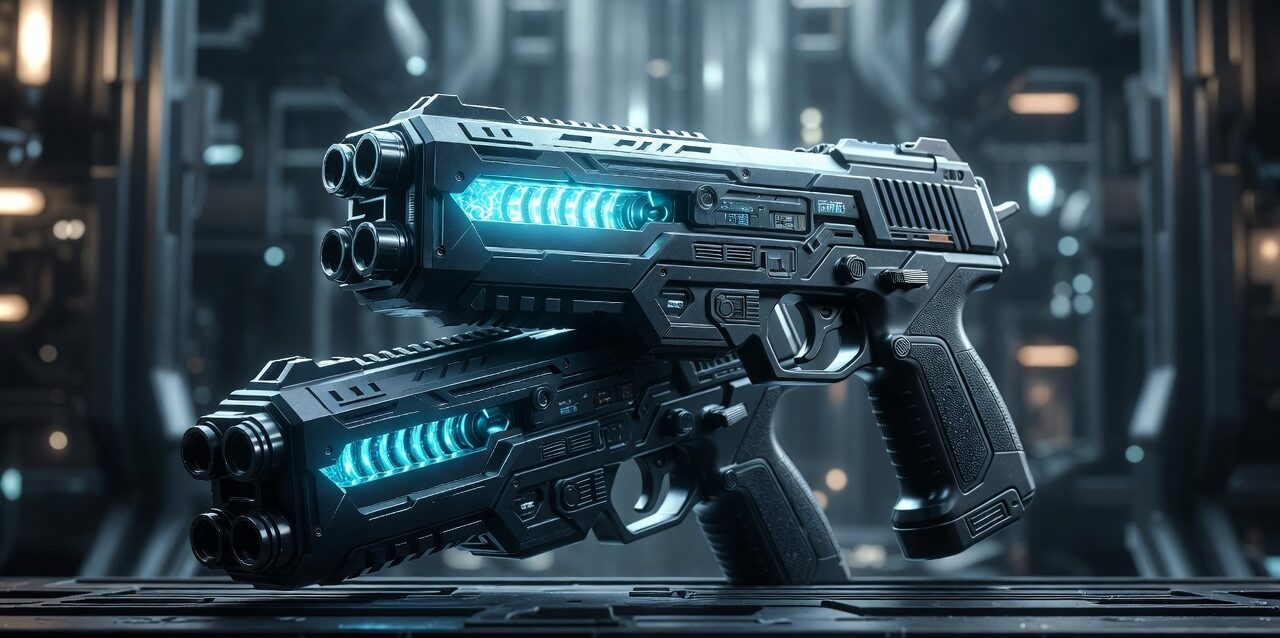
From Mechanical Firearms to Smart, Hybrid, and Potentially Non-Lethal Personal Defense Tools
As of 2026, handguns remain predominantly mechanical firearms — striker-fired or hammer-fired, using conventional ammunition (9mm, .45 ACP, .40 S&W, .380 ACP being the most common). The global civilian handgun market is estimated at $10–15 billion annually, with the U.S. alone having ~400–500 million firearms in circulation (about half handguns). Military/police use is similar, with Glock, SIG Sauer, Smith & Wesson, Beretta, CZ, and Heckler & Koch dominating.
By 2040, handguns evolve into hybrid, smart, and increasingly non-lethal or less-lethal platforms — driven by pressure for reduced lethality, better accountability, integration with law enforcement systems, and emerging non-kinetic technologies. Traditional lethal handguns persist (especially in civilian and military contexts), but their design, use, and societal role change significantly.
1. Near-Term (2026–2030): Smart Features & Early Regulation
- Smart Gun Technology Matures
Biometric locks (fingerprint, palm, facial recognition) become standard on many new models — preventing unauthorized use.
RFID or NFC-enabled “authorized user” systems (bracelet, ring, watch) are common.
Micro-stamping and RFID tagging of ammunition for traceability gain traction (already required in some U.S. states and countries). - Integrated Electronics
Built-in cameras, laser aiming, shot counters, and Bluetooth connectivity appear on premium models.
Some handguns link to smartphones or body cameras — recording video/audio on draw or trigger pull. - Less-Lethal Options Expand
Hybrid handguns capable of firing both lethal rounds and non-lethal projectiles (bean bags, rubber bullets, chemical irritants) enter police and civilian markets.
Conducted energy weapons (Taser-like) become smaller and more pistol-like.
2. Medium-Term (2030–2035): Smart Lethality & Non-Lethal Dominance in Policing
- AI-Assisted & Networked Handguns
Handguns integrate with law enforcement networks — firing only when authorized, auto-reporting location/use, and disabling remotely if stolen/lost.
AI targeting assistance (predictive aim, shot probability overlays) becomes available on high-end models. - Non-Lethal & Variable Lethality
Police forces increasingly issue variable-lethality sidearms — switching between lethal, blunt impact, chemical, and electric modes.
Civilian carry models follow suit in some jurisdictions (with strict regulation). - Ammunition Revolution
Smart ammunition (microchip tracking, self-destruct on lost/stolen) and less-lethal rounds (variable velocity, expanding foam, chemical payloads) become common.
Caseless ammunition and polymer-cased telescoped rounds reduce weight and improve capacity.
3. Long-Term (2035–2040): Directed Energy & Symbiotic Defense Tools
- Directed Energy Handguns
Compact high-energy lasers or high-power microwaves become viable sidearms — non-lethal dazzling/blinding at range, or lethal burn-through at close distance.
Energy density and cooling issues solved via advanced batteries and materials. - Neural & Augmented Interfaces
Early brain-computer interfaces (non-invasive at first) link handguns to neural commands — faster draw, aim, and decision-making.
Augmented reality glasses/helmets overlay targeting data, threat identification, and legal use-of-force guidance. - Non-Lethal Dominance in Civilian & Police Use
In many societies, lethal handguns become heavily restricted or prohibited for civilians and most police roles.
“Personal defense tools” focus on incapacitation, tracking, and deterrence rather than lethality.
Illustrative Handgun Scenarios by 2040
- Police Officer — Variable-lethality pistol with biometric lock, integrated camera, networked to body cam and dispatch. Switches modes based on threat level.
- Civilian Concealed Carry — Compact non-lethal device (laser dazzler + Taser projectile + chemical spray) with smart tracking and emergency beacon.
- Military Special Operations — Hybrid handgun with directed-energy mode and neural-linked targeting for extreme environments.
- Home Defense — Wall-mounted smart vault releases handgun only to authorized users; records and reports any use.
Key Numbers & Trends by 2040 (illustrative)
- Share of new handguns with biometric/smart features: 70–90% in regulated markets
- Non-lethal/variable-lethality handguns in police use: 50–80% in developed countries
- Directed energy sidearms adoption: 10–30% in special forces, 1–5% in general police
- Civilian lethal handgun ownership in strict-control countries: down 40–70%
- Global smart gun market share: 40–60% of new sales
Risks & Societal Shifts
- Hacking & Cyber Vulnerability — Smart guns potentially disabled or misused remotely.
- Access Inequality — Advanced defensive tools favor wealthy/elite users.
- Lethality Reduction vs. Escalation — Non-lethal weapons may embolden aggressive behavior if perceived as “safe”.
- Regulation & Black Markets — Strict controls drive underground markets for lethal firearms.
Bottom Line
By 2040 handguns shift from simple mechanical firearms to intelligent, hybrid, and increasingly non-lethal personal defense tools.
The dominant paradigm becomes smart, networked, and ethically constrained weaponry — biometrics prevent unauthorized use, AI assists targeting, and directed energy or variable-lethality options reduce collateral damage.
Handguns won’t disappear — but their role and design will change profoundly.
The future sidearm isn’t about more stopping power — it’s about smarter, safer, and more accountable power.
Society will decide whether these tools protect or polarize — but the technology will be there either way.