
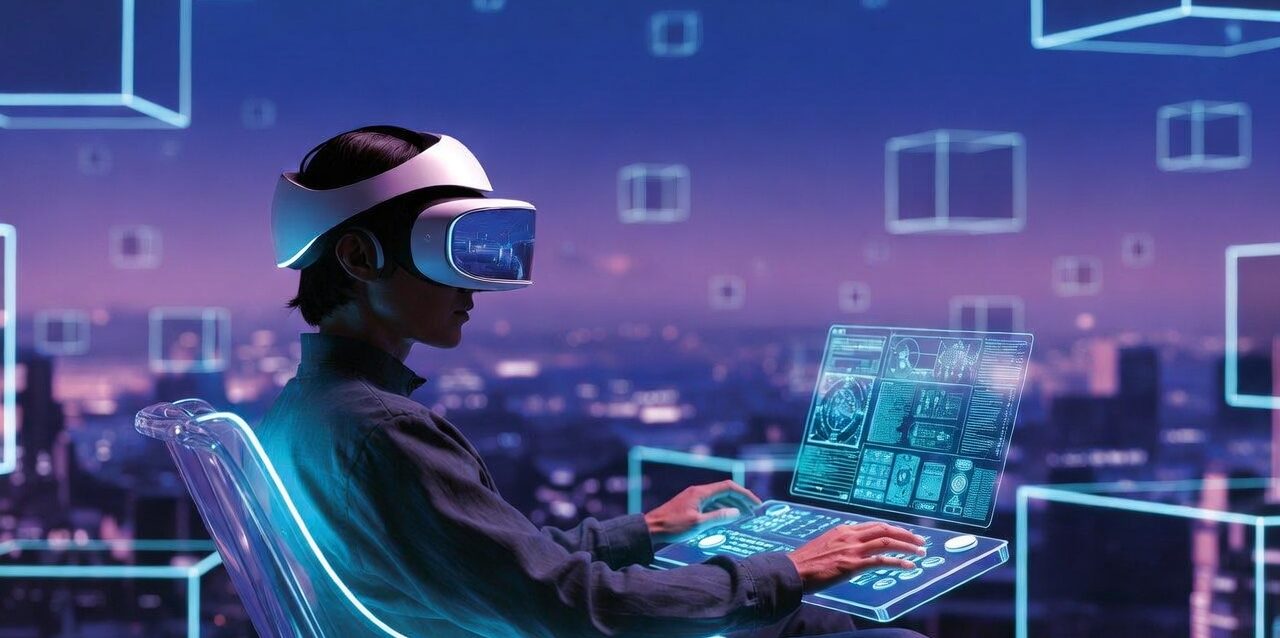
From Niche Entertainment to the Primary Interface for Work, Social Life, Learning & Reality Itself
As of February 2026, consumer VR is still in its early mainstream phase.
Headsets such as Meta Quest 3/3S, Apple Vision Pro, PSVR 2 and Pico 4 dominate, with total active users estimated at ~30–50 million globally.
VR is mostly used for gaming (~60–70% of time spent), fitness (Beat Saber, Supernatural), social VR (VRChat, Rec Room, Horizon Worlds) and very early enterprise/training applications.
By 2040 VR (and its successor XR/AR/mixed-reality continuum) has become the dominant computing platform for knowledge work, education, social interaction, entertainment, therapy and many daily activities — effectively the “next operating system” for human experience.
1. Near-Term (2026–2030): Comfort Breakthroughs & Productivity Pivot
- Hardware becomes truly wearable
Weight drops below 250–300 g, field of view >120–140°, pancake lenses + micro-OLED/micro-LED displays → retina-level resolution (≥60–80 PPD).
Battery life reaches 4–8 hours (or tethered power becomes acceptable).
Eye-tracking, hand-tracking and foveated rendering are standard → no controllers needed for most use. - The Productivity Tipping Point
Virtual multi-monitor setups (Vision Pro style) become better than physical screens for many knowledge workers.
Spatial computing platforms (successors to visionOS, Horizon Workrooms, Immersed, Spatial) reach feature parity with macOS/Windows for office work.
20–35% of remote knowledge workers shift majority of their workday into XR by 2030. - Social VR matures
Avatar realism, facial/body tracking and voice modulation improve dramatically → meetings and hangouts in VR feel almost natural.
VRChat-style worlds become the default hangout for Gen Z / Gen Alpha.
2. Medium-Term (2030–2035): XR Becomes the Primary Computer
- AR glasses replace phones as the main personal device
Lightweight AR glasses (120–180 g, all-day battery, >50° FOV) become the everyday wearable.
Phones become secondary (pocket compute brick + input device).
Most digital interactions (messaging, navigation, browsing, light productivity) happen via AR overlay on the real world. - Virtual offices & campuses dominate
Many companies move headquarters into persistent virtual campuses — physical offices become optional collaboration/event spaces.
Students attend virtual-first schools/universities; physical campuses focus on labs, sports and social life. - Therapy & mental health explosion
VR becomes the gold standard for exposure therapy, PTSD treatment, phobia cure, social skills training and psychedelic-assisted therapy (virtual settings).
“VR wellness retreats” are a major category.
3. Long-Term (2035–2040): Blurred Reality & Full-Dive Era
- Full-dive / high-fidelity VR
Lightweight headsets or direct neural interfaces (non-invasive at first) deliver near-indistinguishable-from-reality experiences.
Visual fidelity reaches photorealism, haptics cover full body, proprioception & vestibular stimulation create convincing motion.
Many people spend 4–12+ hours/day in virtual environments. - Digital twins of reality & persistent worlds
Every person has a continuously updated digital twin of their physical life (home, office, favorite places).
Persistent shared virtual worlds become as “real” as physical ones — people own land, run businesses, form communities, fall in love, and build legacies there. - Societal re-organization
Physical location decouples from economic/social life.
Many people live in low-cost physical locations while working/socializing in premium virtual spaces.
“Digital citizenship” and virtual nation-states emerge.
Time spent in VR often exceeds time spent in base reality for knowledge workers and digital natives.
Illustrative Day in 2040
- 07:30 — Wake up in physical bedroom → immediately enter personal VR workspace (infinite monitors, 3D models floating around you).
- 09:00 — Team meeting in shared virtual office — avatars feel presence, eye contact, micro-expressions.
- 11:00 — Deep work in a custom virtual environment (beach, forest, abstract void) that optimizes focus.
- 13:00 — Lunch with family avatars in virtual dining room (they are in different physical cities).
- 15:00 — Therapy session in VR exposure environment — confront phobia with perfect safety.
- 19:00 — Concert in virtual arena with 100,000 people; feel the crowd, bass in chest.
- 23:00 — Wind down in virtual childhood home — talk to AI-rendered grandparents.
Key Numbers & Trends by 2040 (illustrative)
- 60–85% of knowledge work hours spent in XR
- 40–70% of social interaction occurs in virtual spaces
- Average daily XR usage: 6–10 hours (knowledge workers / digital natives)
- Physical office space per knowledge worker: down 70–90%
- VR/AR device penetration: 70–90% in developed economies
Bottom Line
By 2040 VR/XR does not remain a “device” or “app category” — it becomes the primary interface between humans and digital reality.
Most knowledge work, education, socializing, entertainment, dating, therapy and creative expression happen in shared, persistent, high-fidelity virtual spaces.
Physical reality is increasingly reserved for experiences that require real physics (sports, intimacy, nature, food) and for people who deliberately choose to stay offline.
The future isn’t VR replacing reality — it’s VR becoming the main place where modern life actually happens.
The question is no longer “do you use VR?” — it is “how much of your life do you live in base reality vs. the layers above it?”