From Optional Corporate Perks to AI-Orchestrated, Continuous, and Regenerative Life Optimization
As of 2026, wellness programs are mostly reactive, episodic, and employer-sponsored — gym memberships, mindfulness apps, step challenges, annual biometric screenings, and occasional mental health days.
Participation rates hover around 30–60% in large companies, with mixed ROI: some studies show 20–30% reduction in healthcare costs, others show limited impact due to low engagement and short-term focus.
By 2040 wellness programs evolve into proactive, continuous, hyper-personalized, and symbiotic life-optimization systems — embedded in daily environments, powered by AI, wearables, and regenerative interventions. They shift from “optional perks” to core infrastructure for physical, mental, emotional, and cognitive flourishing — often indistinguishable from everyday life.
1. Near-Term (2026–2030): Continuous Monitoring & Predictive Personalization
- Clinical-Grade Wearables & Ambient Sensing
Devices track dozens of biomarkers continuously (glucose, cortisol, HRV, sleep stages, inflammation, gut microbiome proxies, posture, voice stress).
Smart homes/offices monitor air quality, light, noise, and movement patterns — feeding data into personalized wellness engines. - AI Wellness Coaches as Daily Companions
Personal AI agents (evolved from current health apps) become lifelong coaches: - predict burnout/stress spikes days in advance
- prescribe micro-interventions (5-minute breathwork, posture reset, walk break)
- optimize sleep, nutrition, and exercise based on real-time data
- Employer-Sponsored → Life-Wide Programs
Corporate wellness expands to cover family members and retirees.
Programs become “life-wide” — not just work hours — integrating with personal insurance, telehealth, and longevity clinics.
2. Medium-Term (2030–2035): Regenerative & Neuro-Enhanced Wellness
- Regenerative Interventions at Scale
Senolytics, NAD+ boosters, rapamycin analogs, and early epigenetic therapies become routine preventive tools — slowing biological aging by 5–15 years.
On-site or virtual longevity clinics offer personalized protocols (fasting-mimicking diets, red-light therapy, hyperbaric oxygen). - Neurotech & Mental Renewal
Non-invasive neuromodulation (tDCS, TMS, focused ultrasound) and early neurofeedback become standard for focus, anxiety reduction, and mood regulation.
VR/AR “renewal experiences” simulate psychedelic states for emotional processing and creativity boosts. - Workplace as Wellness Ecosystem
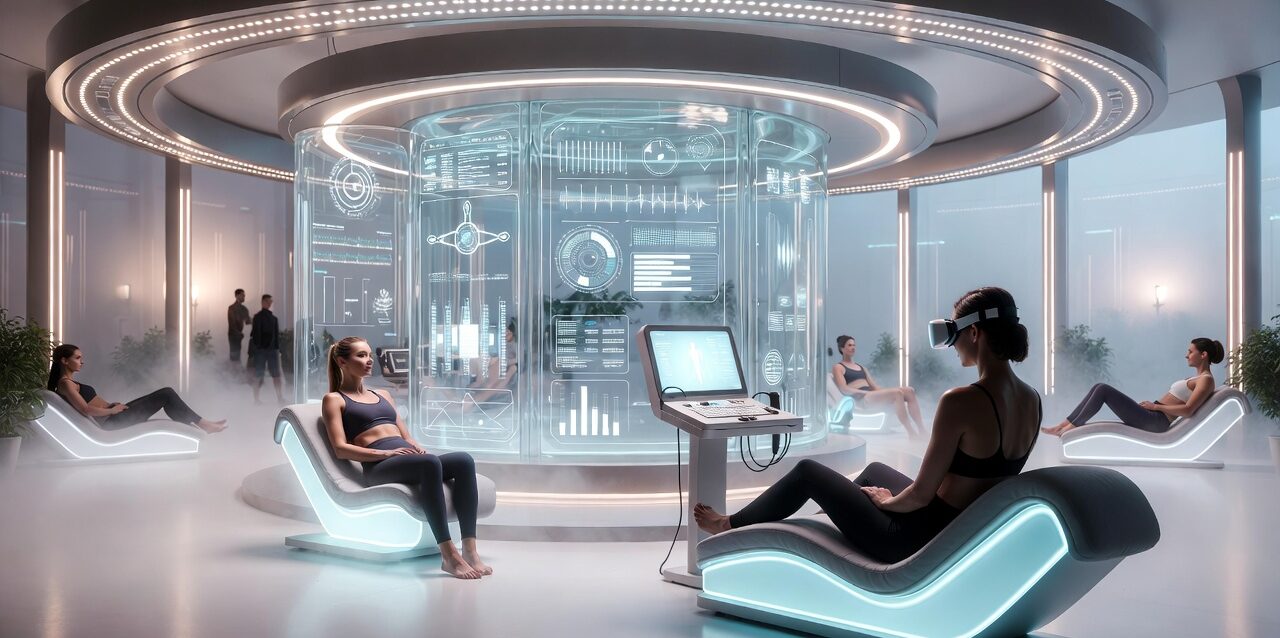
Offices become full wellness campuses — circadian lighting, biophilic design, micro-nap pods, cryotherapy, meditation zones, and AI-scheduled “deep work” blocks.
Companies measure “human performance ROI” — linking wellness investment to productivity, creativity, and retention.
3. Long-Term (2035–2040): Symbiotic & Ambient Wellness Infrastructure
- Ambient & Invisible Wellness
Environments actively optimize health — smart homes adjust light, temperature, scent, and sound for circadian alignment and mood.
Clothing, furniture, and even air deliver micro-doses of nutrients, oxygen, or calming compounds. - Lifelong Biological Age Management
Continuous multi-omics monitoring + regenerative interventions keep biological age 10–25 years below chronological age for participants.
“Healthspan optimization” becomes a standard life goal — like brushing teeth or exercising today. - Societal & Cultural Normalization
Wellness is no longer a luxury — it’s infrastructure.
Governments and employers integrate longevity/wellness into universal basic services.
“Mental renewal days” and “biological age check-ups” become as routine as annual physicals.
Illustrative Wellness Program Scenarios by 2040
- Daily Life — AI agent wakes you with optimal light/playlist → suggests morning routine based on overnight recovery data → monitors stress all day and inserts micro-breaks.
- Workplace — Office building adjusts temperature, scent, and lighting per individual → provides neurofeedback pods during breaks → tracks collective well-being to prevent burnout waves.
- Preventive Intervention — AI detects early inflammation spike → prescribes 3-day fasting-mimicking diet + senolytic → biological age drops 1.2 years in one cycle.
- Mental Renewal — VR-guided psychedelic-like session (legal cyberdelic) processes accumulated stress → emotional baseline reset in 45 minutes.
Key Numbers & Trends by 2040 (illustrative)
- Continuous biomarker monitoring adoption: 60–85% in developed economies
- Average biological age reduction (active participants): 5–15 years
- Corporate wellness program participation: 80–95% in leading companies
- Reduction in chronic disease incidence: 40–70% in optimized populations
- Wellness industry value: $8–15 trillion globally (including longevity tech)
Risks & Societal Shifts
- Inequality — Advanced regenerative/wellness programs initially available only to high earners and forward-thinking employers.
- Over-Optimization — Risk of medicalization of normal life variations → anxiety around “imperfect” biomarkers.
- Privacy & Control — Constant health data creates surveillance risk; ownership and consent become major battlegrounds.
- Human Experience — Potential loss of natural resilience if people rely too heavily on tech interventions.
Bottom Line
By 2040 wellness programs evolve from optional perks to continuous, predictive, and regenerative life optimization systems — embedded in homes, workplaces, clothing, and environments.
The dominant paradigm becomes AI-orchestrated, always-on, and symbiotic health intelligence — disease is prevented before it starts, biological age is actively managed, and well-being is engineered into daily routines.
Wellness stops being something you “do” on weekends — it becomes the invisible background of life, like breathing or gravity.
The future isn’t about living longer — it’s about living better, every single day, with technology that keeps your body and mind in peak condition without you even thinking about it.
Health care ends — health optimization begins.
And in that world, feeling great isn’t an achievement — it’s the default setting.