
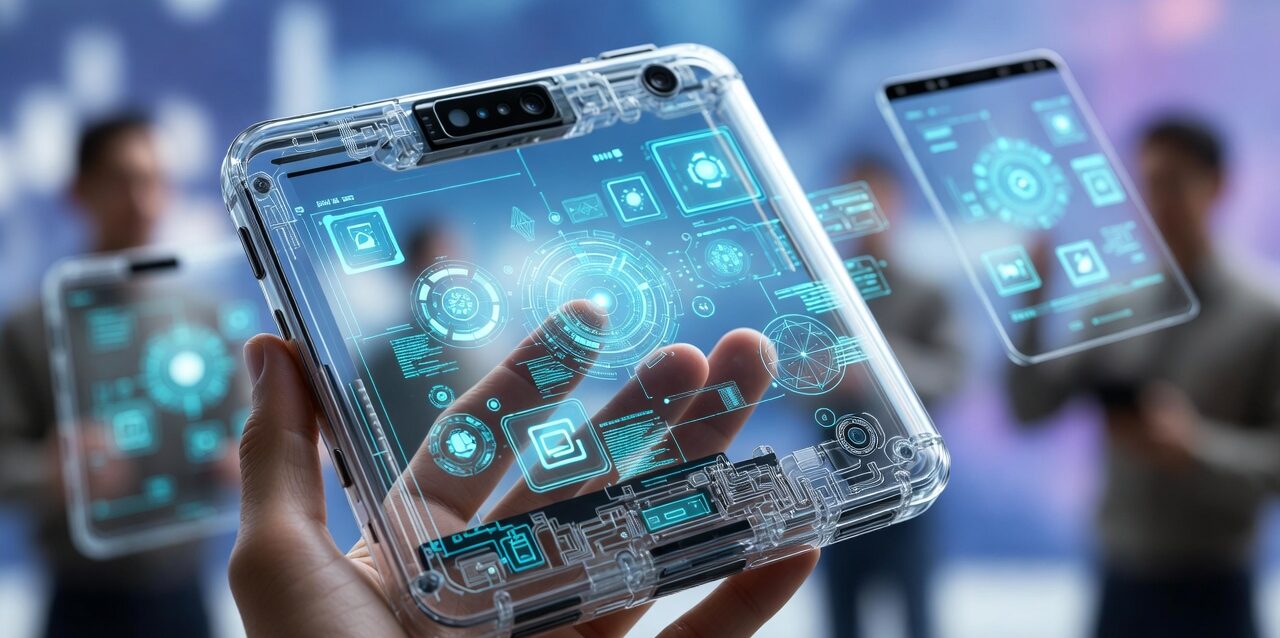
From Pocket Screens to Ambient, Neural-Linked, and Reality-Blurring Interfaces
As of 2026, the smartphone remains the central communication and computing device for most of humanity.
Global smartphone users exceed 6.8 billion, with average daily usage ~4–6 hours (higher among younger demographics).
The market is dominated by Apple (iPhone), Samsung (Galaxy), Google (Pixel), Xiaomi, Oppo/Vivo, and emerging Chinese brands.
Key features include high-resolution OLED/AMOLED displays, 5G connectivity, advanced cameras, AI assistants (Siri, Google Assistant, Bixby), and foldable/rollable form factors in premium segments.
By 2040 the “mobile phone” as a distinct handheld rectangle largely disappears for daily use.
It evolves into ambient, multi-modal, and eventually neural-linked communication layers — always-on, invisible, and integrated into clothing, glasses, earpieces, skin patches, or direct brain interfaces.
The device stops being something you carry — it becomes something you are.
1. Near-Term (2026–2030): AR Glasses & Wearable-First Shift
- AR Glasses Replace Smartphones as Primary Interface
Lightweight AR glasses (Meta Orion-style successors, Apple Vision successors, Google prototypes) become the everyday wearable by ~2028–2030.
Weight drops below 120–180 g, all-day battery life, >50° FOV, high-resolution micro-displays.
Phones become pocket compute bricks + backup input/output — most interactions happen via AR overlay on the real world. - Voice + Gesture + Neural Touch
Voice remains primary input; gesture (hand/finger tracking) and gaze become default navigation.
Early non-invasive neural interfaces (headbands, earpieces) allow thought-to-text and basic command execution. - Multi-Modal & Emotion-Aware Communication
Real-time translation reaches 98–99% accuracy across major languages, preserving tone/emotion.
Haptic feedback transmits basic feelings (heartbeat, squeeze, warmth); AR avatars show micro-expressions and body language.
2. Medium-Term (2030–2035): Ambient & Implantable Layers
- Smart Glasses/Contact Lenses as Default
AR contact lenses or ultra-light glasses (<50 g) become the primary personal device.
Phones shrink to wallet-sized compute nodes or disappear entirely — compute moves to edge/cloud + on-body processing. - Ambient & Implantable Communication
Subdermal chips or ear-implants enable always-on voice/thought communication.
“Always-listening” agents filter conversations, translate live, and provide contextual information (who’s speaking, background facts, emotional state). - Shared Reality & Emotional Bandwidth
Communication includes shared sensory feeds — see what your friend sees, feel their heartbeat, experience their environment.
Virtual presence becomes indistinguishable from physical for most social/professional interactions.
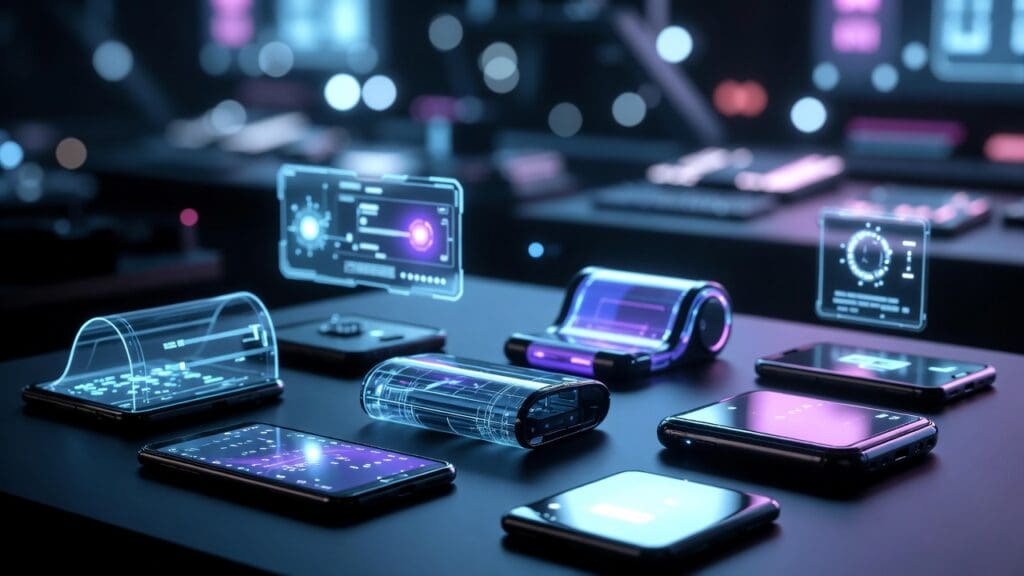
3. Long-Term (2035–2040): Direct Neural & Symbiotic Communication
- Non-Invasive to Minimally Invasive BCI
Brain-computer interfaces (non-invasive headbands → minimally invasive neural dust/links) allow thought-to-thought and concept-to-concept transfer.
Language becomes optional — you share pure ideas, emotions, and memories directly. - Symbiotic & Collective Intelligence
Devices merge with the body — communication feels like thinking to someone.
Group minds emerge for collaborative work/creativity — multiple people share a single mental workspace. - Privacy & Identity Layers
Advanced cryptography and zero-knowledge proofs allow selective sharing — prove identity/age/creditworthiness without revealing full data.
“Digital soul” backups preserve personality/memories for continuity or grief processing.
Illustrative Communication Scenarios by 2040
- Morning Check-In — Wake up → think “good morning” to family → they feel your warmth/smile through neural link even if 5,000 km away.
- Business Meeting — Enter shared neural workspace — feel colleagues’ focus levels, share mental images/concepts directly, no screens or words needed.
- Romantic Conversation — Partner sends emotional “packet” — you feel their affection/calmness directly in your nervous system.
- Learning a Language — Neural link lets you “download” conversational fluency — speak fluently after short immersion simulation.
Key Numbers & Trends by 2040 (illustrative)
- Daily time using AR/XR communication interfaces: 4–10+ hours for knowledge workers/digital natives
- Share of voice/text calls using real-time neural/emotional translation: 80–95%
- Non-verbal/concept-based communication share: 30–60% in close relationships & high-trust professional settings
- BCI adoption (non-invasive/minimally invasive): 20–50% in developed economies
- Physical smartphone ownership: <20–30% among adults under 40 in advanced economies
Risks & Societal Shifts
- Privacy Catastrophe — Constant neural/emotional monitoring creates ultimate surveillance risk.
- Emotional Manipulation — AI-mediated communication can subtly alter feelings or intentions.
- Inequality — Advanced BCI/neural communication remains elite for years.
- Identity & Authenticity — When thoughts can be shared directly, what is “private” thought vs. communication?
Bottom Line
By 2040 speaking different languages (and even speaking at all) becomes optional for most practical communication.
The dominant paradigm becomes instantaneous, emotionally intelligent, culturally fluent, and increasingly direct mind-to-mind interaction — AI removes every friction, preserves intent and nuance, and lets people connect at the speed of thought.
Language survives as cultural treasure, art form, and intimate expression — but for daily life, it becomes secondary to pure concept and feeling transfer.
The future isn’t a universal language — it’s no language needed for most things, while the richness of human tongues lives on in poetry, humor, love, and identity.
Communication stops being a barrier — it becomes pure presence.
The distance between minds vanishes — and with it, many of the oldest divisions in human history.