From Resumes & Interviews to Reputation Portfolios, AI Matching, and Continuous Micro-Credentialing
As of 2026, the job search process remains largely unchanged for decades:
- Candidates submit resumes/CVs (often 1–2 pages)
- Apply through job boards (LinkedIn, Indeed, company sites)
- Undergo multiple interview rounds (behavioral, technical, cultural fit)
- Rely on networking, referrals, and recruiter outreach
- Success rates are low: average applicant-to-interview ratio is 100–250:1 for competitive roles
By 2040 “getting a job” is almost unrecognizable — the traditional resume is obsolete, interviews are rare for most roles, and hiring becomes continuous, reputation-based, predictive, and symbiotic between candidate AI agents and company AI systems.
1. Near-Term (2026–2030): Reputation & Micro-Credentials Replace Resumes
- Digital Reputation Portfolios
Resumes are replaced by dynamic, verifiable on-chain reputation profiles (LinkedIn + GitHub + certification platforms + contribution attestations).
Every contribution (code commits, open-source PRs, freelance deliverables, forum answers, conference talks) is timestamped, verified, and weighted by impact. - AI Matching & Agent Negotiation
Job seekers have personal career agents that continuously scan opportunities, match against skills/reputation, and negotiate terms.
Companies have talent agents that proactively reach out to high-fit candidates before roles are even posted. - Micro-Credentials & Skill Badges
Traditional degrees lose dominance.
Short, verifiable credentials (Coursera-style + blockchain certification) become the currency — “I completed 12-week AI engineering bootcamp with 98th percentile project score” carries more weight than “Bachelor’s in Computer Science”.
2. Medium-Term (2030–2035): Continuous Evaluation & Virtual Tryouts
- Always-On Reputation & Contribution Tracking
Every professional has a live, public/private reputation dashboard updated in real time: - GitHub commits, Stack Overflow answers, Kaggle rankings
- Client reviews, peer endorsements, prediction market accuracy
- Open-source impact score, teaching/mentoring hours, community contributions
- Virtual Tryouts & Simulation-Based Hiring
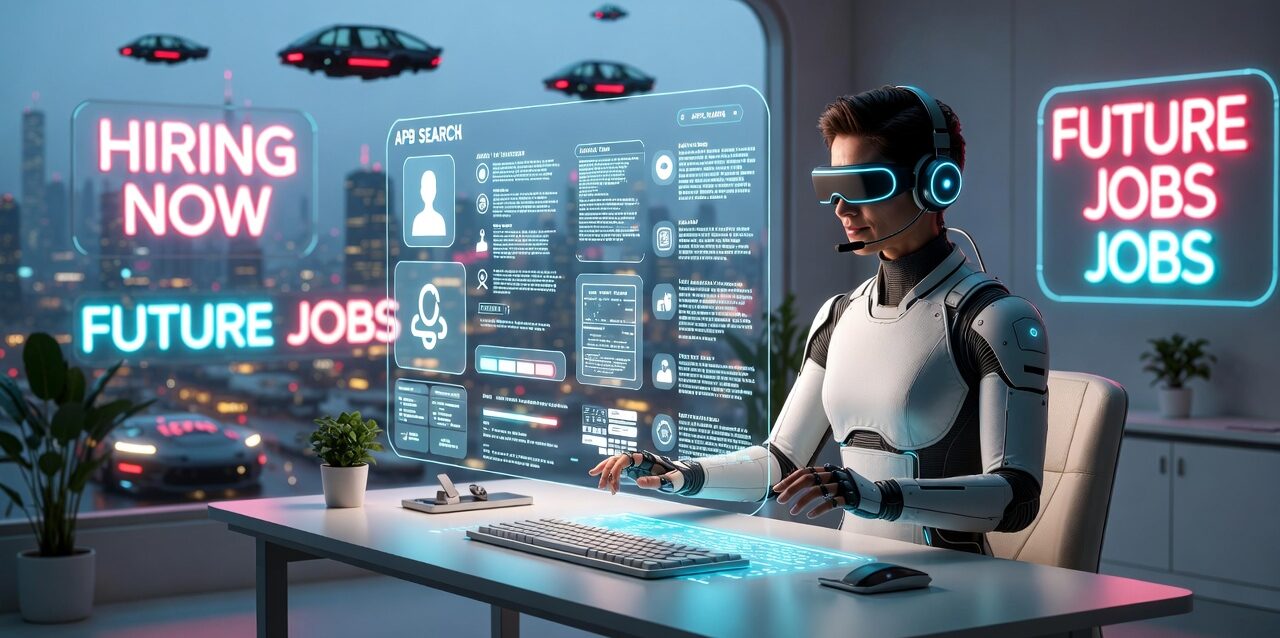
Instead of interviews, candidates complete 1–4 hour real-work simulations in VR/AR environments.
AI evaluates performance across speed, quality, creativity, collaboration, and ethical decision-making.
Top performers receive instant offers; no human bias in scoring. - Talent Marketplaces & Agent Economies
Centralized platforms (LinkedIn successors) become decentralized talent DAOs.
Agents represent both candidates and companies — negotiating salary, equity, remote/hybrid preferences, and even cultural fit in seconds.

3. Long-Term (2035–2040): Symbiotic & Post-Job Economy
- Continuous Matching & Fluid Roles
“Jobs” become fluid project-based assignments.
AI continuously matches people to opportunities based on real-time reputation, current interests, energy levels, and life stage.
Many people have 3–10 concurrent micro-roles instead of one full-time job. - Neural & Cognitive Augmentation in Hiring
Early non-invasive BCI allows candidates to demonstrate thinking process in simulations — showing how they reason, not just what they produce.
Companies assess “cognitive signature” — unique patterns of creativity, resilience, and ethical judgment. - Purpose & Alignment Matching
Hiring prioritizes value alignment over pure skill.
AI agents evaluate cultural fit, purpose overlap, and long-term compatibility — “this person’s life mission aligns 87% with our company’s north star”.
Illustrative “Getting a Job” Scenarios by 2040
- Mid-Career Professional — Reputation agent detects rising demand for AI ethics experts → applies to 12 roles overnight → receives 4 simulation invites → completes 2-hour VR case study → offer received within 24 hours.
- Recent Graduate — Portfolio of micro-credentials + open-source contributions + prediction market track record → AI agent matches to 30+ entry-level roles → virtual tryout in immersive product simulation → hired without ever speaking to a human.
- Gig/Portfolio Worker — AI continuously surfaces 5–10 new micro-projects daily → worker accepts 3 → works asynchronously across time zones → reputation score increases with each successful delivery.
- Executive Transition — Neural-linked simulation lets candidate “run” a virtual company for 4 hours → AI evaluates strategic thinking, team management style, and crisis response → board approves hire based on simulation data.
Key Numbers & Trends by 2040 (illustrative)
- Average time from application to offer: hours to 2–3 days (down from weeks/months)
- Share of roles filled via simulation-based tryouts: 60–85% in knowledge work
- Traditional resume usage: <5–10% of hiring processes
- Micro-credential/badges per professional: 50–200 lifetime
- Percentage of workforce in fluid/project-based roles: 40–70%
- AI agent involvement in hiring: 90–95% of initial screening/matching
Risks & Societal Shifts
- Inequality — Those without access to advanced education/tech augmentation fall behind in reputation economy.
- Gaming the System — Reputation manipulation, fake contributions, and AI-generated portfolios become major issues.
- Loss of Human Judgment — Over-reliance on simulations may miss intangible qualities (charisma, intuition, resilience).
- Psychological Impact — Continuous evaluation creates performance anxiety and identity tied to metrics.
Bottom Line
By 2040 “getting a job” ceases to be an event — it becomes a continuous, reputation-driven, and AI-mediated matching process.
The dominant paradigm shifts to fluid, meritocratic, and purpose-aligned work allocation — resumes are replaced by live reputation streams, interviews become immersive simulations, and careers become portfolios of meaningful contributions rather than linear ladders.
Finding work stops being stressful — it becomes effortless, fair, and aligned with who you are and what you value.
The future isn’t about landing a job — it’s about the world continuously discovering the best place for your talents at any given moment.
In 2040, you don’t apply for jobs — jobs find you, because the system knows you better than you know yourself, and it wants you to thrive.