From Shareholder-Driven Giants to Purpose-Aligned, AI-Orchestrated, Decentralized, and Regenerative Entities
As of 2026, corporations remain largely structured around shareholder primacy, quarterly earnings pressure, hierarchical management, and centralized decision-making. The largest companies (Apple, Microsoft, Amazon, Alphabet, Saudi Aramco, etc.) generate trillions in market cap, but face growing criticism for short-termism, inequality, environmental damage, and misalignment with societal needs.
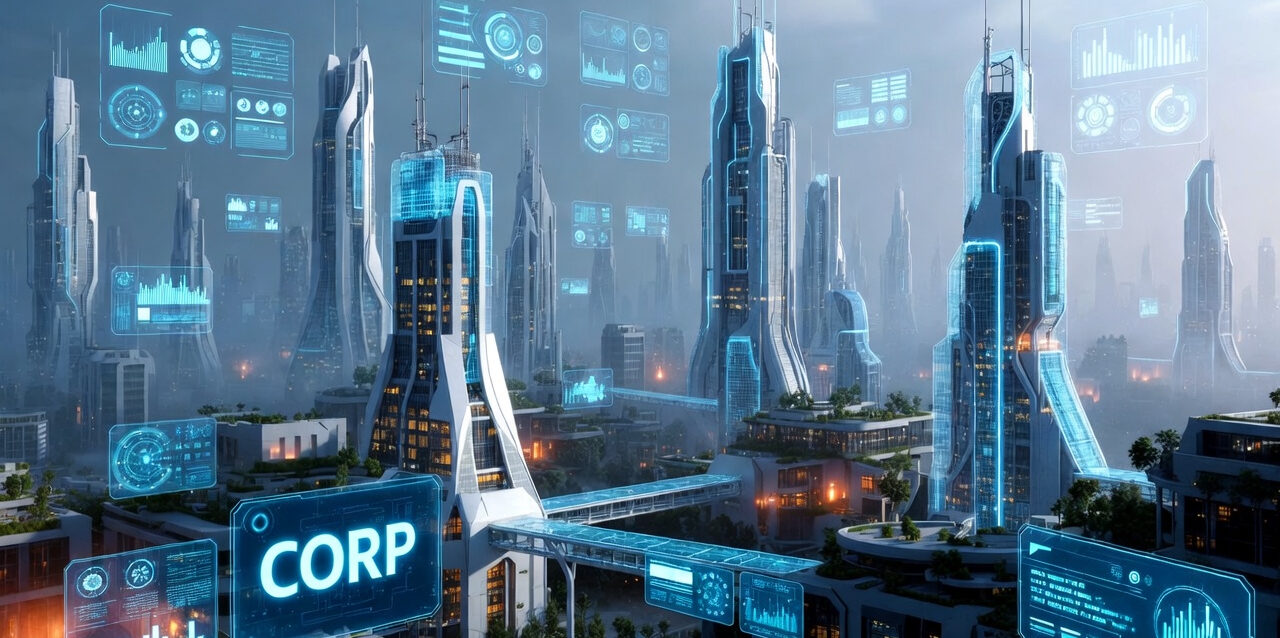
By 2040, corporations evolve into hybrid, purpose-first, AI-augmented, and often decentralized organisms — where profit is a necessary outcome rather than the sole purpose, AI handles most operational decisions, and ownership/decision-making becomes distributed across stakeholders, employees, communities, and even AI agents.
1. Near-Term (2026–2030): Purpose Pressure & AI Governance Layer
- Purpose & Stakeholder Capitalism Becomes Mandatory
Legal and investor pressure forces most large corporations to adopt formal stakeholder models (B-Corp status, EU Corporate Sustainability Due Diligence Directive, SEC climate disclosure rules).
ESG metrics become as important as earnings per share in executive compensation and board evaluations. - AI as Executive & Governance Layer
AI agents join board meetings as non-voting advisors — analyzing strategy, forecasting risks, and simulating outcomes.
Chief AI Officer (CAIO) becomes a C-suite role in most Fortune 500 companies. - Decentralized Decision-Making Pilots
Early DAOs and tokenized governance experiments appear in tech and creative industries.
Employees receive equity-like tokens with voting rights on specific decisions (product roadmaps, hiring policies).
2. Medium-Term (2030–2035): AI-Driven Operations & Employee/Community Ownership
- Autonomous Business Units
Entire functions (marketing, supply chain, customer support, R&D) run as agent teams with one human overseer.
A $10 billion revenue company may have only 100–500 human employees + thousands of specialized AI agents. - Tokenized & Dynamic Ownership
Equity becomes tokenized and liquid — employees, customers, and communities hold governance tokens.
Ownership is dynamic: tokens earned through contribution (code, ideas, usage) rather than just capital investment. - Regenerative & Circular Business Models
Corporations are legally required to be net-positive (carbon, water, biodiversity).
Product-as-a-Service dominates durable goods; take-back and remanufacturing are standard.
3. Long-Term (2035–2040): Symbiotic Corporations & Post-Corporate Structures
- Human-AI Symbiotic Organizations
Humans set long-term vision and ethical boundaries; AI agents execute operations, negotiate contracts, manage resources, and even propose strategy.
Corporations become “symbiotic intelligences” — part human, part machine. - Network & Protocol-Based Entities
Many large corporations dissolve into protocol-based networks (like open-source projects on steroids).
Value accrues to contributors via tokens; governance is on-chain and fluid. - Purpose Supremacy
Legal charters mandate dual-purpose structures (profit + societal/environmental impact).
Stock markets evolve to value purpose metrics (healthspan improvement, ecosystem restoration, inequality reduction) alongside financial returns.
Illustrative Corporate Scenarios by 2040
- Tech Company — 200 humans + 50,000 AI agents; humans set vision, agents run operations. Governance tokens held by employees, users, and impacted communities.
- Consumer Goods Giant — Fully circular — every product leased, tracked forever, remanufactured. AI designs products for maximum longevity and recyclability.
- Pharmaceutical Firm — AI runs clinical trials, designs molecules, and personalizes therapies. Profits capped; surplus reinvested in global health equity.
- Decentralized Media Network — No CEO — protocol governs content moderation, revenue share, and editorial direction. Contributors earn tokens for quality.
Key Numbers & Trends by 2040 (illustrative)
- Average employee count in large corporations: down 60–90% from 2025 levels
- AI agent count per $1 billion revenue: 5,000–50,000+
- Share of companies with formal stakeholder charters: 70–90% in advanced economies
- Tokenized ownership participation: 40–70% of workforce in tech/creative sectors
- Corporate carbon/net-positive status: 60–85% of large public companies
Risks & Societal Shifts
- Power Concentration — AI-orchestrated corporations could become uncontrollable super-entities.
- Inequality — Tokenized wealth may concentrate among early contributors.
- Accountability — Who is liable when AI agents make decisions?
- Purpose Washing — Risk of superficial stakeholder claims without real change.
Bottom Line
By 2040 corporations cease to be purely profit-driven machines — they become purpose-aligned, AI-augmented, decentralized, and regenerative organisms.
The dominant paradigm shifts to human-AI symbiosis with stakeholder governance — profit remains necessary but no longer sufficient; corporations are judged by their contribution to human flourishing, planetary health, and societal resilience.
The future corporation isn’t a legal fiction maximizing shareholder value — it’s a living system that creates value for all stakeholders while healing the world it operates in.
The age of shareholder primacy ends — the age of symbiotic enterprise begins.
Business stops being about extraction — it becomes about regeneration, meaning, and collective thriving.
In 2040, the most valuable companies won’t be the biggest — they’ll be the ones that make life better for the most people, with the least harm.