
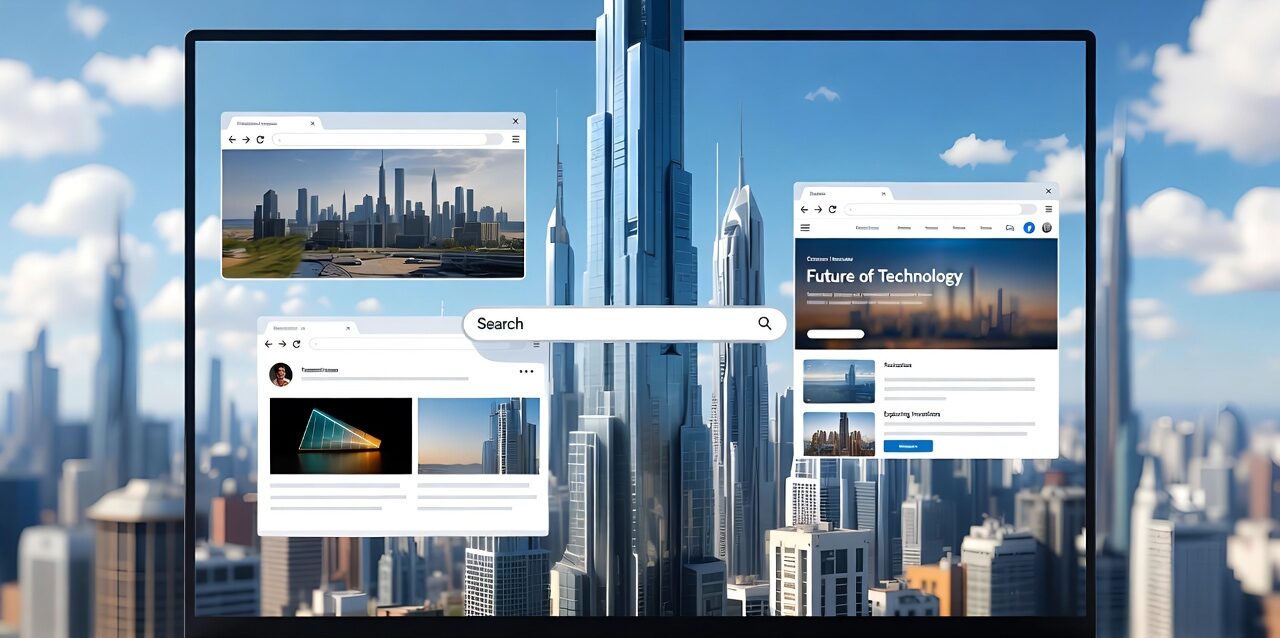
From Static Web Pages to Ambient, Multi-Modal, Agentic, and Reality-Integrated Interfaces
As of February 2026, the World Wide Web remains the dominant digital interface for information, commerce, social interaction, and services.
There are ~1.9–2.1 billion active websites, but the vast majority of user attention is captured by a handful of platforms (Google, YouTube, TikTok, Instagram, X, Reddit, Amazon, Wikipedia, major news sites).
Websites are still primarily 2D, browser-based, and passive — users visit URLs, scroll, click, read/watch, and fill forms.
By 2040 the traditional “website” as a rectangular browser window is largely obsolete for most daily use cases.
The web evolves into ambient, multi-modal, agent-mediated, and reality-blended experiences — where information, services, and interactions come to the user rather than the user going to them.
Websites don’t disappear — they become invisible infrastructure, APIs, and backend data sources for smarter, more natural interfaces.
1. Near-Term (2026–2030): AR Glasses & Agentic Interfaces Emerge
- AR Glasses / Contact Lenses as Primary Access Layer
Lightweight AR glasses (Meta Orion successors, Apple Vision successors, Google prototypes) replace phones as the default way to access the web.
Websites render as 3D spatial objects floating in your environment — persistent, shared, and context-aware.
You no longer “visit” amazon.com — Amazon’s catalog appears as a virtual store shelf when you look at your kitchen counter. - Personal AI Agents Replace Browsing
Every person has a primary AI agent that acts as universal web interface.
Instead of opening tabs, you say/think: “Find me the best noise-cancelling headphones under $300 with 40-hour battery and good ANC reviews from 2025–2026.”
The agent searches, compares, reads reviews, checks return policies, and presents 3 ranked options in AR — often completing the purchase if authorized. - Websites Become APIs & Data Sources
Traditional HTML/CSS/JS sites still exist for legacy compatibility and SEO, but most user-facing interactions happen through structured APIs + AI mediation.
“Web scraping” becomes obsolete — sites expose clean, real-time data feeds for agents.
2. Medium-Term (2030–2035): Persistent Shared Worlds & Zero-Click Experiences
- Persistent Digital Twins of Websites
Every major brand/site has a persistent 3D virtual twin — always running, up-to-date, and accessible via AR/VR.
You don’t browse Nike.com — you step into the Nike virtual store, try on shoes in AR, see how they look on your body, and buy with a gesture. - Zero-Click & Predictive Delivery
AI agents anticipate needs and deliver outcomes without explicit browsing.
Example: “I need a new laptop for video editing” → agent researches, compares, orders, and schedules delivery — you never open a website. - Decentralized & Community-Owned Interfaces
Open protocols and decentralized web (Web3/Web5 successors) allow communities to own and govern interfaces to popular services.
Users pay micro-fees or contribute attention/data in exchange for ad-free, privacy-first access.
3. Long-Term (2035–2040): Neural & Symbiotic Information Access
- Direct Neural & Concept-Level Access
Non-invasive to minimally invasive brain-computer interfaces allow thought-to-information retrieval.
You “think” a question → relevant knowledge appears as memory, visualization, or voice in your mind — no screen needed. - Ambient & Contextual Information
Information arrives proactively based on context, location, mood, and intent — no browsing required.
Example: walking past a restaurant → menu, reviews, and reservation availability appear as gentle AR overlay; you “nod” to book a table. - Post-Website Internet
The URL bar and traditional browsing become legacy concepts.
The web is now a seamless layer of reality — accessed via voice, thought, gesture, or gaze — with AI handling discovery, synthesis, and delivery.
Illustrative Everyday Scenarios by 2040
- Shopping — Think “new running shoes” → AI agent presents 3D models in AR on your floor → you “try on” via body scan → purchase completes silently.
- Research — Wonder about quantum computing → relevant concepts appear as interactive 3D models in your visual field; AI narrates key papers and controversies.
- Social Connection — Miss a friend → think their name → their current emotional state and availability appear; you “join” their reality for a shared walk.
- Learning — Want to understand relativity → enter persistent virtual classroom — Einstein’s digital twin teaches you personally, adapting to your pace and questions.
Key Numbers & Trends by 2040 (illustrative)
- Daily time spent in traditional browser windows: <5–15 minutes for most adults
- Share of information access via AI agents / ambient interfaces: 80–95%
- AR/XR glasses/contact lens adoption: 70–90% in developed economies
- Traditional website visits per day (average user): down 70–90% from 2026
- AI-mediated transactions (purchases, bookings, research): 85–98% of all interactions
Risks & Societal Shifts
- Filter Bubbles & Reality Fragmentation — Hyper-personalized feeds create parallel realities; shared cultural context erodes.
- Privacy Catastrophe — Constant intent/context monitoring enables unprecedented surveillance and manipulation.
- Digital Divide — Advanced neural/ambient access remains elite for years; billions still use legacy interfaces.
- Loss of Serendipity — When everything is perfectly curated, accidental discovery and diverse viewpoints decline.
Bottom Line
By 2040 websites as we know them — rectangular browser windows you visit — are largely obsolete for daily life.
The dominant paradigm becomes ambient, agent-mediated, and reality-integrated information access — knowledge, services, people, and experiences arrive proactively, personally, and seamlessly.
The internet stops being a place you go — it becomes the invisible background layer of reality, accessed via voice, thought, gaze, or gesture.
Browsing ends — discovery begins.
The future isn’t better websites — it’s the dissolution of the browser window and the rise of a world where information finds you, perfectly timed and perfectly suited, without ever needing to search.
The web doesn’t disappear — it disappears into everything.