
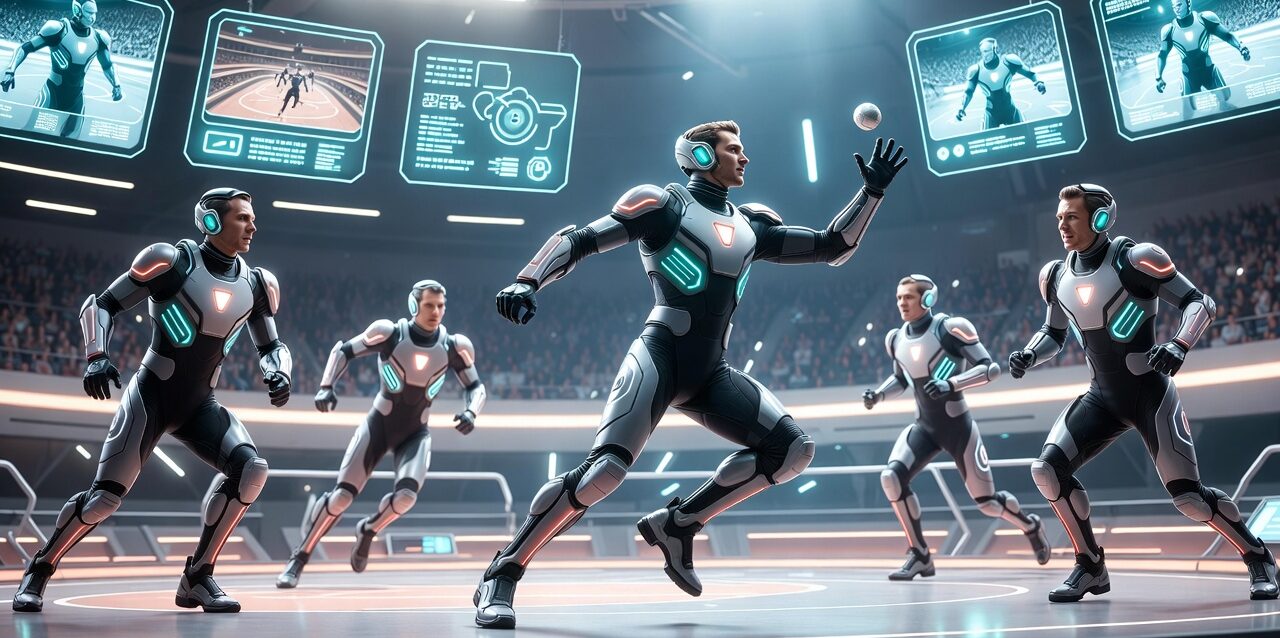
From Traditional Athletics to Augmented, Virtual, Data-Driven, and Hyper-Personalized Performance & Spectatorship
As of 2026, sports remain largely governed by biological limits and traditional formats:
- Elite athletes push human ceilings (100 m sprint ~9.58 s, marathon ~2:00:35, high jump ~2.45 m)
- Spectatorship is split between live attendance, TV/streaming, and short-form highlights
- Global sports industry revenue exceeds $600–700 billion annually (events, media rights, sponsorships, merchandise, betting)
- Technology is already transformative (VAR, Hawk-Eye, smart balls, wearables, data analytics), but still supplementary
By 2040 sports split into parallel realities:
- Natural/human-only leagues preserve biological performance
- Augmented/enhanced leagues showcase superhuman feats via exoskeletons, gene editing, neural interfaces
- Fully virtual & simulated sports become the largest spectator category by time spent and revenue
1. Near-Term (2026–2030): Wearables, Analytics & Early Augmentation
- Performance Optimization
Wearables (smart insoles, skin patches, smart clothing) provide real-time biomechanical feedback, injury prediction, recovery optimization, and personalized training.
AI coaches analyze every movement frame-by-frame, suggesting micro-adjustments that shave fractions of seconds or add centimeters. - Spectator Experience Upgrade
AR glasses / contact lenses overlay stats, replays, player POV, alternate angles during live events.
Personalized broadcasts: watch from any camera position, hear only your favorite commentator, or see friend’s reactions in shared AR view. - Early Augmented Sports
Exoskeletons and powered prosthetics used in exhibition events (e.g. Cybathlon-style competitions).
First “augmented leagues” emerge for non-Olympic sports (e-sports hybrid, powered racing).
2. Medium-Term (2030–2035): Hybrid & Virtual Dominance
- Augmented Leagues & Categories
Separate “enhanced” divisions appear in major sports (running, jumping, swimming, cycling, strength events).
Exosuits, neural stimulation, and early gene therapies push performance 20–50% beyond natural limits.
Natural divisions remain prestigious (Olympics, World Championships), but augmented leagues draw larger audiences and prize money. - Fully Virtual & Simulated Sports
VR/AR sports explode — realistic physics engines, millions of concurrent players/spectators.
Popular formats: - hyper-realistic soccer/football in custom stadiums
- zero-gravity basketball
- fantasy combat sports
- extreme environment racing (volcano, underwater, space)
- Fan Participation & Co-Creation
Spectators influence live games (vote on rule changes, player decisions, weather).
AI generates personalized highlight reels, virtual meet-and-greets, and fan-created tournaments.
3. Long-Term (2035–2040): Redefined Human Performance & Reality-Blurring Spectacle
- Biological + Technological Ceiling
Gene editing, neural interfaces, and full-body augmentation allow natural humans to approach 20–50% improvement in speed, strength, endurance (e.g. 100 m in ~8.0–8.5 s, vertical jump >3 m).
Augmented athletes perform at levels previously considered impossible (100 m sub-7 s, 4+ m vertical jumps in exhibition events). - Blended & Full-Dive Spectatorship
Most fans experience sports in high-fidelity VR — feeling the impact of tackles, the speed of a sprint, the height of a jump.
“Full-dive” events let spectators temporarily “inhabit” athletes’ bodies (via non-invasive BCI) for key moments. - New Sports & Cultural Shift
Entirely new sports emerge in virtual/physical hybrid formats (zero-gravity dance, underwater racing, drone-human team sports).
Traditional sports split into natural, augmented, and virtual divisions.
Esports and virtual sports surpass traditional viewership in total hours watched.
Illustrative Sports Scenarios by 2040
- 100 m Sprint
Natural division: 9.4–9.6 s
Augmented division: 7.8–8.5 s (exosuit + neural boost) - Vertical Jump Competition
Natural elite: ~1.25–1.35 m
Augmented elite: 2.8–4.0+ m (powered ankle/knee actuators) - Virtual Football Final
100 million simultaneous spectators in a persistent digital stadium; fans vote on one rule change mid-game; AI referees with 99.9% accuracy. - Fan Experience
Watch from athlete’s POV, feel the adrenaline, change angles instantly, interact with friends in shared virtual box seats.
Key Numbers & Trends by 2040 (illustrative)
- Share of sports viewing time in VR/AR: 60–85%
- Augmented sports revenue share: 40–70% of total sports economy
- Average performance improvement in augmented divisions: 20–60% vs natural
- Global esports/virtual sports audience: 3–5 billion
- Physical stadium attendance: down 40–80% for most major events
Risks & Societal Shifts
- Inequality — Augmented sports favor those with access to expensive tech/therapies.
- Ethics & Doping — Gene editing, neural implants, and exoskeletons spark “natural vs enhanced” debates.
- Reality Disconnect — Over-immersion in virtual sports risks detachment from physical activity.
- Cultural Loss — Traditional sports may lose prestige if augmented/virtual versions draw bigger audiences.
Bottom Line
By 2040 sports split into three parallel realities:
- Natural — preserving human biological limits
- Augmented — showcasing superhuman feats via technology
- Virtual — becoming the largest spectator and participation category
The future of sports isn’t about breaking records with the same body — it’s about redefining what “record” means when humans can merge with machines, enter digital worlds, and co-create experiences.
Watching sports stops being passive — it becomes participatory, immersive, and emotionally overwhelming.
Performing sports stops being limited by biology — it becomes limited only by imagination and technology.
Fun, competition, and wonder will be greater than ever — but so will the questions:
What does it mean to be human when we can run faster, jump higher, and feel more — and when the biggest stadiums exist only in our minds?