
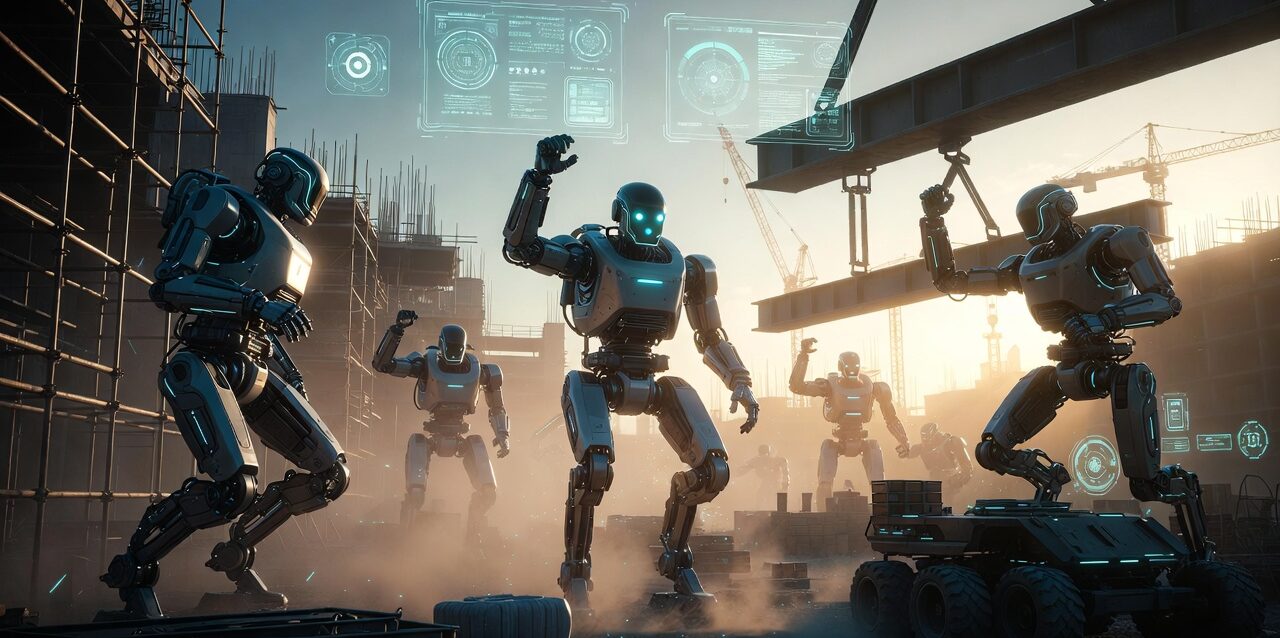
Intelligence in Motion: AI-Robotics Fusion Ending Labor Shortages Forever
From Experimental Embodiments to Ubiquitous, Intelligent, and Autonomous Physical Agents
As of 2026, physical AI—defined as AI systems that perceive, understand, reason, and interact with the physical world through robotics, sensors, and actuators—remains in early deployment, with AI enhancing traditional robots for specific tasks in controlled environments:
- Humanoid prototypes like Tesla Optimus V3 and Figure AI models demonstrate basic walking, object manipulation, and learning via simulation-to-real training
- Industrial robots integrate analytical and generative AI for autonomy in factories, but lack generalization across dynamic settings
- Market size for AI robotics ≈ $19–35 billion, focused on warehouses, healthcare pilots, and autonomous vehicles
- Challenges include high costs, dexterity limitations, and regulatory hurdles for widespread adoption
By 2040 physical AI and robotics have converged into adaptive, multi-modal, and self-evolving ecosystems — where embodied AI agents handle complex real-world tasks autonomously, from household chores to industrial operations, with billions of units deployed globally, addressing labor shortages and enhancing human productivity.
1. Near-Term (2026–2030): AI Maturation in Robotics + Simulation-to-Real Training + Pilot Deployments
- Agentic AI for Robotic Autonomy
Analytical and generative AI enable robots to process data, learn tasks via self-evolution, and handle unstructured environments; examples include path planning in logistics and failure prediction in manufacturing. - Dexterity & Multimodal Perception Advances
Tactile sensors and vision-language models allow fine manipulation (e.g., threading needles or handling fragile objects); sim-to-real platforms like NVIDIA Omniverse train robots virtually, reducing real-world costs by 50–80%. - Humanoid & Sector-Specific Pilots
Early commercial humanoids (e.g., Tesla Optimus mass production in 2026) deploy in warehouses and homes; AI-robotics integration in healthcare for minimally invasive surgeries and elder care.
2. Medium-Term (2030–2035): Scalable Embodiments + Multi-Agent Systems + Commercial Expansion
- Humanoid & Versatile Robot Scaling
Mass-produced humanoids reach 1 million annual sales, fitting into human environments for multi-task versatility; convergence with wearables and AI for enhanced mobility and collaboration. - AI-Orchestrated Multi-Robot Ecosystems
Agentic AI coordinates swarms for complex operations (e.g., construction or disaster response); multimodal models integrate voice, vision, and touch for real-time adaptation. - Industry-Wide Integration
Physical AI penetrates retail, hospitality, and autonomous transport; costs drop, enabling 20–30% penetration in industrial settings.
3. Long-Term (2035–2040): Predictive Autonomy + Global Ubiquitous Deployment
- Generalizable Physical Reasoning
AI achieves broad physical understanding, applying learned models across tasks, environments, and robot forms; predictive systems anticipate needs and self-optimize. - Billions of Embodied Agents
Cumulative deployments reach 400 million humanoids and billions overall, including household assistants and military applications; fusion with biotech for advanced sensing. - Interconnected Global Networks
Quantum-enhanced AI links robots worldwide; international standards ensure equitable access, with robots in education, agriculture, and environmental monitoring.
Illustrative Physical AI / Robotics Scenarios by 2040
- Household Chore Automation — AI predicts daily needs → humanoid robot cleans, cooks, and cares for elderly → integrates with smart home for seamless operation → frees hours for human leisure.
- Industrial Lights-Out Factory — Multi-agent swarm detects anomalies → self-repairs machinery and optimizes production → handles 90% of tasks without human intervention → boosts efficiency amid labor shortages.
- Disaster Response Deployment — Predictive model flags earthquake → pre-positions versatile robots → agents navigate rubble, locate survivors, and deliver aid → reduces response time to minutes.
- Healthcare Companion Network — Embodied AI monitors patient vitals → performs precision tasks like medication delivery or surgery assistance → collaborates with global databases for personalized care.
Key Numbers & Trends by 2040 (illustrative)
- Global AI-robot deployments: 1–4 billion (up from millions in 2026)
- Humanoid unit sales (cumulative): 400 million
- Labor shortage mitigation: 20–50% in affected sectors like manufacturing and care
- Market value for humanoids: $5–7 trillion
- Productivity gains from convergence: 30–80% in automation-heavy industries
Risks & Societal Shifts
- Job Displacement & Skill Erosion — Billions of robots could exacerbate unemployment in routine jobs; over-reliance may diminish human dexterity and problem-solving.
- Safety & Ethical Concerns — Hacking or malfunctions in autonomous systems; debates over robot rights, military use, and decision liability.
- Inequality & Access Gaps — Advanced physical AI concentrates in developed nations, widening global divides in labor and technology adoption.
- Environmental & Resource Strain — Mass production demands rare materials and energy; unchecked deployment could increase e-waste.
Bottom Line
By 2040 physical AI and robotics convergence shifts from siloed experiments to the strategic fabric of embodied intelligence.
The dominant paradigm becomes predictive, versatile, and human-augmenting autonomy — AI perceives reality, robots act seamlessly, and systems learn across domains, turning physical labor into intelligent orchestration.
Convergence stops being about machines — it becomes about symbiosis, addressing shortages while elevating human potential.
The future collaborator isn’t a tool — it’s the one that anticipates needs before they arise.
Lives are transformed not by automation alone, but by agents that make the physical world smarter and safer.
The next generation won’t remember rigid factories — they’ll remember the adaptive companions that redefined work, care, and exploration.