
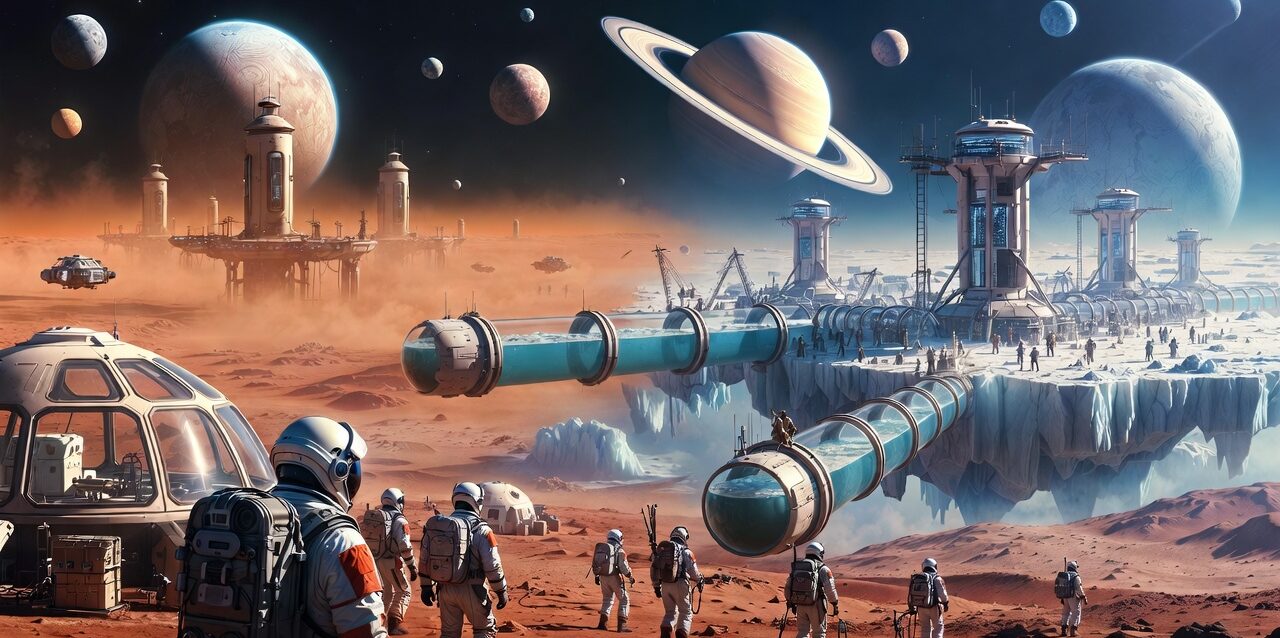
Living on Other Planets 2040: From Lunar Bases to Mars Outposts
From Earth-Only Existence to Permanent Human Outposts on the Moon, Mars, and Beyond
As of February 2026, humanity has no permanent presence off Earth. The International Space Station (ISS) remains the only continuously inhabited off-world habitat (since 2000), but it is scheduled for deorbit around 2030–2031. NASA’s Artemis program, China’s lunar plans, private companies (SpaceX, Blue Origin, ispace), and international efforts are rapidly advancing. The goal is clear: establish sustainable human presence on other celestial bodies — first the Moon, then Mars — within the next 10–20 years.
This case study synthesizes the most credible near- and mid-term projections from NASA (Artemis), SpaceX (Starship/Mars plans), ESA, CNSA (China), private roadmaps, and expert analyses to outline plausible trajectories for living on other planets between 2026 and 2040.
1. Near-Term (2026–2030): Lunar Return & First Permanent Outposts
- Artemis & Lunar Gateway
NASA-led Artemis program targets sustained human presence on the Moon. - Artemis III (2026–2027): first crewed landing since Apollo (south polar region).
- Artemis IV–VI (2028–2030): establish initial surface habitat (lunar lander-derived), power systems, and mobility (rovers).
- Lunar Gateway (orbiting station) becomes operational ~2028–2030 as staging point.
- China & International Efforts
China plans crewed lunar landings ~2029–2030 and an International Lunar Research Station (ILRS) with partners (Russia, others).
Private players (ispace, Intuitive Machines, Astrobotic) deliver cargo and precursors. - Living Conditions
Short-duration stays (weeks to months). Habitats are pressurized modules (inflatable or rigid), radiation shielding (regolith bags), life support (oxygen recycling, water extraction from ice), and solar power. Crews conduct science, test in-situ resource utilization (ISRU), and prepare for longer missions.
2. Medium-Term (2030–2035): Permanent Lunar Bases & Mars Precursors
- Permanent Lunar Presence
By mid-2030s, sustained lunar bases emerge: - NASA/Artemis Base Camp (south pole): multiple habitats, rovers, ISRU for oxygen/water/fuel, power (kilopower fission or large solar).
- Crew rotations of 6–12 months; growing capacity for science, mining (helium-3, volatiles), and tourism (private missions).
- Underground lava tubes explored for natural shielding against radiation and micrometeorites.
- Mars Precursors
- SpaceX Starship uncrewed missions (2026–2028) test landing, propellant production (methane/oxygen from CO₂ + water ice).
- First crewed Mars missions targeted late 2020s to early 2030s (optimistic: 2028–2033).
- Initial stays: months to 1–2 years in surface habitats (inflatable, 3D-printed regolith structures, hydroponics).
- Living Conditions
Radiation protection (regolith cover, magnetic shielding concepts), closed-loop life support, psychological countermeasures (VR, crew dynamics), and partial gravity effects management. Food production (greenhouses) and ISRU become critical.
3. Long-Term (2035–2040): Self-Sustaining Outposts & Early Colonies
- Lunar Self-Sufficiency
Permanent lunar settlements: - Hundreds of residents (rotating crews + semi-permanent).
- Mining, manufacturing (3D printing structures/parts), large-scale ISRU (oxygen, water, fuel).
- Underground or lava-tube cities for radiation protection and thermal stability.
- Mars Settlement
- SpaceX/NASA/others establish initial outposts: dozens to low hundreds of people.
- Surface habitats expand (dome clusters, underground tunnels).
- Propellant production (Sabatier process) enables return trips and refueling.
- Early agriculture (greenhouses, hydroponics, aeroponics) begins; local resource use grows.
- Beyond Moon & Mars
Concepts for asteroid mining bases, Venus cloud colonies (floating habitats), and Europa/Enceladus subsurface oceans remain speculative — no permanent presence before 2040.
Illustrative Living Scenarios by 2040
- Lunar South Pole Base — Underground habitat modules, solar + nuclear power, ice mining, greenhouse food, 6–12 month rotations.
- Mars Outpost — Pressurized domes/tunnels, ISRU fuel plant, hydroponic gardens, Starship cargo deliveries, multi-year stays.
- Daily Life — Radiation shielding, recycled air/water, exercise to counter low gravity, VR for mental health, remote work/science.
Risks & Societal Shifts
- Radiation & Health — Cosmic rays, solar flares; long-term effects on reproduction, bones, eyes.
- Psychological & Isolation — Confinement, delayed communication (Mars: up to 24 min one-way), crew dynamics.
- Cost & Access — Multi-trillion-dollar endeavor; initially elite/government-driven.
- Planetary Protection — Contamination risks (Earth microbes to Mars, vice versa).
Bottom Line
By 2040, living on other planets moves from science fiction to early, permanent human outposts — first on the Moon (sustained bases with dozens to hundreds of people), then initial Mars settlements (small crews, multi-year stays). The dominant paradigm becomes self-sustaining, resource-using, and shielded habitats — leveraging ISRU, closed-loop life support, and modular construction to make life beyond Earth viable. This is not mass colonization — yet. It is proof-of-concept: small, difficult, expensive, but irreversible steps toward humanity as a multi-planetary species. The future is not comfortable suburbs on Mars — it is harsh, high-stakes outposts that prove we can live off Earth, setting the stage for larger-scale expansion later in the century.