Remote Work 2040: From Hybrid to Truly Location-Independent Life
From Hybrid Experiments to Fluid, AI-Augmented, and Location-Independent Worklife
As of February 2026, remote work has stabilized as a core part of the global workforce. Approximately 28–35% of full-time employees in advanced economies work fully or mostly remote, and 50–60% are in hybrid arrangements (Gallup, Owl Labs, McKinsey 2025 reports). Productivity debates continue, but most studies show remote/hybrid workers are at least as productive — often more — when equipped with the right tools and trust.
By 2040, remote work evolves from a pandemic-era accommodation into a default, seamless, and deeply integrated way of working — powered by immersive technology, AI agents, spatial computing, and a fundamental rethinking of what “work” means in time and space.
1. Near-Term (2026–2030): Mature Hybrid & AI-First Workflows
- Hybrid Becomes the Norm
60–75% of knowledge workers settle into hybrid models (2–3 office days), with offices redesigned as collaboration/innovation hubs rather than daily desks. Fully remote remains common in tech, creative, and consulting fields. - AI as Daily Co-Worker
Generative AI copilots handle routine tasks (emails, summaries, research, first drafts), freeing humans for high-value work. AI agents schedule meetings, summarize discussions, track action items, and even simulate colleagues for brainstorming when teammates are offline. - Digital Presence Tools
High-fidelity video (spatial audio/video), virtual whiteboards, and early AR/VR meeting spaces reduce “Zoom fatigue.” Asynchronous-first cultures spread — work happens when it’s best for each person.
2. Medium-Term (2030–2035): Immersive & Spatial Work Environments
- AR/VR & Metaverse Offices
Lightweight AR glasses and comfortable VR headsets become standard for remote work. Employees “enter” shared 3D office spaces — avatars interact naturally, walk around virtual desks, and collaborate on persistent 3D models. Physical presence becomes optional; digital twins of offices allow seamless joining. - AI Agents & Autonomous Workflows
Personal AI agents manage calendars, negotiate deadlines, draft responses, and handle low-level decisions. Human oversight focuses on judgment, creativity, and relationships. Many roles become “human-in-the-loop” rather than fully manual. - Global & Asynchronous Teams
Time-zone arbitrage becomes normal — teams span continents, work 24/7 via handoffs, and use AI to translate and summarize across languages/cultures.
3. Long-Term (2035–2040): Fluid, Location-Independent, and Human-Centric Work
- Work Without Geography
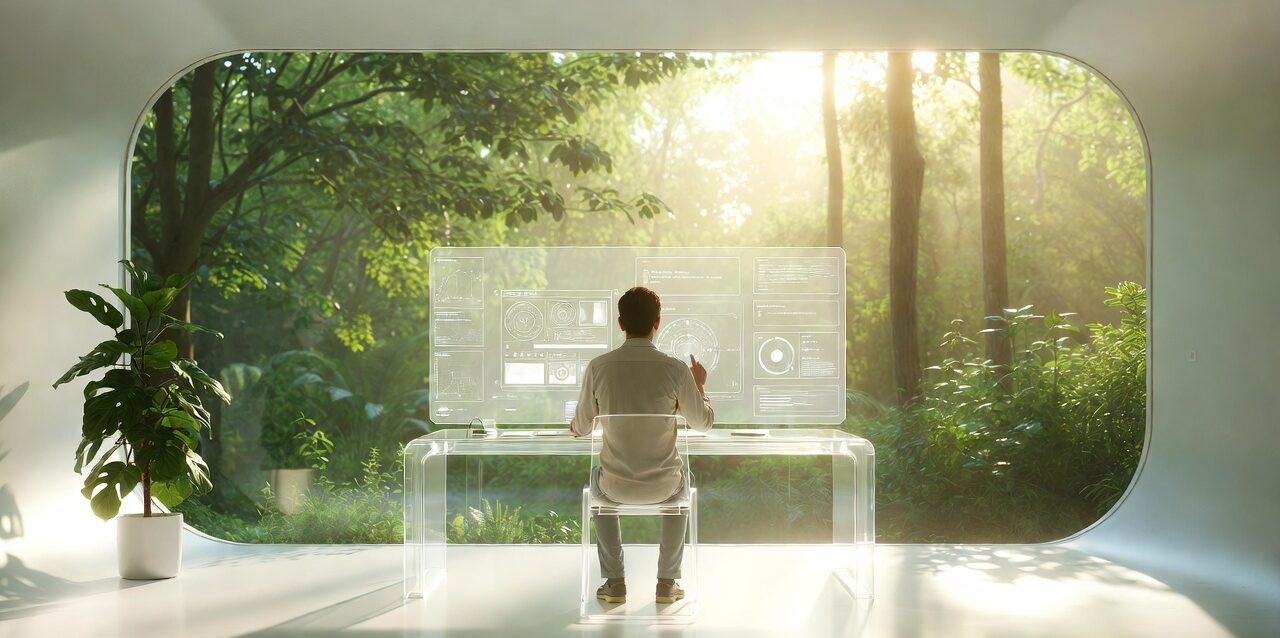
Remote work becomes simply “work.” Physical offices are rare luxury hubs for culture-building, serendipity, and high-touch collaboration. Most people work from anywhere — mountain cabins, coastal villages, or nomadic setups — supported by high-speed global connectivity (Starlink successors, 6G/7G). - Immersive & Brain-Integrated Interfaces
Early non-invasive brain-computer interfaces (BCI) allow thought-driven interaction — typing, navigating, and communicating without screens. AR contact lenses or neural-linked devices create fully spatial, persistent digital workspaces. - Well-Being & Purpose-Centric Work
Companies prioritize mental health, deep work blocks, and meaningful contribution over hours logged. AI monitors burnout and suggests breaks or task switches. Many shift to project-based, portfolio careers rather than 9-to-5 roles.
Illustrative Remote Work Day in 2040
- Morning — AI agent reviews overnight messages, summarizes key points, drafts replies while you exercise.
- Team Sync — Enter shared 3D office via AR glasses; avatars discuss project in virtual conference room.
- Deep Work — Neural interface lets you focus intensely — no distractions, ambient soundscapes, productivity nudges.
- Collaboration — Co-create 3D prototype with global teammates; AI translates languages and suggests ideas.
- End of Day — AI compiles daily summary, flags well-being needs, and plans tomorrow.
Risks & Societal Shifts
- Inequality — High-speed connectivity and advanced devices remain unevenly distributed.
- Isolation — Risk of social disconnection; intentional community-building becomes critical.
- Surveillance — Constant monitoring (productivity, biometrics) raises privacy concerns.
- Purpose — When routine tasks vanish, finding meaning in work becomes the central challenge.
Bottom Line
By 2040, remote work ceases to be a category — it becomes the default mode of knowledge work: fluid, location-independent, and deeply augmented by AI and immersive technology. The dominant paradigm shifts to human-AI partnership in persistent, spatial digital environments — where geography dissolves, productivity is measured by outcomes, and well-being is engineered into the workday. Remote work won’t eliminate offices; it will make them optional luxury spaces for connection and creativity. The future isn’t about where you work — it’s about how work empowers you, connects you, and lets you live a fuller life. The office of 2040 isn’t a building — it’s wherever you are, whenever you choose to engage.