
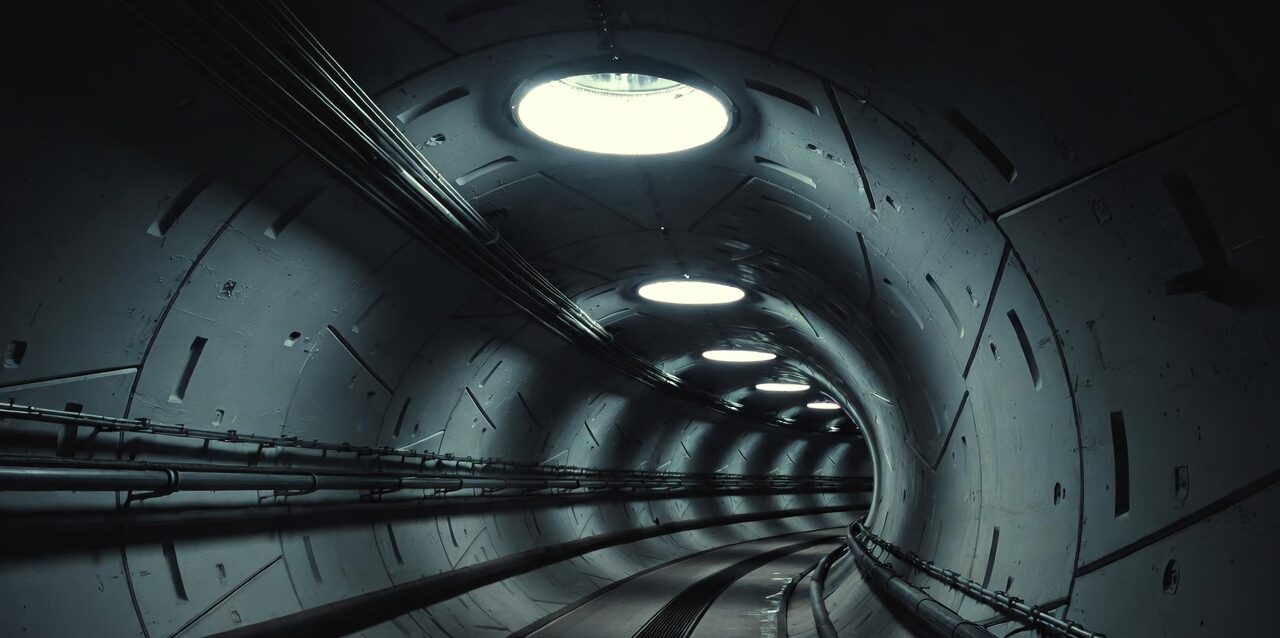
The Future Below Ground: High-Speed Tunnels, Autonomous Freight, and Smart Cities
From Urban Traffic Relief to Multi-Purpose, High-Speed, and Smart Subsurface Networks
As of February 2026, underground tunnels are primarily used for transportation (subways, road tunnels), utilities (water, sewage, cables), and limited freight. The most ambitious ongoing project is The Boring Company’s Vegas Loop (short tunnels for Tesla vehicles), while traditional heavy-rail metro systems continue to expand in cities like London (Crossrail 2 planning), Riyadh, Delhi, and Jakarta. Global tunneling activity is strong, especially in Asia and the Middle East, but still relatively slow and expensive (TBMs advance 10–30 m/day in good conditions).
By 2040, underground tunnels evolve into dense, multi-purpose, high-speed, and intelligent subsurface networks — serving not only transport but also logistics, energy distribution, data, emergency systems, and even limited habitation/utility functions.
1. Near-Term (2026–2030): Faster, Cheaper Tunneling & Urban Loops
- Boring Company & Loop Expansion
Vegas Loop grows to dozens of stations; similar short-loop systems appear in major cities (Miami, Austin, Dubai pilots). TBM speed increases (target 1 mile/week = ~50–70 m/day) through continuous mining, automation, and parallel operations. - Conventional Mega-Projects
Large metro expansions finish or advance: Grand Paris Express, Crossrail 2 (London), California High-Speed Rail tunnels, Riyadh Metro extensions, Jakarta MRT Phase 2–3. Tunneling costs drop 20–40% with better TBMs, precast segments, and digital twins for planning. - Smart & Multi-Utility Tunnels
New tunnels increasingly include utilities (power, fiber, water) in shared corridors. Early “smart tunnel” features: sensors for structural health, traffic, air quality, and predictive maintenance.
2. Medium-Term (2030–2035): High-Speed & Hyperloop Prototypes
- High-Speed Underground Corridors
Long-distance high-speed rail tunnels expand (California HSR, Texas Central, UK HS2 phases, China’s continued network). Vacuum-tube / low-pressure tunnels (Hyperloop, Hardt, Swisspod, TransPod) reach commercial pilots (short inter-city routes, airport connectors). - Urban Multi-Level Tunnel Networks
Cities build layered underground systems: - Level 1–2: metro & pedestrian
- Level 3–4: high-speed pods / autonomous EV tunnels
- Separate utility corridors
Vegas-style loops scale to 50–100+ stations in large metros. - Autonomous & Electric Fleets
Tunnels use electric autonomous pods (Tesla-like or dedicated designs) for high-frequency, on-demand transport. Safety and throughput improve dramatically with AI traffic management.
3. Long-Term (2035–2040): Dense Subsurface Networks & New Functions
- City-Scale Underground Grids
Leading cities (Singapore, Helsinki, Dubai, Riyadh, Shanghai) have extensive multi-level tunnel networks for transport, logistics (autonomous freight), data centers, energy storage (thermal/pumped hydro), and emergency shelters. - Hyperloop & Vacuum Systems
Commercial hyperloop routes operate in corridors (e.g., city pairs 200–600 km apart). Speeds reach 600–1,000 km/h in low-pressure tubes; travel time between major hubs drops to 20–40 minutes. - Beyond Transport
Tunnels host: - large-scale underground data centers (natural cooling)
- vertical farming & food storage
- energy storage (compressed air, batteries, gravity systems)
- civil defense shelters with long-term life support
Illustrative Underground Tunnel Scenarios by 2040
- Urban Loop Network — 100+ stations, autonomous electric pods, 2–5 minute headways, seamless last-mile connection.
- Inter-City Hyperloop — 800 km/h vacuum tube between cities, 30-minute travel time, airport-like stations.
- Multi-Utility Corridor — Transport + power + fiber + water + freight in shared tunnel envelope.
- Emergency & Resilience Hub — Deep underground shelters with air, water, food, and power for weeks/months.
Risks & Societal Shifts
- Cost & Financing — Mega-projects still extremely expensive; public-private partnerships and land-value capture needed.
- Geotechnical & Safety — Deep tunneling risks (groundwater, seismic, fire, evacuation).
- Environmental — Construction disruption and embodied carbon must be minimized.
- Equity — Benefits often concentrate in wealthy cities; rural/poor regions lag.
Bottom Line
By 2040 underground tunnels shift from single-purpose infrastructure to dense, multi-functional, high-speed subsurface networks. The dominant paradigm becomes smart, autonomous, and integrated tunnel ecosystems — moving people, goods, energy, data, and utilities below ground to free surface space, reduce congestion, and increase resilience.
Tunnels won’t replace surface cities — they will make them more livable by taking pressure off the surface.
The future isn’t endless traffic jams — it’s fast, quiet, electric movement under our feet, while the surface returns to people, parks, and nature.
Underground isn’t just pipes and trains anymore — it’s the next great layer of human civilization.