
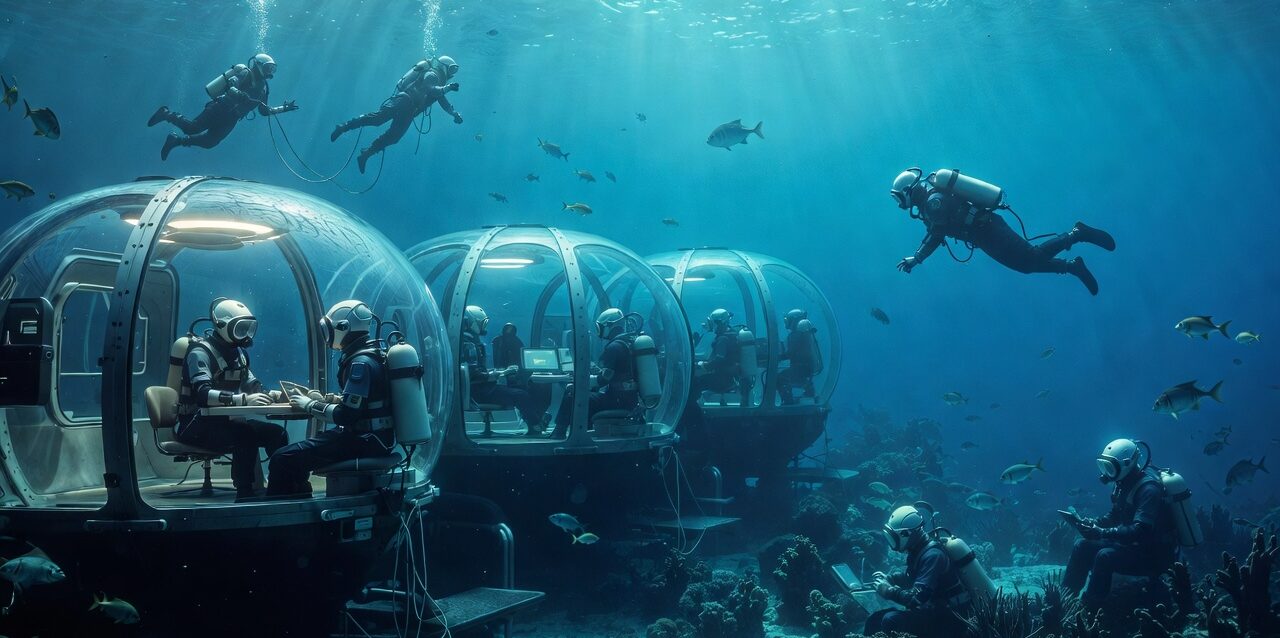
The Future Below the Waves: Permanent Underwater Homes and Ocean Cities
From Experimental Habitats to Permanent, Self-Sustaining Ocean Cities
As of February 2026, no humans live permanently underwater. The longest continuous underwater habitation remains Scott Carpenter’s 30-day stay in Sealab II (1965) and the Aquarius Reef Base (operational since 1986), which has hosted hundreds of missions but only for days to weeks. The ocean covers 71% of Earth’s surface, yet we have explored less than 5–10% in detail and have almost no permanent infrastructure below the surface.
By 2040, underwater living moves from science fiction and short-term research to early permanent habitats and semi-sustained communities — driven by overpopulation pressures, climate adaptation (rising sea levels, extreme weather), resource needs (food, minerals), and breakthroughs in life support, materials, and energy.
1. Near-Term (2026–2030): Advanced Underwater Habitats & Long-Duration Tests
- Next-Generation Research Stations
Aquarius Reef Base upgrades and new underwater labs (e.g., China’s planned deep-sea station, Europe’s EMSO observatories) extend mission durations to 30–90 days. Focus: closed-loop life support (air, water, food recycling), psychological studies, and in-situ resource use (seawater desalination, algae farming). - Private & Commercial Pilots
Companies like Ocean Builders (SeaPod floating/underwater homes) and Ocean Spiral concepts test small-scale private habitats. Initial residents live weeks to months in shallow-water pods (10–50 m depth) with surface support. - Living Conditions
Pressurized habitats with large viewports, artificial lighting mimicking daylight cycles, hydroponics/aquaponics for food, and renewable power (wave, tidal, solar on surface). Psychological support via VR, AI companions, and short surface rotations.
2. Medium-Term (2030–2035): Permanent Shallow-Water Communities
- Shallow Underwater Villages
First semi-permanent communities emerge at 10–100 m depth: modular, expandable habitats with 10–100 residents. Examples include expanded SeaPod-style residences, tourism/research hybrids, and small-scale aquaculture stations. - Energy & Life Support Maturity
Tidal/wave energy, advanced solar (floating arrays), and small modular reactors (SMRs) provide reliable power. Closed-loop systems recycle 95%+ of water/air; algae, fish farming, and 3D-printed structures from seabed materials become standard. - Climate & Economic Drivers
Coastal flooding and land scarcity push wealthy individuals and governments toward underwater real estate. Underwater tourism (hotels, restaurants) grows rapidly; research on deep-sea minerals and biotech accelerates.
3. Long-Term (2035–2040): Deeper Habitats & Ocean Cities
- Mid-Depth & Deep-Sea Settlements
Permanent habitats at 100–500 m become feasible — using advanced materials (transparent ceramics, high-strength composites) and pressure-resistant designs. Larger “ocean cities” (hundreds to thousands of residents) emerge in stable, resource-rich locations. - Self-Sustaining Ecosystems
Full closed-loop ecology: vertical aquaponics, algae bioreactors, fish farming, and synthetic food production. Geothermal vents or seabed reactors provide energy. Psychological health maintained through large communal spaces, natural light simulation, and virtual surface access. - Global & Strategic Role
Underwater living supports resource extraction (nodules, rare earths), climate monitoring, and strategic basing. Some nations build underwater military/research outposts.
Illustrative Underwater Living Scenarios by 2040
- Shallow-Water Pod Community — Modular homes at 20–50 m depth; surface ferries, hydroponic gardens, tourism income.
- Mid-Depth Research Settlement — 100–300 m habitat for 50–200 people; aquaculture, mineral processing, long-term stays.
- Deep-Sea Ocean City Prototype — 300–600 m depth; self-sustaining ecosystem, vertical farms, geothermal power, hundreds of residents.
- Daily Life — Artificial day/night cycles, communal meals from on-site farms, VR surface connection, AI health monitoring.
Risks & Societal Shifts
- Psychological & Physiological — Isolation, confinement, pressure effects, vitamin D deficiency, mental health.
- Engineering & Safety — Pressure hull integrity, emergency evacuation, fire/flood risks at depth.
- Environmental — Habitat impact on ecosystems; deep-sea mining concerns.
- Inequality — Underwater living initially ultra-luxury or strategic; access gaps likely.
Bottom Line
By 2040, living underwater moves from experimental research to early permanent habitats and small-scale communities — first in shallow and mid-depth waters, with prototypes for deeper, self-sustaining ocean settlements. The dominant paradigm becomes modular, closed-loop, and climate-resilient underwater living — leveraging advanced life support, aquaculture, and renewable energy to make subsurface habitats viable for science, tourism, resources, and climate adaptation. Underwater living won’t be mass migration — yet. It will be strategic footholds and proof-of-concept for humanity’s expansion into the ocean, driven by necessity and enabled by technology. The future isn’t drowning cities — it’s deliberate, engineered life below the waves, turning the ocean from threat into home.