The Future of Daily Life: Hyper-Personalized, AI-Augmented, and Regenerative
A Hyper-Connected, AI-Orchestrated, and Human-Centric Existence
As of February 2026, daily life is already shaped by accelerating AI adoption, hyperconnectivity, climate pressures, and biotech advances. By 2040, global population nears 9 billion, urbanization hits ~68%, and AI converges with biotech, quantum computing, and robotics to transform work, health, relationships, and routines. Forecasts from sources like the U.S. Director of National Intelligence’s Global Trends 2040, expert panels on AI impact, and futurist analyses point to a world of abundance in some domains and tension in others — with efficiency gains, extended lifespans, and deeper personalization, but also risks of inequality, job displacement, and eroded agency.
This case study outlines credible trajectories for everyday life over the next 15 years, focusing on routines, work, health, social bonds, and environment.
1. Near-Term (2026–2030): AI as Constant Companion & Efficiency Surge
- Daily Routines Hyper-Personalized
AI agents (voice assistants evolving into proactive “life coaches”) handle scheduling, reminders, shopping, and social cues. Your morning starts with a tailored wake-up: optimal light, music, hydration nudge, and mood check via wearables. Homes become semi-intelligent — lights, temperature, and appliances adapt automatically. - Work & Economy Shift
White-collar roles increasingly oversee AI outputs; many tasks automate. Remote/hybrid work normalizes further with immersive VR meetings. Universal basic income pilots expand in some regions as AI displaces jobs, but new roles emerge in AI oversight, creativity, and human-centric services. - Health & Wellness Baseline
Wearables + AI predict illness early; personalized nutrition and exercise plans are standard. Telemedicine dominates routine care.
2. Medium-Term (2030–2035): Blended Real-Digital Worlds & Adaptive Living
- Immersive & Metaverse-Integrated Days
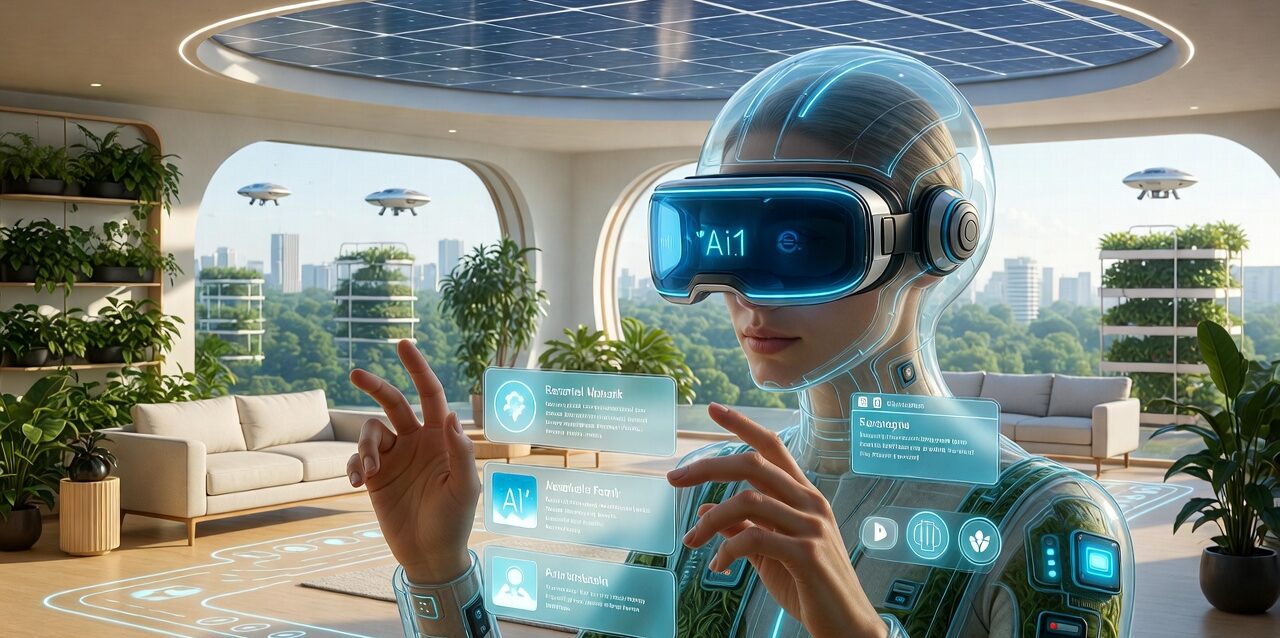
AR glasses or contact lenses overlay information seamlessly — navigation, translations, social prompts. Metaverse spaces become routine for work, socializing, education, and leisure; a refined, immersive version supports half a billion+ users daily. - Work Becomes Fluid & Purpose-Driven
AI handles most mundane labor; humans focus on creativity, relationships, and oversight. Shorter workweeks or gig economies rise; some predict “age of abundance” with reduced need for traditional jobs. Communities and companies emphasize human connection amid automation. - Biotech & Longevity Advances
Gene therapies reduce disease risk; average lifespans extend toward 90–100 in developed areas. Reverse-aging tech emerges in prototypes. Homes integrate health monitoring; robots assist elderly or chores.
3. Long-Term (2035–2040): Post-Human Elements & Regenerative Existence
- Seamless Human-Machine Symbiosis
Brain-computer interfaces (non-invasive to early implants) enable thought-controlled devices, memory enhancement, or direct knowledge access. AI becomes “angel on the shoulder” — guiding ethically or acting autonomously in some scenarios. Daily life blurs physical/digital: virtual travel, digital twins for experiences, or shared consciousness in limited forms. - Sustainable & Resilient Lifestyles
Cities are greener with vertical farms, renewable energy dominance, and climate-adaptive designs. Travel mixes hyper-fast (supersonic/suborbital) with low-carbon options. Food is lab-grown or precision-farmed; energy feels abundant and decentralized. - Social & Emotional Landscape
Relationships deepen via AI mediation (e.g., conflict resolution, empathy training) but risk superficiality from constant connectivity. Some embrace “careful choices” with human agency preserved; others see AI as invisible infrastructure or ethical overseer.
Illustrative Day in 2040
- Wake-up: AI companion optimizes sleep data, brews coffee, briefs news tailored to your values.
- Morning: AR workout in virtual nature; AI suggests meals from home vertical farm or drone delivery.
- Work: 4-hour creative session with AI co-pilot; afternoon in metaverse collaboration or physical community hub.
- Evening: Family time blends physical and virtual; AI helps plan travel or resolve disputes.
- Night: Health scan, mood journal, and regenerative sleep prep.
Risks & Societal Shifts
- Inequality & Displacement — Gains uneven; AI abundance may bypass billions without policy (e.g., UBI, retraining).
- Agency & Privacy — Constant AI presence risks surveillance, addiction, or loss of human decision-making.
- Mental Health — Hyper-efficiency could make reality feel dull; isolation rises if digital bonds dominate.
- Climate & Geopolitics — Adaptation lags in vulnerable areas; tensions over resources or tech control persist.
Bottom Line
By 2040, daily life evolves into a hyper-efficient, AI-augmented, and potentially regenerative existence — where technology handles drudgery, extends healthspan, and blurs reality boundaries, freeing humans for creativity, connection, and purpose. The dominant paradigm shifts from scarcity-driven survival to choice-driven flourishing (in optimistic scenarios) or managed abundance amid ethical trade-offs. Life won’t just be faster or easier; it will be more personalized, interconnected, and redefined by human-machine partnership. The future hinges on deliberate choices today — prioritizing agency, equity, and meaning over unchecked efficiency.