The Future of Learning: AI Tutors, Immersive Realities, and Lifelong Mastery
From Standardized Classrooms to Personalized, AI-Driven, Immersive, and Lifelong Learning Ecosystems
As of February 2026, education systems worldwide are still largely shaped by 20th-century models: age-based classrooms, standardized curricula, teacher-led instruction, and high-stakes exams. The global education market (K-12, higher ed, corporate training) exceeds $6 trillion annually, but faces challenges: learning gaps widened by the pandemic, teacher shortages, unequal access to tech, and rapid skill obsolescence due to AI and automation. The OECD’s Future of Education and Skills 2030/2040 project, along with UNESCO Futures of Education and WEF reports, emphasize the need for new skills (critical thinking, adaptability, digital literacy, emotional intelligence) and transformative approaches to prepare learners for uncertainty.
By 2040, education evolves into personalized, AI-orchestrated, immersive, and lifelong ecosystems — blending physical, virtual, and real-world learning; prioritizing well-being and agency; and shifting from knowledge transmission to competency mastery and human flourishing.
1. Near-Term (2026–2030): AI Personalization & Hybrid Learning
- AI as Personal Tutor
AI tutors and adaptive platforms (successors to Khan Academy, Duolingo, Squirrel AI) become ubiquitous. They analyze real-time performance, learning style, pace, and emotional state to deliver customized lessons, instant feedback, and remedial paths. Classrooms use AI to assist teachers with grading, lesson planning, and identifying at-risk students. - Hybrid & Flexible Models
Blended learning normalizes: in-person for collaboration/social skills, online for flexibility. Micro-credentials, modular courses, and competency-based progression gain traction. Remote/hybrid expands access in underserved areas. - Skills Shift
Curricula prioritize 21st-century skills: creativity, critical thinking, collaboration, digital literacy, and emotional intelligence. Social-emotional learning (SEL) integrates deeply.
2. Medium-Term (2030–2035): Immersive & Metaverse Learning
- VR/AR & Metaverse Classrooms
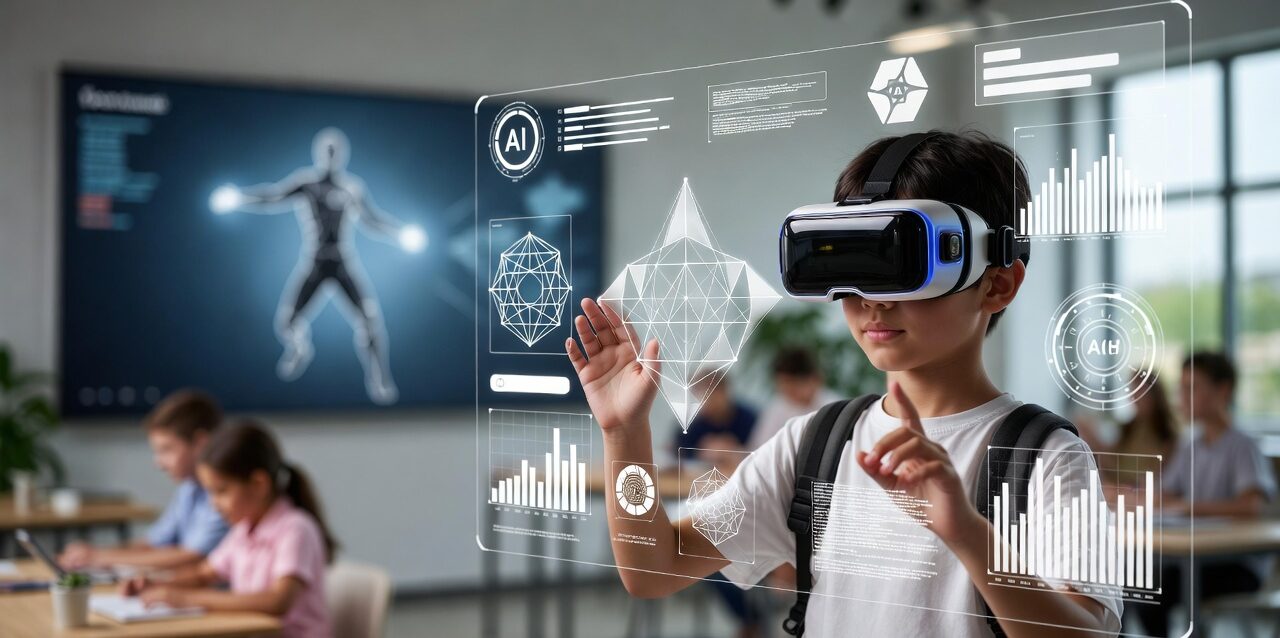
AR glasses and lightweight VR headsets create immersive environments: students “visit” historical sites, conduct virtual science labs, or collaborate in shared 3D spaces. Metaverse platforms host global classrooms, cultural simulations, and project-based learning. - Lifelong & Unbundled Learning
Education becomes continuous: micro-credentials, stackable qualifications, and employer-integrated pathways replace rigid degrees. AI tracks lifelong progress; learning ecosystems connect formal, informal, and real-world experiences. - Teacher Role Evolves
Teachers become facilitators, mentors, and well-being coaches — focusing on human connection, creativity, and ethics while AI handles routine instruction.
3. Long-Term (2035–2040): Learner-Centered & AI-Augmented Ecosystems
- Personalized Learning Ecosystems
AI “learning agents” orchestrate entire educational journeys — predicting needs, curating resources, and adapting in real time. Education unbundles: learners mix formal schools, online platforms, apprenticeships, and community projects. - Immersive & Real-World Integration
Cities become classrooms: project-based, experiential learning dominates. VR/AR/XR enables empathy-building simulations, global collaboration, and skill practice in safe environments. - Equity & Well-Being Priority
Universal access via low-cost devices and AI tutors narrows gaps. Education focuses on flourishing: mental health, purpose, ethics, and adaptability in an AI-driven world.
Illustrative Education Day in 2040
- Morning — AI agent reviews overnight progress, suggests personalized start.
- Class — VR simulation of historical event; collaborative problem-solving with global peers.
- Project — Real-world community challenge guided by mentor; AI provides data/tools.
- Reflection — AI analyzes emotional/cognitive state, offers well-being nudge.
Risks & Societal Shifts
- Inequality — Tech access gaps persist without policy.
- Over-Reliance on AI — Risk of reduced critical thinking or social skills.
- Privacy & Ethics — Constant data collection raises concerns.
- Teacher Role — Potential devaluation if not redefined.
Bottom Line
By 2040, education evolves from standardized classrooms to personalized, immersive, AI-orchestrated, and lifelong learning ecosystems. The dominant paradigm becomes learner-centered, competency-based, and human-AI hybrid — prioritizing adaptability, well-being, creativity, and real-world relevance over rote knowledge. Education won’t just prepare for jobs — it will equip people to thrive in uncertainty, build meaningful lives, and contribute to society. The future is not one-size-fits-all schooling — it’s dynamic, empowering, and deeply human, amplified by technology. The path depends on choices today: equity, ethics, and vision.